Faceted classification is described as an analytico-synthetic system because it is built upon two interrelated and systematic processes: subject analysis and subject synthesis. This dual approach distinguishes faceted classification from traditional enumerative classification schemes and provides it with greater flexibility and precision in organizing knowledge. The analytico-synthetic nature enables the accurate representation of complex, compound, and interdisciplinary subjects, making faceted classification particularly suitable for modern information environments.
The analytical aspect of faceted classification involves breaking down a subject into its fundamental components or facets. Instead of assigning a subject directly to a single predetermined class, the classifier examines the subject carefully and identifies its basic elements, such as the main entity, its properties, the actions or processes involved, the geographical location, and the time period. This detailed subject analysis ensures that each aspect of the subject is clearly identified and represented independently. For example, the subject “Digital library services in Bangladesh” is analyzed into distinct components: digital libraries as the main entity, services as the activity, and Bangladesh as the place.
Following the analysis, the synthetic aspect of faceted classification comes into operation. In this stage, the identified facets are recombined or synthesized according to prescribed rules, particularly the principle of citation order. The synthesis process allows the construction of complex subjects by combining simple facet elements into a coherent and meaningful representation. Using the previous example, the facets of digital libraries, services, and Bangladesh are systematically combined to form a complete subject expression. This process eliminates the need to pre-enumerate every possible subject combination in the classification schedule.
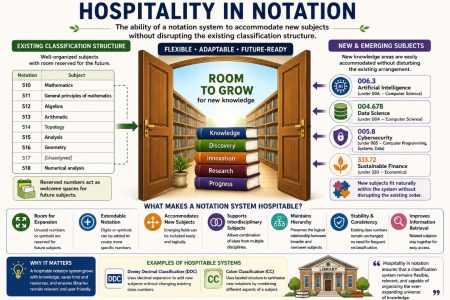
The analytico-synthetic nature of faceted classification also supports flexibility and expansion. Since facets are independent and reusable, new subjects and emerging concepts can be easily accommodated by combining existing facets or introducing new facet values. This makes the system highly hospitable to change, unlike traditional classification schemes that often require extensive revision when new subjects appear. Additionally, this approach enables consistent treatment of subjects across different domains, as the same analytical framework can be applied universally.
In conclusion, faceted classification is described as analytico-synthetic because it systematically analyzes subjects into their basic facets and then synthesizes those facets into structured subject representations. This dual process allows for precise subject description, flexibility in handling complex and interdisciplinary topics, and adaptability to the continuous growth of knowledge. As a result, the analytico-synthetic nature of faceted classification remains one of its most significant strengths in both traditional library systems and modern digital information environments.