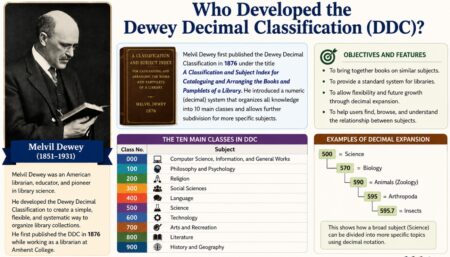
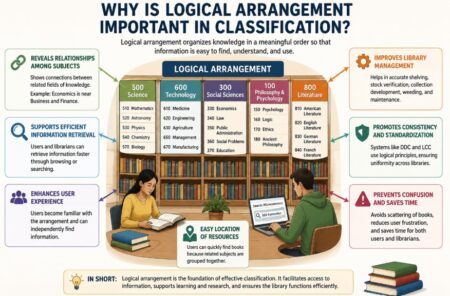
Faceted classification is widely regarded as more flexible than traditional classification schemes because it is designed to accommodate the dynamic, complex, and evolving nature of knowledge. Traditional classification systems such as the Dewey Decimal Classification (DDC) and Library of Congress Classification (LCC) are largely enumerative in nature. They attempt to list subjects and their subdivisions in advance, which often results in rigidity when new subjects, interdisciplinary fields, or emerging concepts appear. Faceted classification, on the other hand, is based on systematic subject analysis and synthesis, allowing subjects to be constructed as needed rather than being confined to a fixed schedule.
One of the primary reasons for the flexibility of faceted classification lies in its analytico-synthetic approach. In this system, a subject is first analyzed into its fundamental components or facets, and then these facets are synthesized according to prescribed rules to represent the complete subject. Because each facet represents a single and clearly defined aspect of a subject, the same facets can be reused and recombined in different contexts. This modular structure enables the classification system to represent complex and compound subjects more accurately than traditional schemes, which often struggle to place such subjects within a single hierarchical location.
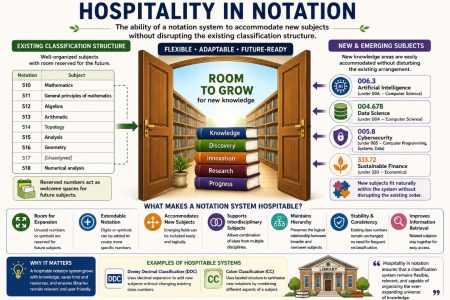
Another important factor contributing to the flexibility of faceted classification is the principle of hospitality. Faceted systems are inherently open-ended, allowing new concepts, topics, or relationships to be incorporated without disrupting the existing classification structure. When a new subject emerges, it is not necessary to revise the entire schedule or create awkward adjustments; instead, new facet values can simply be added within the appropriate category. This makes faceted classification particularly suitable for rapidly developing fields such as science, technology, and interdisciplinary research areas.
Faceted classification also offers greater flexibility in handling interdisciplinary and multidimensional subjects. Traditional schemes often force a subject to be placed in one dominant discipline, even when it clearly overlaps multiple fields. Faceted classification avoids this limitation by allowing different facets to represent different dimensions of a subject, such as its main entity, process, place, and time. As a result, subjects can be described more comprehensively and retrieved more effectively from multiple points of view.
In addition to structural flexibility, faceted classification provides flexibility in information retrieval. In modern library systems, digital libraries, and discovery platforms, faceted classification supports faceted search, enabling users to refine and filter search results using various facets such as subject, format, location, or time period. This multidimensional access enhances user experience by allowing information to be explored and retrieved according to individual needs, something traditional classification schemes are less capable of supporting.
In conclusion, faceted classification is considered more flexible than traditional classification schemes because of its analytico-synthetic nature, openness to new subjects, effective handling of interdisciplinary knowledge, and strong support for modern information retrieval systems. Its ability to adapt to change while maintaining logical consistency makes it a powerful and relevant approach to knowledge organization in both traditional and digital library environments.