What is Faceted Classification?
Faceted classification is a systematic method of organizing knowledge in which a subject is analyzed into several clearly defined and mutually exclusive components, known as facets, and then synthesized to represent complex subjects in a flexible and logical manner. Unlike traditional enumerative classification systems that attempt to list all possible subjects in advance, faceted classification allows subjects to be constructed dynamically by combining individual facets according to established rules. This approach is particularly effective for representing multidimensional and interdisciplinary subjects that cannot be adequately expressed through a single rigid hierarchy. The foundation of faceted classification lies in subject analysis, where a subject is not treated as a single unit but is broken down into its essential aspects, such as the main entity, its properties, the processes involved, the place, and the time. Each aspect forms a separate facet, and together they provide a complete, precise, and meaningful representation of the subject.
The theoretical framework of faceted classification was developed by S. R. Ranganathan, who identified five fundamental categories known as PMEST: Personality, Matter, Energy, Space, and Time. Personality represents the primary focus or entity of the subject, Matter refers to the substance or properties involved, Energy denotes actions or processes, Space indicates geographical location, and Time refers to the chronological period. Faceted classification is described as an analytico-synthetic system because it involves two interrelated processes: analysis, where the subject is broken into facets, and synthesis, where these facets are recombined in a prescribed citation order to form a complete subject representation. One of the major strengths of this system is its flexibility and hospitality, as new subjects and emerging concepts can be easily accommodated without disrupting the existing structure. In modern information environments, faceted classification plays a significant role in improving information retrieval by enabling multidimensional access to information. It is widely used in online public access catalogs, digital libraries, institutional repositories, and discovery systems, where users can refine searches using multiple facets such as subject, place, and time. Thus, faceted classification remains a vital and adaptable approach to knowledge organization, particularly in the context of rapidly expanding and evolving information systems.
Originator of Faceted Classification
S. R. Ranganathan is widely recognized as the originator of faceted classification in library and information science. An eminent Indian librarian and scholar, Ranganathan, introduced the concept in the early twentieth century as a response to the limitations of rigid, enumerative classification systems. His pioneering work led to the development of the Colon Classification, first published in 1933, which was the first fully articulated faceted classification system. Through this system, Ranganathan demonstrated how complex subjects could be analyzed into fundamental facets and then systematically synthesized to represent knowledge more precisely and flexibly.
Ranganathan further strengthened the theoretical foundation of faceted classification by proposing the five fundamental categories-Personality, Matter, Energy, Space, and Time (PMEST)-which provided a universal framework for subject analysis across all disciplines. His ideas revolutionized knowledge organization by emphasizing flexibility, hospitality for new subjects, and multidimensional subject representation. As a result of his extensive theoretical contributions and practical innovations, S. R. Ranganathan is universally regarded as the originator and father of faceted classification, and his work continues to influence modern classification systems, digital libraries, and faceted search technologies.
Fundamental Principles of Faceted Classification
Faceted classification is a scientifically structured system of knowledge organization that is based on a set of well-defined principles aimed at ensuring flexibility, consistency, and precision in subject representation. Developed primarily by S. R. Ranganathan, these principles guide the analysis and synthesis of subjects, enabling the logical organization and efficient retrieval of complex and multidimensional knowledge. The following discussion outlines the fundamental principles of faceted classification, accompanied by relevant examples.
1. Principle of Subject Analysis: The foundation of faceted classification lies in detailed subject analysis. Every subject is analyzed into its basic components instead of being treated as a single unit. This ensures that all aspects of a subject are identified and represented accurately.
Example: The subject “Digital library services in Bangladesh” can be analyzed into:
-
- Main entity: Digital libraries
- Process: Services
- Place: Bangladesh
This analytical approach allows precise classification rather than placing the subject under a broad or ambiguous category.
2. Principle of Facet Formation: Once a subject is analyzed, its components are organized into clearly defined and mutually exclusive facets. Each facet represents only one characteristic of the subject and does not overlap with others.
Example: In the subject “Training programs for librarians”:
-
- Librarians → Personality facet
- Training programs → Energy facet
Each element belongs to a single facet, ensuring clarity and consistency.
3. Principle of Fundamental Categories (PMEST): Ranganathan proposed five fundamental categories—Personality, Matter, Energy, Space, and Time (PMEST)—which serve as a universal framework for facet analysis. Every subject, regardless of discipline, can be analyzed using these categories.
Example:
“Research methods in education in India in 2020”
-
- Personality: Education
- Energy: Research methods
- Space: India
- Time: 2020
This principle ensures uniformity across subject domains.
4. Principle of Synthesis: After identifying facets, they are combined or synthesized in a systematic manner to represent the complete subject. Synthesis allows the construction of new and complex subjects without pre-enumerating them.
Example: “Online information literacy training for university students” is synthesized by combining:
-
- Students (Personality)
- Information literacy training (Energy)
- Online mode (Matter/Property)
This approach supports flexibility and adaptability.
5. Principle of Citation Order: Faceted classification follows a prescribed order in which facets are cited while synthesizing a subject. Generally, facets are arranged from the most concrete to the most abstract, often following the PMEST sequence.
Example: In “Library automation in Bangladesh in 2022”, the citation order would be:
-
- Library (Personality)
- Automation (Energy)
- Bangladesh (Space)
- 2022 (Time)
This ensures consistency and predictability in class numbers.
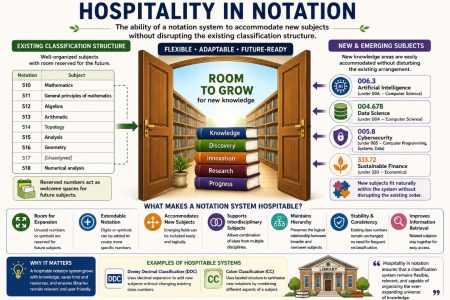
6. Principle of Hospitality: Hospitality refers to the system’s ability to accommodate new subjects without disturbing the existing classification structure. Faceted classification supports unlimited expansion by allowing new facet values to be added easily.
Example: If a new concept such as “Artificial Intelligence in libraries” emerges, it can be classified by combining existing facets without revising the entire schedule.
7. Principle of Flexibility: Faceted classification is inherently flexible because facets can be rearranged, expanded, or combined in multiple ways depending on the subject context. This flexibility makes it suitable for interdisciplinary and emerging fields.
Example: The subject “Health information services during pandemics” can be approached from health science, information science, or social science perspectives using the same facet structure.
8. Principle of Consistency and Economy: By reusing the same facets across different subjects, faceted classification avoids redundancy and ensures consistent subject representation. This leads to economical use of notation and logical organization.
Example: The facet “Bangladesh” can be reused across subjects like education, health, or library services, maintaining consistency.
The fundamental principles of faceted classification-subject analysis, facet formation, PMEST categories, synthesis, citation order, hospitality, flexibility, and consistency work together to create a powerful and adaptable system of knowledge organization. These principles enable accurate representation of complex subjects and support efficient information retrieval, making faceted classification highly relevant in both traditional libraries and modern digital information environments.
Why Faceted Classification Has Been Less Widely Adopted in Traditional Libraries
Faceted classification has been less widely adopted in traditional libraries primarily because of its complexity and the practical challenges involved in its implementation. Unlike enumerative classification systems such as the Dewey Decimal Classification (DDC) or Library of Congress Classification (LCC), faceted classification requires a high level of subject analysis and intellectual effort from classifiers. Librarians must carefully analyze each document, identify appropriate facets, and synthesize them according to specific rules, which can be time-consuming and demanding, especially in libraries with large and continuously growing collections.
Another important reason for its limited adoption is the lack of standardized and widely accepted faceted classification schedules for general library use. While systems like Colon Classification demonstrate the theoretical strength of faceted classification, they are often perceived as complex and difficult to understand, both for library staff and users. Traditional libraries tend to prefer established and familiar systems that are supported by extensive documentation, training resources, and shared cataloging practices, which faceted systems have historically lacked.
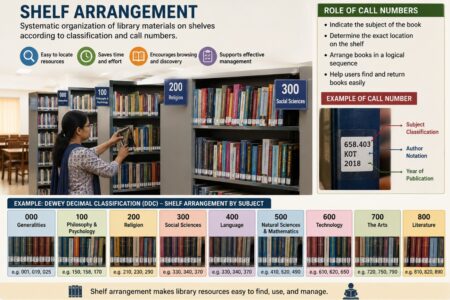
User convenience and shelf arrangement also play a significant role in this limited adoption. Traditional libraries are designed for physical browsing, where users expect books on similar subjects to be placed together on shelves in a straightforward hierarchical order. The synthesized notations of faceted classification can appear long and unfamiliar, making shelf arrangement and user navigation more challenging in physical spaces. As a result, libraries have favored simpler and more intuitive classification schemes for physical collections. Additionally, institutional inertia and legacy systems have influenced classification choices. Many libraries have invested significant time, resources, and training in traditional schemes, making a transition to faceted classification costly and disruptive. Without strong practical incentives or technological support in earlier periods, libraries were reluctant to adopt a system that required extensive retraining and restructuring.
In summary, despite its theoretical strengths and flexibility, faceted classification has been less widely adopted in traditional libraries due to its intellectual complexity, lack of standardization, challenges in physical shelf arrangement, and resistance to change within established library systems. However, its principles have gained renewed relevance in digital libraries and information retrieval systems, where technological support reduces many of these traditional barriers.