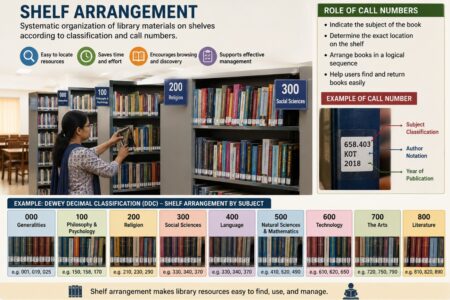
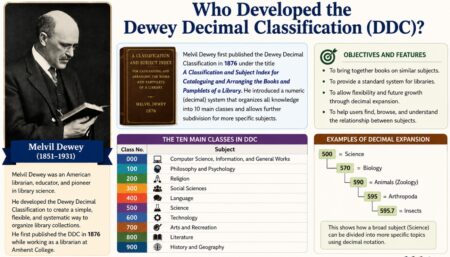
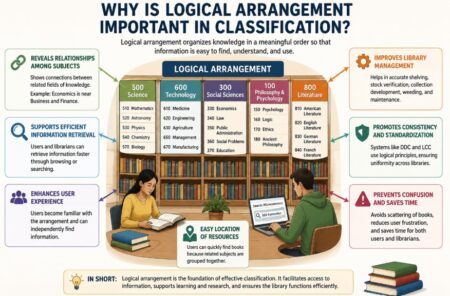
Classification in libraries plays a vital role in arranging books systematically, making it easier for both users and librarians to locate and manage resources. By assigning a specific number or code to each book based on its subject or field, classification ensures that materials on similar topics are grouped together in a logical sequence. For example, in the Dewey Decimal Classification (DDC) system, books on science are placed in the 500 range, while literature is categorized in the 800 range. This means a student looking for books on physics (530) will find them shelved close to related subjects like chemistry (540) or biology (570). Similarly, in the Library of Congress Classification (LCC) system, books on medicine are classified under the “R” section, making it easier to find all medical-related resources in one place.
This systematic arrangement not only saves time but also minimizes confusion, as every book has a designated “address” on the shelf. For readers, it creates a clear path to discover related works within a subject area; for instance, someone searching for economics books (HB-HJ in LCC) can easily explore related fields like political science (J) or sociology (HM-HX). For librarians, classification simplifies shelving, reshelving, and maintaining order in large collections, ensuring that thousands of volumes can be managed efficiently. Without classification, libraries would risk becoming disorganized, making it difficult to retrieve information promptly. Thus, classification acts as the backbone of library organization, ensuring that knowledge is accessible in a structured and user-friendly way.
How Does Classification Help in Arranging Books Systematically?
Classification plays a central role in arranging books systematically in libraries, ensuring that knowledge remains accessible, organized, and easy to use. A library is often described as a treasure house of knowledge, but without proper organization, this treasure would be difficult to access. By classifying books according to their subjects or fields, libraries give each item a specific place on the shelves, making it easier for both readers and librarians to locate and manage resources. In practice, classification transforms a vast and diverse collection into a logical, structured, and user-friendly system.
One of the most important ways classification helps is by grouping books on similar or related subjects together. This allows readers to explore a topic in depth without wasting time on unrelated materials. For example, in the Dewey Decimal Classification (DDC) system, all science books are placed in the 500 range, while technology is arranged in the 600 range. A student interested in biology (570) can easily find related subjects like botany (580) and zoology (590) nearby. Likewise, the Library of Congress Classification (LCC) places medicine under “R,” within which nursing (RT), public health (RA), and pharmacy (RS) are arranged in a logical order. This reflects the structure of knowledge itself, guiding readers smoothly from general to more specific areas of study.
Another key contribution of classification is that it assigns each book a unique call number, which works like an address on the shelf. This number tells exactly where a book belongs, reducing confusion and saving time. For example, in LCC, a book labeled QA76.73.J38 refers specifically to programming languages in computer science. Just as a postal address directs a letter to its destination, classification directs readers to the exact location of a book. In addition, it empowers readers to navigate the library independently. Once users become familiar with a classification scheme, they can locate resources without needing constant guidance from staff. For instance, a student who understands that DDC places literature in the 800s can always find those resources in the same general area, no matter how large the library grows.
Systematic classification also greatly benefits library staff by simplifying shelving, reshelving, and inventory management. With thousands of books in circulation, classification ensures that misplaced books are quickly identified and returned to their proper spots. It also helps librarians in collection development, as gaps in subject coverage become visible when books are arranged by discipline. Ultimately, classification saves time and effort for both staff and users, turning what could be a chaotic assortment of materials into a well-ordered system.
How Classification Ensures That Books on Similar Subjects Are Kept Together
Classification in libraries is designed to group books on similar subjects in one place, allowing readers to access related materials easily. Each book is assigned a classification number or code based on its subject, and these numbers follow a logical sequence on the shelves. For example, in the Dewey Decimal Classification (DDC) system, books on science are placed in the 500s, with subdivisions such as physics (530), chemistry (540), and biology (570). This arrangement ensures that all science-related books are found in one section, while literature, history, or philosophy are located in different ranges. Similarly, in the Library of Congress Classification (LCC) system, economics books are placed under class “H,” with subcategories like theory (HB), finance (HG), and commerce (HF) grouped side by side. Such systematic placement prevents scattering of related subjects across different areas of the library and makes it easier for readers to explore a topic in depth.
Why Is Systematic Arrangement Through Classification Important for Readers?
A library is not merely a storage space for books; it is an organized system designed to make knowledge accessible to its users. Without order, a library would resemble a warehouse where books are piled together without logic, making the search for information overwhelming. Systematic arrangement through classification solves this problem by providing a structured method of organizing books based on subjects, themes, and disciplines. For readers, this arrangement is vital, as it saves time, reduces confusion, and allows them to access and explore knowledge with ease.
- Easy Location of Books: One of the most immediate benefits of classification is that it allows readers to locate books quickly and accurately. Every book is assigned a classification number or “call number” that serves as a unique address on the library shelf. For example, in the Dewey Decimal Classification (DDC), books on mathematics are given the number 510, while those on physics are placed under 530. A student searching for a book on calculus will not only find it in the 510 section but will also see nearby books on algebra, geometry, and statistics. This precision reduces the frustration of searching and ensures that readers spend their time studying rather than hunting for materials.
- Access to Related Materials: Classification also ensures that books on similar subjects are grouped together, allowing readers to explore a topic in depth. For instance, in the Library of Congress Classification (LCC), all medical books are placed under the letter “R.” Within this broad category, subfields are organized logically—public health (RA), nursing (RT), and pharmacy (RS) appear side by side. This arrangement means that a nursing student who picks up one book may discover additional resources in nearby sections that expand their understanding. By creating these clusters of knowledge, classification transforms a simple search for one title into an opportunity for broader learning and discovery.
- Saving Time and Reducing Confusion: For readers, time is often a critical factor, especially in academic environments where assignments and research projects come with deadlines. Systematic arrangement saves valuable time by giving books a fixed, predictable place. If a particular title is unavailable, readers can still browse the same shelf for alternative works on the same subject. For example, if a book on computer programming is checked out, a student can still find related works in the QA76.73 range in LCC, covering programming languages like Java or Python. Without classification, this process would become chaotic, with readers forced to sift through disorganized shelves in hopes of finding something useful.
- Encouraging Independent Use of the Library: Another major advantage of systematic arrangement is that it empowers readers to use the library independently. Once users understand how a classification system works, they do not need to rely on librarians for every query. A student familiar with DDC knows that books on social sciences are in the 300s, and with that knowledge, they can directly browse the relevant shelves for books on sociology, anthropology, or political science. This independence builds confidence and helps readers feel more comfortable navigating the library on their own. It also reduces pressure on librarians, allowing them to focus on providing specialized support for advanced research needs.
Systematic arrangement through classification is not simply a tool of organization; it is a key factor that shapes how readers interact with library resources. It ensures quick and accurate location of books, provides easy access to related materials, saves time, reduces confusion, and promotes independent use of the library. Most importantly, it enhances the research and learning process by encouraging exploration and discovery across related fields. In this way, classification transforms the library from a mere collection of books into an organized gateway of knowledge, enabling readers to learn efficiently and meaningfully.
In What Ways Does Classification Make It Easier for Librarians to Manage Large Collections?
Classification makes the job of managing large collections far more systematic and efficient for librarians. By assigning every book a call number that corresponds to its subject, classification ensures that each item has a fixed and predictable place on the shelves. This means shelving and reshelving become simple tasks, as staff can quickly identify the exact section where a book belongs. In a large university library with thousands of items in circulation every day, such an order prevents chaos and minimizes the chances of books being misplaced. If a book is accidentally shelved in the wrong place, the sequence of classification numbers allows librarians to detect the error easily, since an item out of order is immediately noticeable.
Another way classification supports librarians is in cataloging and maintaining records. When books are classified by subject, the catalog system can be directly linked to their physical arrangement, making it easier to track what is available, borrowed, or missing. This also helps during inventory checks, as librarians can verify entire sections at once by following the classification order. Moreover, classification provides valuable insights into collection development. By examining classified records, librarians can identify strengths, weaknesses, or gaps in the library’s holdings. For example, if there are plenty of books in medicine but few in environmental science, this imbalance becomes visible through classification reports, guiding future acquisitions.
Classification also improves the quality of service librarians provide to users. When a reader requests a book on a specific topic, the librarian does not need to search through the entire collection but can immediately direct the user to the appropriate subject area. For instance, if someone asks for books on world history, the librarian can guide them straight to the DDC 900s or LCC class “D.” Once there, the reader will not only find the requested book but also related works on the same subject. This efficiency saves time for both staff and patrons and enhances the overall user experience.
In large academic or research libraries, where thousands of new materials are added each year, classification also prevents duplication and ensures a balanced growth of resources. Since books are grouped by subject, librarians can easily monitor how many titles already exist in an area before making new acquisitions. This keeps the collection relevant and avoids unnecessary overcrowding in certain sections. Overall, classification transforms what could be an overwhelming mass of materials into a manageable and logical system. It reduces confusion, improves accuracy, supports strategic planning, and ensures that librarians can deliver fast, reliable service even in the largest collections.
What Happens If a Library Does Not Follow a Classification System?
If a library does not follow a classification system, the entire collection quickly becomes disorganized and difficult to use. Without a systematic arrangement, books would be scattered randomly across the shelves, leaving readers unable to find materials efficiently. A student searching for a textbook on biology, for instance, might have to browse through hundreds of unrelated titles in history, literature, or economics before finding the desired book-if it can be found at all. This lack of order wastes time, causes frustration, and reduces the overall usefulness of the library. For librarians, the absence of classification creates serious management challenges. Shelving and reshelving books would become guesswork, and keeping track of borrowed or missing items would be nearly impossible. Cataloging would lose its connection to the physical arrangement of books, making inventory control and collection development chaotic. Ultimately, without classification, a library cannot function as a reliable information hub. It becomes little more than a storeroom of books, where the true value of knowledge is buried under disorder, and both readers and staff struggle to access information effectively.
Reference Links: