
Knowledge can be defined as a justified, true, and reliable understanding of reality that enables individuals to make sense of the world. It is more than the accumulation of facts; it involves processing, interpreting, and internalizing information in a way that can be applied meaningfully. For instance, knowing that water boils at 100°C at sea level is knowledge because it is supported by scientific evidence and universally validated.
By contrast, information refers to raw data or factual content that has not yet been fully understood or contextualized. A thermometer reading “100°C” is information, but without connecting it to the broader scientific principle of boiling point, it does not become knowledge. Similarly, reading a list of historical dates provides information, but analyzing those events to understand patterns of social change creates knowledge.
On the other hand, belief is a personal conviction or acceptance of something as true, regardless of evidence. For example, someone might believe that carrying a lucky charm ensures success in exams. This is a belief, but it cannot be considered knowledge because it lacks justification and objective truth. Another person may believe that the Earth is flat, but despite their conviction, this does not qualify as knowledge, since it contradicts established scientific evidence. Thus, while information supplies the building blocks of learning, and beliefs reflect personal or cultural perspectives, knowledge emerges when information is critically examined, tested, and justified against reality. This distinction highlights why knowledge is considered a higher order of cognition: it is not just about holding facts or beliefs, but about understanding and validating them within an accurate framework.
The Nature of Knowledge
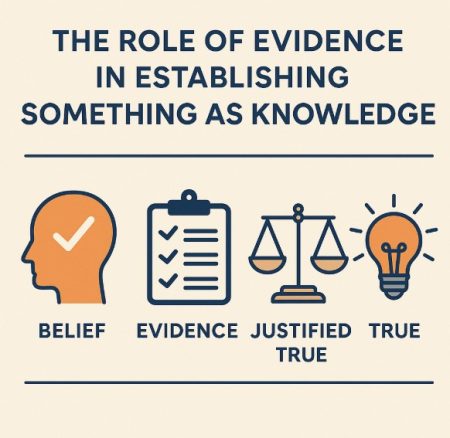
The nature of knowledge has been a central concern of philosophers, educators, and scientists for centuries. It goes beyond the simple possession of facts, representing a deeper understanding and justified awareness that guides human thought and action. Knowledge is traditionally defined as justified true belief, a concept that can be traced back to Plato. This means that for something to qualify as knowledge, it must be true, it must be believed, and there must be sufficient justification for holding that belief. For example, stating that the Earth orbits the Sun qualifies as knowledge because it is true, accepted, and supported by scientific evidence. By contrast, a superstition or ritual believed to bring luck does not meet these conditions, as it lacks justification and objective truth.
It is important to distinguish knowledge from information and belief. Information refers to raw data or facts, which may or may not carry meaning on their own. Reading that Bangladesh gained independence in 1971 provides information, but analyzing the context of the Liberation War and its impact on nation-building transforms that information into knowledge. Similarly, belief is a personal conviction or acceptance of something as true, regardless of evidence. A person might believe that carrying a charm ensures success in examinations, but without justification, this cannot be considered knowledge. While knowledge always involves belief, not all beliefs can be considered knowledge.
Knowledge itself takes many forms. Practical knowledge refers to skills and abilities, such as riding a bicycle or using library software, while theoretical knowledge involves conceptual understanding, such as the principles of physics or library classification. Tacit knowledge includes personal insights or intuitions that are hard to express, like the instinct of an experienced librarian in locating rare materials. Explicit knowledge, by contrast, is structured and documented, such as policies, manuals, or academic research. These forms illustrate the diverse ways in which knowledge is acquired and applied in different domains.
The sources of knowledge have also been widely discussed. Knowledge may be gained through perception, such as observing the color of the sky, or through reasoning and logical deduction, as seen in mathematics and philosophy. It can also come from testimony, where individuals rely on the accounts of others, such as teachers, books, or databases. Intuition is another source, offering immediate understanding without deliberate reasoning, often associated with creativity. Each of these sources contributes in its own way to shaping human knowledge.
In today’s digital world, the nature of knowledge has become even more complex. The internet provides an overwhelming abundance of information, but this does not automatically translate into knowledge. The challenge lies in distinguishing valid knowledge from misinformation. Critical evaluation, verification, and contextual understanding are necessary to transform information into meaningful knowledge. This is where universities, libraries, and research institutions play an essential role in guiding people toward a reliable, evidence-based understanding.
Ultimately, knowledge is a justified, true, and meaningful form of understanding that distinguishes itself from both raw information and untested belief. It provides a reliable foundation for learning, reasoning, and decision-making. Unlike information, which is unprocessed, or belief, which may lack evidence, knowledge is structured and validated, making it a cornerstone of human progress. At the same time, it is not static but evolves with new discoveries, reflections, and experiences, continually shaping how individuals and societies grow.
Can Knowledge Exist Without Certainty?
The question of whether knowledge requires certainty has long been debated in philosophy and epistemology. Traditionally, knowledge was thought of as something absolute and indubitable, a truth that could not be doubted under any circumstances. Philosophers such as René Descartes argued that true knowledge must be certain, and he attempted to strip away all assumptions until he reached something beyond doubt: “I think, therefore I am.” From this perspective, if there is even the slightest chance of error, what we possess is belief or opinion rather than knowledge. However, this strict view excludes much of what we ordinarily consider knowledge- scientific theories, historical interpretations, or medical diagnoses, all of which are open to revision when new evidence arises.
Modern philosophy has shifted toward a fallibilist view, which holds that knowledge can exist without absolute certainty. According to fallibilism, knowledge does not require infallibility but rather sufficient justification and reliability. For example, we commonly say we know that the Earth orbits the Sun, even though our understanding of astronomy could, in theory, be refined further. Similarly, we know that vaccines protect against diseases, even though ongoing research may update or expand our knowledge of how they work. In these cases, knowledge is not absolutely certain, but it is supported by strong justification and consistent evidence, making it reliable enough to be accepted as true.
In everyday life, knowledge clearly operates without the need for certainty. People rely on what they know to make decisions, even when there is a chance of being wrong. A librarian may say that a certain book is available in the catalog, but it might have been misplaced or checked out recently. Weather forecasts are another example. We say we know it will rain tomorrow, but forecasts sometimes prove inaccurate. These examples illustrate that knowledge serves practical purposes, even if it is not guaranteed to be infallible.
What makes knowledge possible without certainty is the quality of justification and the reliability of the methods used to obtain it. Scientific knowledge, for instance, is built not on unshakable certainty but on evidence, experimentation, and peer review. This process ensures that knowledge is testable, self-correcting, and robust, even though it may evolve over time. The reliability of such processes gives knowledge its strength, despite the possibility of error.
In summary, knowledge does not depend on absolute certainty to be meaningful or valid. While traditional philosophers set certainty as the standard, modern thinkers recognize that human understanding is inherently fallible. What matters most is not the impossibility of being wrong but the degree of truth, justification, and reliability that supports our beliefs. By accepting this more flexible view, knowledge becomes both practical and progressive, enabling us to learn, adapt, and refine our understanding of the world. In this sense, knowledge without certainty is not only possible but essential for human growth and discovery.




1 Comment
WHAT IS THE NATURE OF LIBRARY