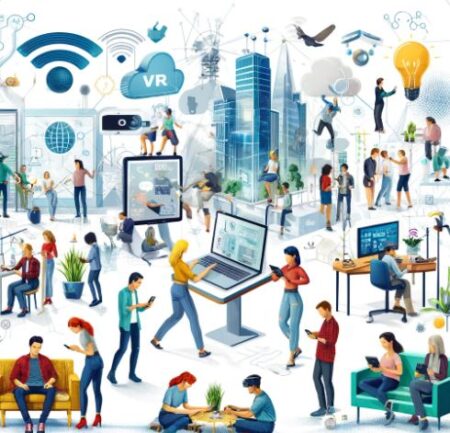
In today’s digital era, information and knowledge serve as the backbone of progress, innovation, and decision-making in almost every sphere of life. Access to reliable information is no longer just a luxury; it is a necessity for education, research, business, governance, and even day-to-day activities. The growth of Information Technology (IT) has revolutionized how people create, store, share, and consume knowledge. For example, researchers who once depended on printed journals or visiting physical libraries can now access thousands of scholarly articles instantly through digital libraries like JSTOR or ScienceDirect. Similarly, students can participate in online courses offered by platforms such as Coursera or edX, gaining access to world-class educational content without leaving their homes.
The transition from traditional methods of information access, such as consulting physical books, manually searching card catalogues, or depending on institutional archives, to digital and online resources has drastically reduced barriers of time and distance. University libraries now maintain institutional repositories and subscribe to electronic journals, making knowledge accessible from anywhere through authentication systems like OpenAthens or proxy servers. Likewise, cloud-based storage services such as Google Drive and Dropbox allow individuals and organizations to preserve and share information globally, ensuring that knowledge is no longer restricted to a particular physical space.
The aim of this article is to examine how IT improves access to information and knowledge and why this improvement matters. By making knowledge more widely available, IT empowers students in classrooms, facilitates advanced research, enables businesses to make data-driven decisions, and helps ordinary people stay informed about global issues. Understanding this transformation is essential, as it not only reflects the technological progress of our time but also emphasizes the crucial role of IT in shaping an informed, educated, and interconnected society.
How Does IT Improve Access to Information and Knowledge?
In the modern digital age, information and knowledge have become essential resources for personal development, education, research, business, and societal progress. The rapid growth of Information Technology (IT) has dramatically reshaped how information is created, stored, shared, and accessed. Instead of relying solely on traditional sources such as printed books, physical archives, or in-person libraries, people can now access vast amounts of knowledge instantly through digital platforms and online networks. This transformation has not only made information more accessible but has also broken down barriers of geography, cost, and time. This article explores how IT improves access to information and knowledge, why it matters, and what challenges and opportunities lie ahead.
- Expanding Access Through Digital Platforms: One of the most significant contributions of IT is the creation of digital libraries and online databases. Universities and research institutions subscribe to databases like JSTOR, ScienceDirect, or SpringerLink, allowing students and faculty to access thousands of scholarly articles instantly. Open-access initiatives, such as the Directory of Open Access Journals (DOAJ), have further expanded free availability of peer-reviewed content. Beyond academia, platforms like Wikipedia, YouTube, and Khan Academy provide open access to educational resources for millions worldwide.
Similarly, search engines such as Google, Bing, and Yahoo have become gateways to knowledge. Instead of spending hours in a library catalogue, users can now retrieve relevant information within seconds. This democratization of access ensures that information is no longer confined to a select group but is available to anyone with an internet connection. - Speed and Convenience of Information Access: IT has removed time and physical constraints, enabling 24/7 availability of knowledge. Unlike traditional libraries that close at certain hours, digital platforms remain open all the time. A student can prepare for exams late at night using e-books, while professionals can access business reports or research data at any time of the day.
The role of mobile devices has further accelerated this transformation. Smartphones and tablets allow individuals to carry libraries in their pockets, accessing e-books, articles, and news from anywhere. For instance, language learners can use Duolingo, while professionals can stay updated through platforms like LinkedIn Learning or Coursera. - Overcoming Geographical Barriers: One of IT’s most powerful contributions is eliminating distance barriers. Remote access systems such as OpenAthens or VPNs allow students to log into their institutional databases from anywhere in the world. This has proven especially useful for international collaborations and distance learning programs.
E-learning platforms such as Coursera, edX, and Udemy bring courses from world-class universities and institutions to learners in remote or underdeveloped regions. During the COVID-19 pandemic, these tools proved invaluable in keeping education active despite lockdowns. Similarly, video conferencing platforms like Zoom and Microsoft Teams support real-time collaboration and virtual classrooms, enabling people across different continents to work and learn together. - Improving Information Organization and Retrieval: Information Technology also enhances the organization and retrieval of knowledge. Advanced cataloguing systems supported by IT, such as MARC21, Library of Congress Classification, and metadata indexing, ensure that materials are systematically arranged for quick access.
Artificial Intelligence (AI) and machine learning have further refined the process by offering personalized recommendations. Platforms like Google Scholar suggest relevant research papers, while Amazon or Netflix recommend content based on user preferences. Big Data and analytics allow businesses, researchers, and policymakers to process massive datasets, turning raw data into actionable knowledge. - Enhancing Knowledge Sharing and Communication: IT has revolutionized how knowledge is shared and communicated. Social media platforms like Twitter, Facebook, and LinkedIn enable instant dissemination of news, research findings, and educational content. Academic networking sites such as ResearchGate and Academia.edu allow researchers to share their publications and collaborate globally.
Cloud-based collaboration tools such as Google Docs, Dropbox, and Microsoft Teams facilitate real-time group work, knowledge exchange, and document sharing. Universities and organizations use institutional repositories to archive and share theses, dissertations, and publications, ensuring that valuable knowledge remains accessible for future generations.
Information Technology has fundamentally transformed how humanity creates, stores, shares, and accesses information. From digital libraries and online learning platforms to mobile devices and AI-powered search engines, IT has made knowledge more accessible, convenient, and collaborative than ever before. While challenges such as the digital divide, misinformation, and data privacy persist, the opportunities IT offers far outweigh the drawbacks. Ultimately, IT has not only democratized access to information but has also empowered individuals, institutions, and societies to learn, innovate, and thrive in the digital age.
In What Ways Has IT Transformed the Way People Access Information Compared to Traditional Methods?
Access to information has always been central to human progress, but for centuries, people relied on traditional methods such as printed books, physical libraries, and archival records as the main gateways to knowledge. While these resources remain important, the rapid growth of Information Technology (IT) has fundamentally changed the way people seek, retrieve, and use information. What once required hours of manual searching and physical presence can now be accomplished within seconds from virtually anywhere in the world. This transformation is not just about speed and convenience; it has redefined the very nature of how knowledge is created, stored, shared, and consumed.
One of the most striking differences brought by IT is the accessibility and reach of information. In traditional settings, individuals had to visit libraries, sift through card catalogues, and physically locate books or journals. Today, digital libraries, online databases, and search engines have removed those barriers. Platforms such as Google Scholar, JSTOR, and ScienceDirect allow researchers and professionals to access scholarly content instantly, while open-access repositories and educational platforms like Khan Academy or Wikipedia make knowledge available to anyone with an internet connection. This shift ensures that information is no longer confined to physical spaces or privileged groups but is widely accessible.
IT has also transformed the speed and efficiency of information retrieval. Traditionally, obtaining a research article or specific book might take hours or even days, depending on availability and borrowing policies. Now, search engines and indexing systems provide instant results from vast digital collections, with advanced algorithms refining results to match user needs. Mobile devices have made information portable, allowing people to carry digital libraries in their pockets and access them anytime. For example, students can prepare for exams using e-books on tablets, and professionals can consult reports or data on their smartphones while traveling.
Collaboration and knowledge sharing have also been reshaped by IT. In the past, sharing information meant lending books, photocopying articles, or attending physical seminars. Today, information exchange happens in real time through cloud-based tools like Google Docs, Dropbox, and Microsoft Teams. Social media platforms such as Twitter, LinkedIn, and Facebook provide spaces where news, ideas, and research spread instantly. Academic networks like ResearchGate and Academia.edu allow scholars to share their work globally and collaborate without geographical limitations, making knowledge more dynamic, interactive, and responsive to immediate needs.
Another transformation is seen in the organization and personalization of information. Traditional cataloguing systems like the Dewey Decimal or Library of Congress classifications required manual searching and physical effort, but IT now supports digital catalogues, metadata indexing, and AI-driven search tools that make retrieval faster and more precise. Machine learning algorithms also personalize the experience by recommending articles, books, or courses based on user preferences. Platforms like Coursera or YouTube suggest content tailored to individual interests, creating opportunities for self-directed and continuous learning.
Equally significant is the way IT has overcome geographical and physical barriers. Traditionally, access to knowledge depended heavily on proximity to libraries, universities, or resource centers. Today, remote access systems such as VPNs and OpenAthens allow users to log into institutional databases from anywhere. Online learning platforms like edX and Udemy bring courses from leading institutions to learners in remote regions. During the COVID-19 pandemic, these digital tools became essential for maintaining continuity in education and research, highlighting their importance in modern knowledge systems.
Despite these advantages, IT-driven access is not without challenges. The digital divide still prevents equal opportunities for people in underdeveloped areas who lack reliable internet or digital literacy. Moreover, the abundance of information has led to problems of information overload and misinformation, requiring individuals to develop strong critical thinking skills to filter credible sources from unreliable ones. Concerns about privacy and data security also persist as more information is stored and shared digitally.
How Does IT Help Overcome Geographical and Physical Barriers to Information Access?
Access to information is one of the most valuable resources in today’s world, and in the past, it was often limited by geography and physical barriers. People had to visit libraries, archives, or educational institutions to gain knowledge, and those in rural or underdeveloped areas were often deprived of such opportunities. The advancement of Information Technology (IT) has transformed this situation by allowing people to cross these barriers and access information from anywhere. Today, university libraries and research institutions provide remote access to digital resources through systems like VPNs and OpenAthens, enabling students and researchers to log in and retrieve thousands of journals, e-books, and databases without needing to travel. Platforms such as JSTOR, ScienceDirect, and ProQuest have made scholarly content widely available, breaking down the traditional dependence on physical spaces.
E-learning has further revolutionized the accessibility of knowledge. Massive Open Online Courses (MOOCs) offered by Coursera, edX, and Udemy allow learners around the globe to access world-class education regardless of location. During the COVID-19 pandemic, these platforms ensured continuity in education when classrooms remained closed. Video conferencing tools such as Zoom, Microsoft Teams, and Google Meet enabled real-time interaction between teachers and students across time zones, making learning more inclusive and accessible. At the same time, cloud storage technologies like Google Drive, Dropbox, and OneDrive have allowed individuals and institutions to store, share, and collaborate on information seamlessly. Researchers from different countries can now work together on the same projects without meeting physically, while institutional repositories preserve and distribute research outputs globally.
The spread of mobile technology and internet connectivity has also been a major breakthrough in overcoming geographical barriers. Smartphones and tablets have brought digital libraries, educational apps, and online resources to people’s fingertips, even in remote areas. Community internet centers and offline e-learning applications extend these opportunities to populations with limited connectivity. Moreover, IT has helped overcome not just geographical barriers but also physical limitations faced by individuals with disabilities. Assistive technologies like screen readers, speech-to-text software, and accessible e-books ensure that visually impaired or physically challenged individuals can access and benefit from digital knowledge, making information truly inclusive.
Despite these advancements, challenges remain in the form of the digital divide, where reliable internet access and affordable devices are not equally available to all. Issues of misinformation, digital literacy, and privacy also complicate the picture. However, ongoing efforts by governments, NGOs, and international organizations continue to reduce these gaps and extend IT-enabled opportunities to underserved populations. Overall, Information Technology has proven to be a powerful force in breaking down barriers to knowledge. By enabling remote access, supporting online learning, fostering global collaboration, and promoting inclusivity through assistive tools, IT has created a world where learning and research are no longer confined by location or physical limitations. In the long run, it continues to shape a more informed, connected, and equitable global society.
How Do Mobile Devices and Internet Connectivity Expand Access to Information Globally?
Mobile devices and internet connectivity have become powerful tools for expanding access to information across the world. Unlike traditional computers, smartphones and tablets are affordable, portable, and widely available, making them accessible even in regions where other technologies are scarce. With the rise of mobile applications and online platforms, users can now access e-books, academic articles, news, and educational content instantly from their pockets. For example, a student in a remote village can use a smartphone to attend virtual classes or access digital libraries that were once limited to urban centers.
The spread of internet connectivity has also broken geographical barriers by linking people to global knowledge networks. High-speed internet, along with community Wi-Fi centers and mobile data services, allows individuals in underdeveloped or rural areas to connect to the same information as users in advanced cities. Platforms like YouTube, Wikipedia, and Khan Academy provide free educational content, while social media and messaging apps keep people informed about current events in real time. As a result, knowledge is no longer restricted by physical location or financial status, but has become a shared resource accessible to anyone with a connected device.
Together, mobile devices and internet connectivity have democratized information access, promoting equality and inclusivity. They enable lifelong learning, professional development, and social participation on a global scale, ensuring that people from diverse backgrounds can benefit from the digital age.
How Has IT Changed the Way Researchers, Educators, and Students Share and Exchange Knowledge?
Information Technology (IT) has reshaped the landscape of education and research by revolutionizing the way knowledge is shared, accessed, and exchanged. In earlier times, researchers depended on printed journals, conferences, and personal correspondence to communicate findings, while educators primarily taught within classrooms using printed handouts, and students relied on physical books and face-to-face discussions as their main sources of learning. Today, IT has transformed this environment into a dynamic, interactive, and borderless ecosystem where researchers, educators, and learners can collaborate and communicate globally in real time. Digital platforms now play a central role in this transformation. Researchers share their work not only in traditional journals but also through digital repositories and academic networking sites such as ResearchGate, Academia.edu, and Google Scholar, which make their findings instantly available to a worldwide audience. Educators use Learning Management Systems (LMS) like Moodle, Blackboard, and Canvas to upload lecture materials, distribute assignments, and communicate with students beyond the classroom, while students benefit from access to digital libraries and e-journal databases such as JSTOR, ProQuest, and ScienceDirect. Open Educational Resources (OER) further enhance learning by offering free textbooks, lecture notes, and multimedia content accessible to anyone with an internet connection.
The ability to collaborate in real time has fundamentally changed academic interactions. Cloud-based tools like Google Docs, Dropbox, and Microsoft OneDrive allow multiple users to co-create and edit documents simultaneously, enabling research teams across different countries to work on projects together. Video conferencing platforms such as Zoom, Microsoft Teams, and Google Meet have become vital for virtual classes, online seminars, and group discussions, ensuring continuity in teaching and research even during crises like the COVID-19 pandemic. Beyond formal platforms, IT has also opened up informal avenues for sharing knowledge through social media and online communities. Twitter and LinkedIn allow academics to post research updates, share short insights, and engage in scholarly debates, while Facebook groups, online forums, and YouTube channels provide spaces for students and teachers to exchange ideas, discuss assignments, and share tutorials or recorded lectures. These tools have made knowledge sharing faster, more interactive, and more inclusive, creating global learning communities that go beyond institutional walls.
IT has also introduced personalization and inclusivity into the exchange of knowledge. Adaptive learning systems powered by artificial intelligence analyze learners’ progress and suggest customized content, making education more efficient and targeted. Assistive technologies such as screen readers, closed captions, and translation tools ensure that individuals with disabilities or language barriers can access and contribute to global knowledge networks. Preprint servers like arXiv and bioRxiv allow researchers to share early findings, inviting diverse feedback and accelerating the pace of discovery. Overall, IT has made knowledge more accessible, collaborative, and inclusive, transforming the way researchers, educators, and students interact with information.
In conclusion, the integration of IT into education and research has fundamentally changed how knowledge is shared and exchanged. By providing access to digital platforms, enabling real-time collaboration, supporting informal knowledge networks, and ensuring inclusivity, IT has created a world where knowledge flows more freely and reaches a wider audience. While challenges such as the digital divide and information overload still exist, the positive impact of IT is undeniable. It has helped build a more connected, informed, and innovative global community, where researchers, educators, and students can learn, teach, and collaborate without the limits once imposed by time, geography, or resources.