Document classification is the process of organizing and categorizing documents into predefined groups or categories based on their content, structure, or other relevant characteristics. It plays a crucial role in information management, enabling efficient retrieval, storage, and access to documents in various settings, such as libraries, digital archives, businesses, and academic institutions. By categorizing documents, classification systems streamline the search process, making it easier to locate specific information quickly.
Document classification can be performed manually, with human expertise, or automatically, using machine learning and natural language processing (NLP) techniques. With the growing volume of digital content, automated classification has become increasingly important, as it allows systems to process large datasets and assign appropriate categories without extensive human intervention. Document classification supports a wide range of applications, including document retrieval, information filtering, and knowledge management, and is essential for improving the overall efficiency of information systems.
What is Document Classification?
Document classification is the process of organizing and categorizing documents into specific groups or classes based on their content, structure, or other relevant characteristics. This essential practice plays a critical role in information management, helping organizations and individuals efficiently organize vast amounts of data. The objective of document classification is to facilitate quick retrieval, improve accessibility, and enhance the overall organization of documents.
This process can be performed manually, where human experts classify documents based on their understanding and judgment, or automatically, through the use of machine learning algorithms, natural language processing (NLP), and other computational techniques. In the case of automated classification, algorithms analyze the content of a document and assign it to a predefined category, such as “Legal Documents,” “Financial Reports,” or “Research Papers.” The use of automated document classification has become particularly crucial in handling large datasets, enabling organizations to process documents quickly and accurately.
The benefits of document classification extend beyond just storage and retrieval. Categorizing documents enhances knowledge management systems, improves search engine functionalities, and supports various applications in industries like healthcare, legal, academic, and business sectors. Document classification is vital for transforming unstructured data into a more organized, accessible, and manageable format.
Document Classification vs. Document Indexing: Key Differences and Applications”
Document classification and document indexing are both critical processes in the organization and retrieval of information, but they serve different purposes and involve distinct methods.
Document Classification refers to the process of categorizing documents into predefined groups or classes based on their content, structure, or other distinguishing characteristics. The primary aim is to group similar documents together, making it easier to retrieve a set of related documents when needed. For example, in a library system, documents may be classified into categories such as “Science,” “Literature,” or “History.” This process helps organize large collections of documents by subject matter, which facilitates efficient access and retrieval.
Document Indexing, on the other hand, involves creating a detailed list or index of key terms or concepts within a document to improve its searchability. Indexing assigns keywords or terms to specific parts of a document, such as titles, headings, or important phrases, allowing search engines or retrieval systems to quickly identify relevant documents based on a query. Indexing is often more granular than classification because it focuses on identifying and tagging specific terms or concepts within the text.
Classification organizes documents into broad categories or classes, while indexing focuses on adding detailed, searchable keywords or metadata to make the individual documents easier to find based on specific search terms. Both processes are complementary: classification provides a broad organization, while indexing enhances the precision of document retrieval. Together, they improve the efficiency of document management systems, especially in environments with large volumes of information.
Primary Goals of Document Classification in Information Management
Document classification is a crucial aspect of information management that helps organizations effectively handle the vast amounts of data they generate and maintain. By categorizing documents into predefined groups, classification simplifies the management of documents and facilitates quicker, more efficient retrieval. It is pivotal in organizing, storing, and accessing information across different sectors, from libraries and academic institutions to corporate and legal environments. The primary goals of document classification in information management are as follows:
- Improved Document Organization: One of the primary goals of document classification is to organize documents in a structured manner. Whether it’s for physical or digital documents, classification ensures that related documents are grouped together, making them easy to find and manage. By categorizing documents based on common themes, subjects, or types, classification reduces the complexity of managing large volumes of information. This organized structure helps prevent information overload and minimizes the time spent searching for relevant documents. In an increasingly digital world, proper classification systems allow organizations to streamline the organization of electronic records, making them easily accessible when needed.
- Enhanced Search and Retrieval: A well-executed document classification system improves the search and retrieval process. Without proper classification, finding specific information within a large dataset can be cumbersome and time-consuming. By categorizing documents into relevant groups, users can quickly navigate through the classification structure and locate the document they need. Whether in a digital library, content management system, or enterprise resource planning (ERP) system, classification allows users to filter and retrieve documents based on their category, significantly reducing search time. For example, in academic research, documents classified under specific subjects such as “Physics,” “Engineering,” or “Biology” can be easily accessed by researchers looking for resources in those fields.
- Efficient Knowledge Management: Document classification plays a crucial role in knowledge management by helping organize, store, and share knowledge efficiently. In an organizational context, employees rely on well-structured document classification systems to access the information and resources they need to perform their tasks. Proper classification enables knowledge-sharing, collaboration, and decision-making across departments. By categorizing documents into relevant topics, organizations can ensure that employees can find existing knowledge and discover new insights related to their work. In the context of academic institutions, classified documents or research papers contribute to an accessible knowledge base that enhances learning and innovation.
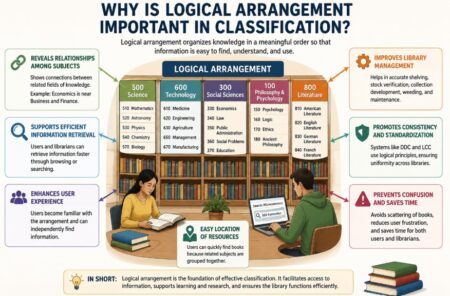
- Support for Information Discovery: Beyond improving search accuracy, document classification also aids in information discovery. By categorizing documents, users can uncover connections between different documents that may not have been immediately apparent through simple keyword searches. For example, when documents are classified under broader categories, users can explore related content within the same class. This ability to find new, related information supports deeper research and more comprehensive analysis. For instance, in a library setting, classification systems such as the Dewey Decimal System or Library of Congress Classification allow users to explore various subjects within a specific field of study, aiding in academic research and learning.
- Compliance and Legal Requirements: In certain industries, such as healthcare, finance, and legal sectors, compliance with industry regulations requires organizations to maintain specific types of documents for defined periods. Document classification ensures that documents are organized in a way that makes compliance easier. By classifying documents based on their legal or regulatory relevance, organizations can store documents according to the necessary guidelines, making them readily available for audits or legal proceedings. Additionally, classification helps organizations meet data retention policies and manage sensitive or confidential information in accordance with privacy laws.
- Automation and Scalability: As organizations increasingly rely on digital systems, the volume of documents being generated and stored continues to grow. Automated document classification systems, driven by technologies such as machine learning and natural language processing, enable the efficient processing of large datasets. These systems can classify documents without human intervention, allowing organizations to scale their information management systems to handle growing volumes of data. Automated classification ensures accuracy and consistency across large datasets, reduces the burden of manual classification, and enables real-time processing of documents. This scalability makes it possible to manage vast repositories of information in industries ranging from healthcare to finance with ease.
- Cost Efficiency: Effective document classification leads to cost savings by streamlining document management processes. When documents are organized efficiently, organizations can save time on searching, storing, and retrieving information. This increases productivity, as employees spend less time looking for information and more time on value-added tasks. Additionally, well-organized classification reduces the need for duplicate documents, unnecessary storage, and redundant data entry. The ability to retrieve information quickly and accurately also minimizes the potential for errors and mismanagement, further cutting costs related to inefficiencies.
Document classification is a foundational element of information management, offering a range of benefits to organizations across various sectors. By improving document organization, searchability, knowledge sharing, and compliance, classification systems support the efficient handling of vast amounts of data. Automated systems further enhance these goals, providing scalability and cost efficiency. In an age where information is growing exponentially, the importance of document classification cannot be overstated. It enables organizations to unlock the full potential of their data, ensuring that it is accessible, organized, and useful for all users.
Different Methods of Document Classification
Document classification is a crucial process in information management that helps organizations categorize and organize large volumes of information. By classifying documents into predefined categories, it becomes easier to store, retrieve, and manage information. The methods used for document classification can be broadly divided into manual, rule-based, and automated techniques. Here’s a look at the different methods used for document classification:
- Manual Classification: Manual classification is the traditional method of categorizing documents, where human experts read and analyze the content to assign it to predefined categories. In this method, the classification is based on the judgment and understanding of the classifier, who may use a classification scheme such as a classification hierarchy or a taxonomy.
- Advantages: Manual classification is highly accurate, especially when the document’s content is complex or nuanced. It allows for a deep understanding of context and subject matter, making it ideal for sensitive, highly specialized, or ambiguous documents.
- Disadvantages: Manual classification is time-consuming and labor-intensive. It also becomes inefficient as the volume of documents grows. Furthermore, consistency in classification may vary depending on the individual’s knowledge and expertise, which could lead to errors or discrepancies.
- Rule-Based Classification: Rule-based classification uses a predefined set of rules or criteria to classify documents. These rules are often created by domain experts and typically rely on keywords, phrases, metadata, or document features. For example, if a document contains certain keywords or metadata attributes, such as “invoice” or “payment,” it may be classified as a financial document.
- Advantages: Rule-based classification is relatively fast and can be automated to some extent. It is useful for documents that fit clearly defined categories or patterns, making it a good option for structured or semi-structured documents.
- Disadvantages: Rule-based methods are inflexible and cannot easily adapt to new types of documents or changes in content. Additionally, creating and maintaining rules can be a cumbersome task, especially for large-scale systems. It is also less effective when dealing with ambiguous or unstructured content.
- Machine Learning-Based Classification: Machine learning (ML)-based classification relies on algorithms that “learn” from data. In this approach, a machine learning model is trained on a set of labeled documents (documents that are already classified) so the algorithm can recognize patterns and features that help categorize new, unseen documents.
- Supervised Learning: In supervised machine learning, the algorithm is trained using a labeled dataset where each document is assigned to a predefined class. The model learns from this training data and, once trained, can predict the category of new documents.
- Advantages: Supervised learning can achieve high accuracy, especially when a large dataset of labeled documents is available. The model can continuously improve its accuracy as more labeled data is fed into it.
- Disadvantages: Supervised learning requires a large amount of labeled data to train effectively, which can be resource-intensive and time-consuming. If the data is not well-labeled or diverse, the model may not perform as expected.
- Unsupervised Learning: Unsupervised learning, in contrast, does not require labeled data. Instead, the algorithm looks for inherent patterns in the data and groups similar documents together into clusters. Common techniques include clustering algorithms like k-means.
- Advantages: Unsupervised learning is particularly useful when labeled data is unavailable. It can identify hidden patterns and organize documents into groups that may not have been obvious at first.
- Disadvantages: The results can be less interpretable and may not align perfectly with predefined categories. Additionally, there is no clear benchmark for performance, making it harder to evaluate.
- Supervised Learning: In supervised machine learning, the algorithm is trained using a labeled dataset where each document is assigned to a predefined class. The model learns from this training data and, once trained, can predict the category of new documents.
- Natural Language Processing (NLP)-Based Classification: Natural Language Processing (NLP) is a subset of machine learning that focuses on processing and analyzing human language. NLP-based classification involves analyzing the textual content of documents to extract features such as topics, sentiment, and keywords. Techniques such as text classification, named entity recognition (NER), and part-of-speech tagging are used to classify documents based on their content.
- Advantages: NLP-based classification is well-suited for dealing with unstructured or complex textual content. It can be used for a variety of document types, including emails, research papers, reports, and legal documents. Additionally, it can automatically extract relevant information, such as named entities (e.g., people, organizations, dates), which improves classification accuracy.
- Disadvantages: NLP-based methods can be computationally expensive and require significant resources to process large volumes of text. Moreover, NLP models require training data and may struggle with documents containing slang, jargon, or ambiguous language.
- Clustering-Based Classification: Clustering is a type of unsupervised learning where documents are grouped based on similarities in their content. Instead of assigning documents to predefined categories, clustering algorithms identify patterns and create natural groupings or “clusters” based on features like keywords, topics, or text structure. Popular clustering techniques include k-means and hierarchical clustering.
- Advantages: Clustering is useful for discovering hidden patterns in data and organizing documents without requiring predefined categories. It can be particularly valuable for exploratory data analysis and understanding document relationships.
- Disadvantages: The results of clustering can be difficult to interpret and may not always align with business or organizational needs. It also requires careful tuning of parameters such as the number of clusters.
- Deep Learning-Based Classification: Deep learning-based classification leverages neural networks, particularly deep neural networks (DNNs), to analyze and classify documents. This method is highly effective in dealing with large datasets and complex, high-dimensional data. Techniques such as Convolutional Neural Networks (CNNs) or Recurrent Neural Networks (RNNs) are used for document classification tasks.
- Advantages: Deep learning models can achieve high accuracy, particularly in complex classification tasks involving large datasets, such as classifying multimedia documents (e.g., images, videos, text) or handling very nuanced textual content.
- Disadvantages: Deep learning models require substantial computational resources and large labeled datasets to train effectively. The training process can also be time-consuming, and the models may be difficult to interpret, making them less transparent than other methods.
- Content-Based Classification: Content-based classification focuses on the actual content of the document to determine its category. Techniques like keyword extraction, topic modeling, and sentiment analysis are used to analyze the text and classify it based on the content within. This method is particularly useful for documents that contain specific topics, keywords, or language patterns.
- Advantages: Content-based classification is ideal for documents with rich textual content. It allows for detailed, context-driven classifications that can reflect the nuances of the document’s subject matter.
- Disadvantages: Content-based methods may struggle with documents that have little text or where the content is too general or ambiguous. They also require efficient text analysis algorithms to extract meaningful features from large datasets.
Document classification is an essential process in organizing and managing information effectively. The choice of classification method depends on the type of documents being handled, the volume of data, and the resources available. While manual classification offers accuracy and control, automated methods like machine learning, NLP, and clustering provide scalability and efficiency, making them ideal for large-scale systems. As technology advances, new methods like deep learning and advanced NLP are becoming increasingly popular, improving the accuracy and capabilities of document classification systems.
Manual vs. Automated Document Classification Systems
Document classification is a key process in information management that involves categorizing documents into predefined groups. The classification process can be carried out manually by human experts or automatically using algorithms and machine learning techniques. Both methods aim to organize documents for easier retrieval and management, but they differ significantly in terms of efficiency, scalability, accuracy, and costs.
| Aspect | Manual Document Classification |
Automated Document Classification |
|---|---|---|
| Accuracy and Consistency | Manual classification relies on human judgment, which can lead to a high degree of accuracy, especially when the content is complex or nuanced. Experts can interpret context and domain-specific information in a way that automated systems may struggle with. However, human classifiers may be subject to fatigue, biases, and inconsistency, especially when handling large volumes of documents. Different classifiers may interpret the same document differently, leading to potential inconsistencies. | Automated systems, particularly those driven by machine learning algorithms, can achieve high accuracy, especially when trained on large labeled datasets. These systems are consistent, as they apply the same rules or models to classify each document. However, their performance depends heavily on the quality and size of the training data. If the training data is biased or insufficient, automated systems can misclassify documents. Additionally, automated systems may struggle with ambiguous or complex content that requires deeper contextual understanding. |
| Efficiency and Speed | Manual classification is time-consuming and labor-intensive. Human classifiers need to read and interpret each document individually, which can be slow, particularly for large volumes of data. As the number of documents increases, manual classification becomes increasingly inefficient. This method is typically impractical when dealing with large-scale document collections, as it can lead to significant delays and resource constraints. | Automated systems are highly efficient and can process vast amounts of data in a fraction of the time it would take for humans to classify the same documents. Once trained, these systems can classify documents quickly and consistently. This makes automated classification ideal for environments with large document volumes, such as digital libraries, content management systems, or legal and medical document processing. |
| Scalability | Manual classification is not scalable. As the volume of documents increases, the need for additional human classifiers grows. This can become a significant challenge for organizations that need to handle a large number of documents on a continuous basis. Scaling up manual classification typically requires hiring more staff, which can be expensive and time-consuming. | Automated classification systems are highly scalable. Once the system is set up and trained, it can easily handle increases in document volume without significant additional cost or time. This makes automation a more sustainable solution for organizations dealing with large and continuously growing datasets, such as social media platforms, online archives, and businesses managing customer data. |
| Cost | The primary cost associated with manual classification is labor. Since it requires human expertise, organizations need to pay staff to classify documents. This can be a significant expense, especially when dealing with large volumes of data. Additionally, there may be ongoing costs related to training and maintaining a skilled workforce. | Automated classification systems can reduce costs over time by eliminating the need for extensive manual labor. However, there are initial costs associated with developing, setting up, and training the system, especially if machine learning or natural language processing (NLP) techniques are used. Once the system is in place, however, the ongoing costs are relatively low compared to manual classification. For large-scale applications, automation can ultimately result in significant cost savings. |
| Flexibility and Adaptability | Manual classification offers flexibility, as human classifiers can adapt to new types of documents, changing contexts, or nuanced content that may not fit into predefined categories. Humans can apply domain-specific knowledge and adjust their classification decisions accordingly, making manual systems well-suited for specialized or complex document types. | Automated systems can be less flexible, as they rely on predefined rules or models trained on specific datasets. While machine learning systems can adapt to new data over time, they may require retraining when the types of documents change significantly. Additionally, automated systems may struggle with documents that do not fit well into existing categories or contain ambiguous language. However, advancements in machine learning, especially in deep learning, have made automated systems more adaptable and capable of handling a wider range of document types. |
| Human Intervention | In manual classification, human intervention is needed to handle errors, resolve ambiguities, and make judgment calls. This can be a strength when dealing with complex or subjective content, but it also means that the process is dependent on the classifier’s expertise and attention to detail. Additionally, human classifiers can introduce errors due to fatigue, misinterpretation, or oversight. | Automated systems are typically less prone to errors related to fatigue or human inconsistency. However, they can still make mistakes, especially when faced with documents that do not conform to the patterns in the training data. Errors in automated systems can often be addressed by retraining the model or adjusting the classification algorithm. Nevertheless, human oversight may still be required to handle edge cases or documents that the system struggles to classify correctly. |
| Best Use Cases | Manual classification is best suited for situations where accuracy, domain expertise, and nuanced decision-making are required. It is ideal for specialized or complex documents, such as legal contracts, academic papers, or highly sensitive materials, where the context and subject matter may not be easily captured by automated systems. It is also effective for smaller datasets or situations where automation may not be cost-effective. | Automated classification is most effective when dealing with large volumes of structured or semi-structured documents that can be categorized using patterns and keywords. It is ideal for environments with high data throughput, such as digital libraries, corporate document management systems, or content platforms. Automated classification is also well-suited for scenarios where consistency and scalability are important, such as in customer service operations or e-commerce platforms. |
Both manual and automated document classification systems have their strengths and weaknesses, and the choice between them largely depends on the context and the needs of the organization. Manual classification excels in accuracy, flexibility, and handling complex, nuanced documents, making it ideal for specialized tasks. However, it is slow, labor-intensive, and not scalable for large datasets.
On the other hand, automated classification systems offer speed, consistency, scalability, and cost-effectiveness, making them well-suited for high-volume environments. While they may struggle with complex or ambiguous content, advancements in machine learning and natural language processing are improving the capabilities of automated systems, making them increasingly adaptable and accurate.
In many cases, a hybrid approach that combines the strengths of both manual and automated classification can provide the best results, where automation handles large volumes of straightforward documents and manual classification is used for more complex or specialized cases.
Advantages of Using Automated Document Classification Over Manual Methods
Automated document classification has become a game-changer in information management, offering several distinct advantages over traditional manual classification methods. With the increasing volume of data and the need for efficient document management, automated systems powered by machine learning and artificial intelligence have emerged as critical tools for organizations across various sectors. Here are the key advantages of using automated document classification over manual methods:
- Increased Efficiency and Speed: One of the most significant advantages of automated document classification is its speed and efficiency. Manual classification requires human intervention, where experts or staff members need to read, analyze, and categorize each document individually. This process can be slow, especially when handling large volumes of documents. In contrast, automated systems can classify thousands of documents within minutes or seconds, dramatically reducing the time it takes to organize information. Once set up, automated systems are highly efficient and can process documents continuously without breaks or delays, making them ideal for high-throughput environments like legal firms, healthcare organizations, and e-commerce platforms.
- Scalability: As organizations grow and accumulate more data, manual classification systems become increasingly difficult to scale. Manual processes require additional personnel to handle the growing volume of documents, which can be costly and impractical in the long term. Automated document classification, on the other hand, is highly scalable. Once the system is trained and deployed, it can handle a virtually unlimited number of documents with minimal human intervention. Automated systems can easily adjust to increased document volumes without the need to hire additional staff, making them a sustainable solution for organizations that are dealing with large and continuously growing datasets.
- Cost-Effectiveness: Manual document classification can be resource-intensive, as it requires hiring and training personnel to classify documents. Additionally, human classifiers must dedicate significant time and effort to ensure that documents are categorized correctly. This can lead to high labor costs, especially when dealing with large datasets. Automated document classification, however, reduces the need for manual labor, leading to substantial cost savings. Once an automated system is in place, the ongoing costs are relatively low, as it can classify documents quickly and accurately without the need for constant human oversight. For organizations with large volumes of data, this cost-effectiveness is a significant advantage.
- Consistency and Accuracy: Manual classification is often prone to human error, especially when dealing with repetitive tasks over long periods. Fatigue, distraction, and subjective interpretation can lead to inconsistencies in classification decisions. Automated systems, on the other hand, apply the same classification rules or machine learning models consistently across all documents. This ensures a higher level of accuracy and consistency, as the system will categorize documents based on predefined criteria without variation. Furthermore, machine learning algorithms can be trained to improve their accuracy over time, adapting to new types of documents and refining their classification capabilities.
- Reduction of Human Error: Human error is an inherent risk in manual classification, as classifiers may overlook important details, misinterpret content, or make mistakes due to fatigue or distraction. Automated systems, however, are less prone to such errors. They process documents based on algorithms that have been trained on large datasets, ensuring that the classification process is carried out with high reliability. While automated systems are not immune to errors—particularly if the training data is insufficient or the algorithm is not properly fine-tuned—the chances of error are significantly lower compared to manual methods.
- Better Handling of Large Datasets: One of the most compelling reasons to switch to automated document classification is its ability to handle large datasets. As the amount of data generated by organizations increases, manual classification becomes increasingly impractical. The sheer volume of documents can overwhelm human classifiers, leading to delays, backlogs, and errors. Automated systems can process vast quantities of documents in a fraction of the time it would take humans, making them ideal for environments that require real-time processing of large datasets, such as social media platforms, news aggregators, or document-heavy industries like finance and law.
- Improved Document Search and Retrieval: Automated classification makes it easier to search and retrieve documents by organizing them into clearly defined categories. When documents are classified accurately, they can be quickly located through a search query or browsing interface, which enhances the overall user experience. Automated systems can assign relevant tags or keywords to documents, making it easier for users to find specific documents based on subject, topic, or other criteria. In comparison, manual classification may result in inconsistencies or misclassification, which can hinder the effectiveness of search and retrieval processes.
- Adaptability and Continuous Improvement: Automated document classification systems, especially those based on machine learning, are adaptable and capable of continuous improvement. These systems learn from the data they process, allowing them to refine their classification models over time. As new types of documents or categories emerge, the system can be retrained with updated data to ensure that it remains effective. This adaptability makes automated classification systems ideal for organizations that experience frequent changes in document types or classifications. In contrast, manual classification lacks the ability to adapt automatically and may require frequent retraining and recalibration by human classifiers.
- Real-Time Classification: In industries where time is of the essence, such as finance, healthcare, or customer service, real-time document classification is crucial. Automated systems can classify documents as soon as they are generated or received, ensuring that information is immediately categorized and available for further processing. Manual classification, however, typically involves delays, as documents need to be processed sequentially by human workers. Real-time classification improves efficiency, enhances workflow, and allows organizations to respond to emerging situations more quickly.
- Freeing Up Human Resources for Higher-Value Tasks: By automating the repetitive and time-consuming task of document classification, organizations can free up their human resources to focus on higher-value tasks that require creativity, judgment, and decision-making. Employees no longer need to spend their time sorting through documents and can instead engage in activities that contribute more directly to the organization’s goals. This not only boosts productivity but also improves employee satisfaction, as it reduces the monotony and frustration of manual classification.
Automated document classification offers numerous advantages over manual methods, including increased efficiency, scalability, cost-effectiveness, and accuracy. It is particularly beneficial for organizations that handle large volumes of data or require consistent, fast processing. By leveraging automation, businesses can save time, reduce costs, and improve the quality of their document management systems. While manual classification may still be necessary in some cases, automated systems are becoming the preferred choice for organizations that need to manage vast datasets efficiently and effectively.
The Role of Machine Learning in Document Classification
Machine learning (ML) plays a pivotal role in modern document classification by automating the process and improving both efficiency and accuracy. In traditional systems, document classification often required manual tagging or rule-based approaches, which were time-consuming and prone to inconsistencies. Machine learning, however, enables systems to analyze and categorize documents based on the data they contain, without the need for explicit programming. The process typically begins with supervised learning, where the algorithm is trained on a labeled dataset of documents that have already been classified into predefined categories. As the system processes these labeled examples, it learns to identify patterns, keywords, and features that distinguish one category from another. Once trained, the machine learning model can classify new, unseen documents accurately by recognizing similar patterns. Over time, as more data is fed into the system, the model continues to improve its classification capabilities, becoming more adaptive and precise. This allows machine learning-based systems to handle large volumes of unstructured data efficiently, making them ideal for environments with ever-growing datasets, such as legal firms, academic institutions, and content-driven platforms. Machine learning’s ability to learn from data, adapt to new information, and process large quantities of documents with minimal human input significantly streamlines document management processes and enhances organizational efficiency.
Common Challenges in Document Classification
Document classification plays a crucial role in organizing and managing large volumes of information, but several challenges can arise in the process. These challenges can impact the accuracy, efficiency, and overall effectiveness of the classification system. Below are some common challenges faced in document classification:
- Ambiguity in Document Content: One of the primary challenges in document classification is dealing with ambiguous or unclear content. Documents often contain vague or overlapping information that makes it difficult to categorize them into distinct categories. For example, a document related to both law and medicine may be difficult to classify into one specific category. In such cases, manual intervention or more sophisticated algorithms that can handle such ambiguity are often required.
- Inconsistent Data or Metadata: Documents are often categorized based on both their content and metadata. However, inconsistencies or inaccuracies in the metadata, such as incorrect tags, missing keywords, or varied formats, can complicate the classification process. Inaccurate or inconsistent metadata can result in documents being misclassified or overlooked, reducing the overall accuracy of the classification system.
- Handling Large Volumes of Data: As the volume of documents continues to grow, classifying vast amounts of data becomes increasingly challenging. Automated classification systems can struggle to keep up with large-scale datasets, especially when new document types or categories emerge. The sheer scale of data can strain systems, leading to delays, errors, or incomplete classifications.
- Quality of Training Data: For machine learning-based document classification, the quality of training data is critical. If the training dataset is too small, unrepresentative, or contains biased information, the model may not generalize well to new documents. Inaccurate or incomplete labeled data can result in poorly trained models that struggle to classify documents correctly.
- Multilingual Documents: In global organizations or environments with diverse content, documents may be written in different languages. Classifying multilingual documents presents a unique challenge, as the classification system must be able to accurately process and categorize content in multiple languages. Traditional keyword-based methods may not be effective across languages, and specialized models are required for each language.
- Class Imbalance: Class imbalance occurs when certain categories have significantly more documents than others. For instance, in legal document classification, there may be thousands of documents related to a particular case type, but only a few related to other case types. This imbalance can lead to biased models that are better at predicting the majority class but struggle to classify minority categories accurately.
- Evolving Document Content: The content and structure of documents can change over time. New topics, terms, or document formats may emerge, which can cause a previously effective classification system to become outdated. Regular updates to the training data and models are necessary to ensure that the system adapts to new content and maintains its accuracy.
- Noise and Unstructured Data: Documents often contain noisy data, such as irrelevant text, formatting issues, or non-textual elements (e.g., images, tables, or graphs), which can complicate the classification process. Unstructured data, like free-form text, makes it difficult for algorithms to extract meaningful features for classification, and this noise can lead to incorrect classifications.
- Integration with Existing Systems: For many organizations, integrating a new document classification system into their existing infrastructure can be a challenge. The new system must be compatible with existing document management, content retrieval, and storage systems. Additionally, transitioning from a manual or rule-based classification process to an automated one can require significant changes to workflows and staff training.
- Ethical and Privacy Concerns: When dealing with sensitive or confidential information, ethical and privacy concerns are paramount. Document classification systems must be designed to ensure that personal, legal, or proprietary information is handled securely. This requires robust data protection measures and compliance with privacy regulations, which can complicate the implementation of classification systems, especially when dealing with large datasets.
Document classification, while essential for effective information management, is not without its challenges. Ambiguity, inconsistent data, scalability issues, and the need for high-quality training data are just a few of the hurdles organizations face. Overcoming these challenges requires ongoing efforts in refining classification algorithms, improving training data quality, and adapting systems to handle evolving content and diverse document types. Addressing these issues can help organizations achieve more accurate, efficient, and reliable document classification systems.
The Role of Document Classification in Knowledge Management
Document classification plays a pivotal role in knowledge management by organizing and structuring vast amounts of information, making it easier to access, share, and use across an organization. In knowledge management, the goal is to facilitate the efficient flow of information to the right people at the right time, and document classification is an essential process in achieving this objective. By categorizing documents into specific groups based on content, such as research papers, manuals, reports, or legal documents, organizations can create well-organized knowledge repositories that allow users to quickly locate relevant information. This not only improves the efficiency of knowledge retrieval but also enhances collaboration by ensuring that employees can easily find and share knowledge resources within their teams or across departments.
Furthermore, document classification supports decision-making processes by providing a clearer, more organized structure of knowledge assets. When documents are properly classified, it becomes easier to identify gaps in knowledge, track trends, and draw insights from historical data. For example, in a research environment, properly classified documents can help researchers quickly access prior studies, case studies, or experimental results, thus reducing duplication of effort and accelerating innovation. Document classification also aids in maintaining the integrity and security of knowledge by ensuring that sensitive or confidential information is correctly categorized and access-controlled, reducing the risk of unauthorized access. In essence, by making knowledge more accessible, organized, and secure, document classification plays a crucial role in maximizing the value of an organization’s intellectual capital, fostering a culture of knowledge sharing, and enhancing overall productivity.
Reference Articles:
- Aguirre, M. (2024, March 13). Document classification chart: What it is and how it is elaborated. https://www.athento.com/document-classification-chart-what-it-is-and-how-it-is-elaborated/
- Calvo, R. A., Lee, J.-M., & Li, X. (2004). Managing Content with Automatic Document Classification. Journal of Digital Information, 5(2), Article 2. https://jodi-ojs-tdl.tdl.org/jodi/article/view/jodi-145
- Chen, D., Müller, H.-M., & Sternberg, P. W. (2006). Automatic document classification of biological literature. BMC Bioinformatics, 7(1), 370. https://doi.org/10.1186/1471-2105-7-370
- Finn, A., & Kushmerick, N. (2006). Learning to classify documents according to genre. Journal of the American Society for Information Science and Technology, 57(11), 1506–1518. https://doi.org/10.1002/asi.20427
- Khalilian, M., & Hassanzadeh, S. (2019). Document classification methods (arXiv:1909.07368). arXiv. https://doi.org/10.48550/arXiv.1909.07368
- KlearStack. (2024, September 21). What is Document Classification: A Complete Overview. Medium. https://medium.com/@klear-stack/what-is-document-classification-a-complete-overview-ba771814ac12
- Mladeni, D., Brank, J., & Grobelnik, M. (2010). Document Classification. In C. Sammut & G. I. Webb (Eds.), Encyclopedia of Machine Learning (pp. 289–293). Springer US. https://doi.org/10.1007/978-0-387-30164-8_230