The Universal Decimal Classification (UDC) is a highly detailed and flexible system used for organizing and classifying knowledge across a wide range of subjects. Developed in the late 19th century by Belgian bibliographers Paul Otlet and Henri La Fontaine, UDC was designed to address the growing need for a systematic way to categorize the rapidly expanding body of human knowledge. Unlike other classification systems, such as the Dewey Decimal Classification (DDC), UDC offers a more precise and multidisciplinary approach, allowing for the classification of complex and specialized fields of study. Advantages and Disadvantages of the UDC.
UDC uses a decimal-based notation system, where broad subjects are divided into more specific categories, and these categories can be further subdivided as necessary. The system is analytic-synthetic, meaning that it can both break down complex topics into smaller components (analytic) and combine different aspects of knowledge to form new, more specific classifications (synthetic). This structure makes UDC particularly effective for handling modern, interdisciplinary subjects that span across multiple fields of study.
With its adaptability and ability to be expanded, UDC has become a global standard for knowledge organization used in libraries, research institutions, and information systems worldwide. The system’s hierarchical structure, combined with its ability to integrate new knowledge and accommodate evolving fields, makes it a powerful tool for organizing and discovering information in an increasingly complex world. Whether in traditional libraries or digital platforms, UDC remains a cornerstone of knowledge management, facilitating access to information and supporting the organization of diverse collections.
Advantages and Disadvantages of the UDC Classification Scheme
The Universal Decimal Classification (UDC) system is a widely used tool for organizing and classifying knowledge in libraries, research institutions, and information centers across the world. Developed in the late 19th century, UDC has proven to be a powerful and flexible method for categorizing knowledge into specific, hierarchical categories, making it easier to retrieve and share information. Its decimal notation system, analytic-synthetic structure, and multidisciplinary approach have made it a popular choice for managing vast collections of both physical and digital resources.
However, like any system, UDC has its advantages and disadvantages. The system’s advantages include its global standardization, multilingual compatibility, flexibility in handling interdisciplinary topics, and its ability to be easily updated and extended as new fields of knowledge emerge. These strengths make UDC an ideal choice for libraries and institutions that manage diverse and expanding collections.
On the other hand, the disadvantages of UDC include its complexity, which can make it difficult to apply consistently across different institutions and regions. The system also faces challenges related to cultural biases, inconsistencies in application, and difficulty in integrating with modern digital technologies. Additionally, UDC’s detailed structure can be cumbersome for smaller libraries or institutions with limited resources.
Advantages of the UDC Classification Scheme.
The Universal Decimal Classification (UDC) system is one of the most widely used classification schemes in libraries, information centers, and research institutions across the globe. Developed by Paul Otlet and Henri La Fontaine in the late 19th century, the system provides a flexible, precise, and efficient method for organizing vast collections of knowledge. The UDC’s unique features, including its decimal-based notation, analytic-synthetic structure, and multidisciplinary scope, make it an indispensable tool for managing complex and diverse information. Below are the key advantages of the UDC classification scheme:
- Global Standardization: One of the greatest strengths of UDC is its ability to provide a universal standard for classifying knowledge. UDC is a globally recognized classification system that ensures consistency across libraries and information centers in different regions and countries. The use of a common framework allows libraries worldwide to share resources, collaborate, and facilitate inter-library loans, which helps to break down barriers between national and regional knowledge repositories. Whether in Europe, Asia, or the Americas, UDC provides a standardized approach to organizing information and promoting global access to knowledge.
- Multilingual and Multicultural Compatibility: UDC is highly adaptable to a range of linguistic and cultural contexts, making it a valuable tool in the global knowledge ecosystem. The system has been translated into over 50 languages, ensuring that it can be used in libraries and institutions around the world. This multilingual capability allows UDC to be utilized in different regions and supports the preservation of diverse cultures and knowledge systems. The flexibility of UDC ensures that libraries can classify and organize materials in their native languages while still maintaining a consistent and standardized framework.
- Flexibility for Multidisciplinary and Interdisciplinary Subjects: In today’s academic and research landscape, many subjects are interdisciplinary, blending knowledge from multiple fields of study. The UDC classification system is well-suited to manage this type of knowledge through its analytic-synthetic structure. In the analytic mode, UDC breaks down complex topics into smaller, manageable subcategories. For instance, a subject like Environmental Science can be divided into smaller topics such as Air Pollution, Climate Change, and Sustainable Development. In the synthetic mode, UDC can combine multiple subjects to create new, specialized classifications. For example, Technology (6) and Medicine (61) can be combined to create Medical Technology (615). This ability to combine and break down concepts makes UDC a flexible system for classifying knowledge that crosses disciplinary boundaries.
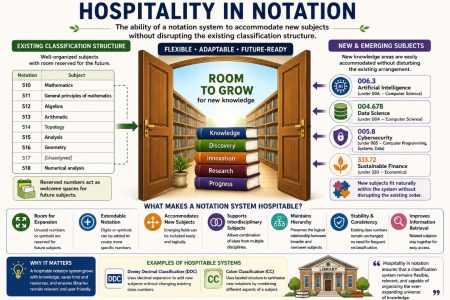
- Detailed and Granular Classification: UDC’s decimal notation system allows for a high level of precision and detail in organizing knowledge. Each subject is represented by a unique numerical code, which can be subdivided further into more specific categories. For example:
-
- 0: General works
- 5: Science
- 530: Physics
- 531: Mechanics
This hierarchical structure, with the option for continuous subdivisions, enables fine-grained categorization of subjects. UDC’s detailed classification is especially useful for libraries that need to organize vast collections of specialized materials, such as scientific journals, technical papers, and academic research. The ability to classify materials in increasing levels of specificity ensures that users can find the exact information they need with minimal effort.
-
- Adaptability and Extensibility: One of the most important features of UDC is its ability to evolve and adapt as new fields of knowledge emerge. Unlike many traditional classification systems, UDC is designed to be extensible, allowing for the addition of new categories and subdivisions as needed. As the body of human knowledge expands, UDC can integrate new subjects or research areas seamlessly. This adaptability is particularly valuable in rapidly changing fields such as technology, digital resources, and biotechnology, where new knowledge is constantly being produced. The UDC system’s continuous updates ensure that it remains relevant and up-to-date in the face of new challenges and developments.
- Effective Information Retrieval: The hierarchical structure of UDC ensures that information is organized logically, making it easier for users to locate the materials they need. The decimal classification system provides a clear path for navigating large collections, allowing users to start from broad categories and drill down to more specific topics. For example, a researcher looking for information on climate change can begin with the general category for Environmental Sciences and narrow their search down to more specific issues such as global warming or carbon emissions. This structure aids in efficient information retrieval and ensures that resources are easy to find and access. Whether in physical libraries or digital repositories, UDC provides a reliable framework for organizing and discovering information.
- International Collaboration and Resource Sharing: UDC’s widespread adoption and global applicability foster international cooperation among libraries and research institutions. Since UDC is used by thousands of libraries worldwide, it supports the exchange of knowledge and resources across borders. This facilitates collaborative research, inter-library loan systems, and digital repositories that allow for the seamless sharing of materials between institutions. Libraries in different parts of the world can catalog their resources using a common system, ensuring that users can access relevant information no matter where it is housed. This international collaboration helps to create a more connected and efficient global information infrastructure.
- Support for Various Information Types: UDC is not limited to classifying traditional print materials; it is also capable of handling digital resources, multimedia content, and electronic journals. As libraries transition to digital collections and online repositories, UDC remains a relevant tool for organizing a variety of information types. The system can categorize books, periodicals, e-books, websites, databases, and other digital media. This versatility ensures that UDC remains a valuable tool for managing modern library collections in both physical and digital formats.
- Comprehensive Coverage of Knowledge: UDC covers all fields of human knowledge, from general works to highly specialized subjects. The system provides a comprehensive framework for classifying everything from general encyclopedic knowledge to niche academic topics. This broad scope makes UDC an ideal system for managing a diverse range of materials, ensuring that every field of study, no matter how specific or broad, can be classified efficiently. Whether it’s history, philosophy, the sciences, or technology, UDC offers a consistent and comprehensive method for categorizing knowledge.
The Universal Decimal Classification (UDC) scheme offers numerous advantages that make it a powerful tool for organizing and managing the growing body of human knowledge. From its global standardization and multilingual support to its flexibility for multidisciplinary topics and its ability to provide detailed and granular classification, UDC ensures that libraries, research institutions, and information centers can organize materials efficiently and facilitate effective information retrieval. As a flexible, adaptable, and comprehensive system, UDC continues to be an essential framework for knowledge organization in an increasingly interconnected world.
Disadvantages of the UDC Scheme
While the Universal Decimal Classification (UDC) system has numerous advantages in organizing and classifying knowledge, there are also several challenges and limitations associated with its use. These disadvantages stem from the system’s complexity, regional variations, and the evolving landscape of information management. Below are some key disadvantages of the UDC system:
- Complexity and Learning Curve: One of the most significant disadvantages of UDC is its complexity. The system’s hierarchical structure, use of decimal notation, and inclusion of various symbols and punctuation marks can be difficult to learn and apply, especially for those who are new to classification. For libraries or institutions with limited resources, training staff to effectively use UDC can be a time-consuming and resource-intensive process. This complexity can lead to inconsistent application of the system, particularly in smaller libraries or those in developing regions with fewer technical resources.
- Cultural and Regional Bias: Despite its efforts to be universal, the UDC system may reflect Western-centric biases in some of its classifications. Certain subjects, particularly those related to non-Western cultures, indigenous knowledge, or traditional systems of thought, may not fit neatly into UDC’s framework. For example, topics related to traditional medicine or indigenous knowledge may not be adequately represented, leading to gaps or imbalances in the system. While UDC is adaptable and can be revised to reflect cultural diversity, the historical development of the system has led to some Eurocentric biases that may not fully account for different knowledge traditions.
- Inconsistencies in Application: UDC’s flexibility can sometimes lead to inconsistencies in its application across different institutions and regions. While the system is intended to be universal, its implementation can vary depending on the institution’s interpretation or regional adaptations. Different libraries may use slightly different approaches to classification, and this lack of consistency can create difficulties when attempting to share resources or collaborate across library networks. For example, one library might classify a topic under a specific number, while another might use a different code for the same subject, leading to confusion and challenges in inter-library loans or information retrieval.
- Difficulty in Maintaining and Updating: Maintaining and updating the UDC system can be a challenging task, particularly on a global scale. While the system is regularly updated to incorporate new fields of knowledge, these updates can sometimes lag behind rapidly changing fields such as technology, digital media, and biotechnology. Additionally, UDC’s detailed structure requires continuous monitoring and revision, which can be resource-intensive for institutions and may not always be applied uniformly across all libraries. As a result, discrepancies between older and newer versions of the system can lead to versioning issues, where different libraries or information centers use slightly outdated or incompatible versions of UDC.
- Limited Integration with Modern Technologies: UDC was originally developed for traditional library systems, and while it has been adapted to manage digital resources, it can sometimes struggle with integration into modern information technologies. The system’s reliance on hierarchical decimal notation and punctuation makes it less compatible with newer data management systems, such as those used in the semantic web or linked data technologies. As a result, it may not be as flexible or scalable as modern metadata schemes or machine learning-based classification systems that use more intuitive, keyword-driven approaches.
- Overwhelming Detail for Smaller Libraries: The level of detail and granularity in the UDC system can be an advantage in large collections, but for smaller libraries or those with limited resources, this level of classification can be overwhelming. Smaller institutions may find it difficult to justify the time and effort required to apply such a detailed classification system to relatively modest collections. The complexity of managing a highly detailed classification system may not be warranted for libraries with fewer resources or a narrower focus.
- Overlapping Categories and Confusion: UDC’s flexibility can sometimes result in overlapping categories or ambiguities in classification. Because the system allows for the combination of different fields and subcategories, there is a possibility that similar subjects could be classified under multiple codes, leading to redundancy or confusion. For example, the same subject might be categorized under both technology and medicine, leading to challenges in information retrieval when users are uncertain about which classification to use. This problem may be particularly challenging when dealing with rapidly evolving or highly interdisciplinary subjects, where the boundaries between different fields are not always clear.
- Potential for Inconsistent Hierarchies: Although UDC follows a hierarchical structure, the way in which subcategories are created and linked to broader categories can sometimes seem arbitrary or inconsistent. For instance, a field that is closely related to social sciences might be classified under philosophy or technology depending on the approach taken by the person creating the classification. These inconsistencies in hierarchical relationships can create difficulty for users trying to navigate the system, especially when dealing with complex or niche topics. This lack of uniformity in the arrangement of categories can lead to inefficiencies in finding relevant materials.
- Lack of Visual Appeal and User-Friendliness: While the UDC system is effective for organizing knowledge, its reliance on numeric codes and symbols can make it less visually appealing or intuitive compared to modern classification systems. Unlike more user-friendly, keyword-based systems that use tags or simple search functions, UDC’s reliance on decimal notation and punctuation can seem overly complex and intimidating to users who are not familiar with the system. This can make the system less accessible to non-experts, particularly in environments where simplicity and ease of use are priorities.
While the Universal Decimal Classification (UDC) system offers a wide range of advantages regarding global applicability, flexibility, and precision, it also comes with several disadvantages that can make it challenging to use, especially in smaller institutions or regions with distinct cultural contexts. The system’s complexity, inconsistencies in application, and difficulty in integrating with modern technologies are some of the key limitations that libraries and information centers must navigate. Understanding these disadvantages is crucial for institutions considering the implementation of UDC, as it helps ensure that the system is used effectively while also addressing its challenges.
References:
- RAJU (AA N). Universal decimal classification (IME-1993): Theory and practice: A self-instructional manual. 2007. Ess Ess Publications; New Delhi. p-4- 9
- SARDANA (JL) and SEHGAL (RL). Universal decimal classification: Structure and methodology. 1983. Ess Ess Publication; New Delhi. p 1.
- KRISHAN KUMAR. Theory of classification. 1993. Vikas Publishing; New Delhi. p1.
- SHARMA (C D). Use of libraries: A guide to better use of libraries and their resources. 1978. Metropolitan Book; New Delhi. p-120.
- SHARMA (C D). Op. cit., p 121.
- KRISHAN KUMAR. Op. cit., p 4.
- INDIRA GANDHI NATIONAL OPEN UNIVERSITY (IGNOU). Unit 2: Needand purpose of library classification. IGNOU; New Delhi. p 26.
- DUTTA (Dwijendranath). Library classification: Theory and practice. 1962. The Western Book Depot; Nagpur. p 48.
- RAJU (Addepali Appala Narasimha). Dewey decimal classification (DDC 20): Theory and practice: A practical and self instructional manual. 1995. T.R. Publications; Madras. p 4.
- CHOWDHURY (G G). Introduction to modern information retrieval. Ed. 3. 2004. Facet Publishing; London. p 89.