
Library Classification System
A library classification system is a methodical approach to organizing library resources- including books, journals, and digital materials- into structured categories based on their subject matter. This system enables easy access, arrangement, and retrieval of library items. It serves as the intellectual foundation for library organization by grouping related subjects together and separating unrelated ones in a logical order. Each item in the library is assigned a unique notation or call number, which not only indicates its subject but also determines its specific location on the shelves. This organized arrangement allows users to browse efficiently and find materials without confusion. Furthermore, a classification system improves both physical and digital information retrieval by maintaining consistency and order within the collection.
Widely used systems, such as the Dewey Decimal Classification, Library of Congress Classification, and Colon Classification, demonstrate how knowledge can be systematically organized to support learning, research, and effective library management.
Types of Library Classification Systems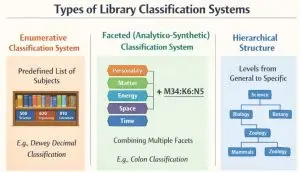
Library classification is a crucial process that organizes knowledge into a structured and easily accessible format. Over time, various types of classification systems have been developed to address the increasing complexity of knowledge and user needs. These systems differ in their approaches, structures, and flexibility, but they all aim to bring order to information and enhance efficient retrieval. Broadly speaking, the main types of library classification systems include enumerative, faceted (analytico-synthetic), and hierarchical classification systems.
1. Enumerative Classification System
An enumerative classification system is a type of library classification in which all subjects and their possible subdivisions are listed in advance within a predefined schedule. Each topic is assigned a specific notation. In this system, the classifier selects the most suitable class number directly from the existing list rather than creating one from scratch. This approach emphasizes simplicity and ease of use, as users do not need to analyze subjects into their components.
One of the most well-known examples of this system is the Dewey Decimal Classification, which organizes knowledge into a structured hierarchy of main classes and divisions. While enumerative classification is practical and widely used in libraries due to its straightforward approach, it has certain limitations. For instance, it may not effectively accommodate new or interdisciplinary subjects since all topics must be anticipated and included in advance. Despite these limitations, it remains a popular and efficient system for organizing library collections, especially in general and academic libraries.
2. Faceted (Analytico-Synthetic) Classification System
A faceted (analytico-synthetic) classification system is a method for organizing library materials where a subject is first analyzed into its fundamental components, known as facets. These facets are then synthesized or combined to create a complete class number. Unlike traditional classification systems that rely on a fixed list of subjects, this approach allows classifiers to break down complex topics into basic elements such as personality, matter, energy, space, and time. This method enables the construction of a notation that accurately represents the subject.
Faceted classification offers a high degree of flexibility and precision, making it especially suitable for complex, interdisciplinary, or emerging fields of knowledge. A well-known example of this system is the Colon Classification, developed by S. R. Ranganathan, which utilizes the PMEST formula to systematically analyze subjects.
Although applying faceted classification requires more skill and understanding than enumerative systems, it is highly adaptable and aligns well with modern information retrieval systems, particularly in digital and online environments.
3. Hierarchical Classification System
A hierarchical classification system is a method for organizing knowledge in a structured, tree-like format where subjects are arranged from general to specific levels. In this system, broad categories are subdivided into smaller, more specialized subcategories, creating a clear relationship between classes and subclasses. Each level of the hierarchy represents a more focused aspect of the subject, allowing users to understand how different topics are interconnected.
For example, a general category like “Science” can be divided into “Biology,” which can be further broken down into “Zoology,” and then into specific topics such as “Mammals.” This logical progression makes hierarchical classification easy to navigate and useful for browsing library collections.
Well-known systems like the Dewey Decimal Classification and the Universal Decimal Classification utilize hierarchical structures to organize knowledge. While this system offers clarity and a systematic arrangement, it may sometimes struggle to accurately represent complex or interdisciplinary subjects that do not fit neatly into a single hierarchical path.
In conclusion, understanding the main types of library classification systems is essential for effectively organizing knowledge and ensuring efficient information retrieval. The enumerative classification system simplifies the process with predefined subject listings, making it practical for many libraries. In contrast, the faceted (analytico-synthetic) classification system, pioneered by S. R. Ranganathan, offers flexibility and precision in representing complex and interdisciplinary subjects. Additionally, the hierarchical structure is crucial for arranging knowledge from general to specific levels, helping users navigate library collections in a logical manner. Together, these approaches form the foundation of modern library classification, enabling libraries to adapt to both traditional collections and evolving digital environments. A clear understanding of these systems not only improves library organization but also enhances access to information, ultimately contributing to effective learning, research, and knowledge dissemination.
