Information Literacy and Its Importance in Higher Education
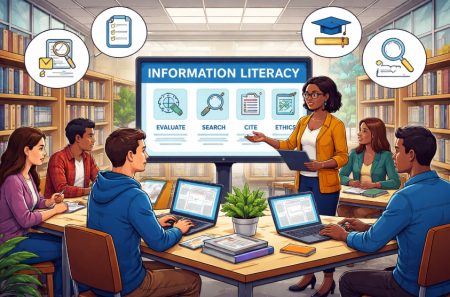
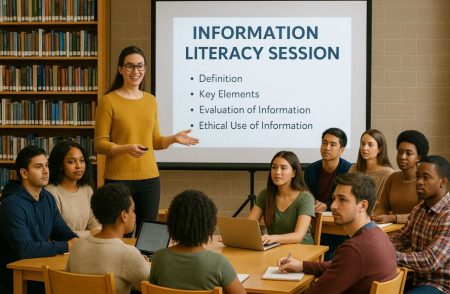
Information literacy refers to the ability to recognize when information is needed and to locate, evaluate, use, and communicate that information effectively and ethically. It goes beyond basic searching skills and encompasses critical thinking, analytical judgment, and responsible use of information across various formats, including books, academic journals, databases, and digital resources. An information-literate individual can formulate effective research questions, select appropriate information sources, assess the credibility and relevance of retrieved information, and apply it meaningfully to solve academic or real-world problems while adhering to ethical standards such as proper citation and avoidance of plagiarism.
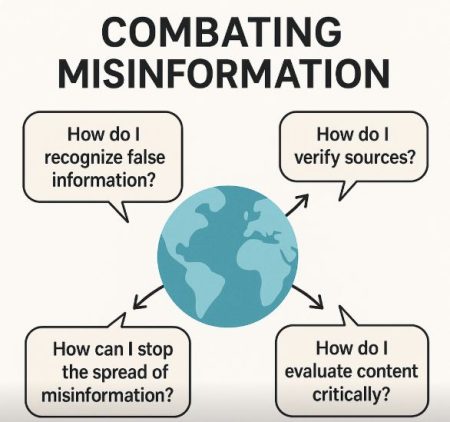
In higher education, information literacy is essential because students are constantly required to engage with complex academic materials, conduct independent research, and produce evidence-based assignments. Without strong information literacy skills, students may struggle to navigate vast amounts of information, differentiate scholarly sources from unreliable content, or apply information critically in their coursework. Information literacy empowers students to become independent learners, enhances their academic performance, and supports the development of lifelong learning skills. Moreover, in an era of digital information overload and misinformation, information literacy is crucial for enabling students to make informed decisions, uphold academic integrity, and develop the research competencies necessary for professional and scholarly success.
Role of Information Literacy in Supporting Lifelong Learning and Academic Success
Information literacy plays a vital role in supporting both lifelong learning and academic success by equipping individuals with the skills needed to locate, evaluate, and apply information effectively in changing learning and professional environments. In academic settings, students who possess strong information literacy skills are better able to understand assignment requirements, formulate clear research questions, and identify appropriate scholarly sources. For example, a student preparing a research paper can use academic databases to retrieve peer-reviewed articles, evaluate their relevance and credibility, and synthesize findings to construct well-supported arguments. These abilities directly contribute to higher-quality coursework, improved grades, and greater confidence in academic research.
Beyond formal education, information literacy supports lifelong learning by enabling individuals to continuously update their knowledge and adapt to new information demands throughout their lives. As technologies, professions, and societal needs evolve, individuals must independently seek reliable information to make informed decisions. For instance, a graduate entering a professional field may need to learn new policies, technologies, or best practices by critically evaluating online resources, professional reports, and research publications. Information literacy helps individuals avoid misinformation, assess the reliability of sources, and apply information responsibly in real-world contexts. By fostering critical thinking, ethical information use, and independent learning, information literacy empowers learners to remain intellectually curious, adaptable, and informed long after their formal education has ended.
Core Competencies of an Information-Literate Student
An information-literate student demonstrates a range of essential competencies that enable effective engagement with information in academic and professional contexts. These core competencies include the following:
- Ability to Identify Information Needs: An information-literate student can clearly recognize when information is required and define the scope of a research problem or question. For example, the student can narrow a broad topic into a focused research question and determine which types of information—such as scholarly articles, books, statistics, or primary sources—are needed.
- Effective Information Searching Skills: The student can locate information efficiently using appropriate tools and search strategies. This includes using library catalogs, academic databases, and search engines; selecting relevant keywords; and refining searches with filters and advanced search techniques.
- Critical Evaluation of Information Sources: An information-literate student can assess the credibility, accuracy, relevance, and timeliness of information. They are able to distinguish between scholarly and non-scholarly sources, identify authoritative authors, and recognize bias or misinformation.
- Ability to Use Information Effectively: This competency involves synthesizing information from multiple sources and applying it meaningfully to academic tasks. The student can integrate evidence into assignments, research papers, or presentations to support arguments and draw informed conclusions.
- Ethical and Responsible Use of Information: An information-literate student understands academic integrity and uses information ethically by properly citing sources and avoiding plagiarism. They respect intellectual property rights and follow recognized citation styles.
- Critical Thinking and Analytical Skills: The student can analyze information, compare different viewpoints, and evaluate arguments logically. This allows them to move beyond simple information gathering to a deeper understanding and knowledge creation.
- Ability to Learn Independently: Information-literate students are self-directed learners who can adapt to new information needs. They are capable of updating their knowledge, learning new tools, and applying information skills in both academic and real-world situations.
Together, these competencies define an information-literate student and support academic success, informed decision-making, and lifelong learning.
Why Is Library Instruction Considered a Key Component of Information Literacy Development?
Library instruction is considered a key component of information literacy development because it provides students with structured guidance on how to effectively navigate, evaluate, and use information in an increasingly complex information environment. Through planned instruction sessions, workshops, and hands-on training, libraries help students understand how information is organized, how academic resources differ from general web content, and how to access credible scholarly materials. For example, library instruction teaches students how to use library catalogs and subject-specific databases, develop effective search strategies, and identify peer-reviewed sources, enabling them to move beyond basic searching and engage in more meaningful academic research.
Library instruction plays a crucial role in developing students’ critical thinking and ethical information-use skills. Librarians guide students in evaluating the reliability, relevance, and authority of information sources and in understanding issues related to plagiarism, citation, and academic integrity. Instructional support also helps students apply information literacy skills across disciplines by aligning library sessions with course requirements and research assignments. By offering continuous support and skill-based learning opportunities, library instruction empowers students to become independent, confident, and responsible information users, making it an essential foundation for information literacy development and lifelong learning.
How Structured Library Instruction Contributes to Improving Students’ Information Literacy Skills
In today’s information-rich academic environment, students are expected to locate, evaluate, and use information effectively for assignments, research projects, and lifelong learning. However, many students enter higher education with limited experience in using scholarly resources or applying critical evaluation skills. Structured library instruction plays a vital role in addressing this gap by systematically developing students’ information literacy skills through planned, goal-oriented, and learner-centered educational activities.
- Building a Strong Foundation for Information Access: Structured library instruction introduces students to the academic information landscape in a logical and progressive manner. Through orientation sessions, course-integrated workshops, and guided demonstrations, students learn how information is organized within libraries, including the use of catalogs, classification systems, and academic databases. This structured exposure helps students understand where to find reliable scholarly information instead of relying solely on general internet searches. As a result, students become more confident and efficient in accessing appropriate resources for their academic needs.
- Enhancing Effective Searching Skills: One of the key contributions of structured library instruction is the development of effective searching strategies. Librarians teach students how to identify keywords, use subject terms, apply Boolean operators, and refine searches using filters such as publication date, document type, and peer-review status. These skills enable students to retrieve relevant and high-quality information while avoiding information overload. Over time, students learn to adapt their search strategies based on different research topics and disciplines, strengthening their overall information literacy competence.
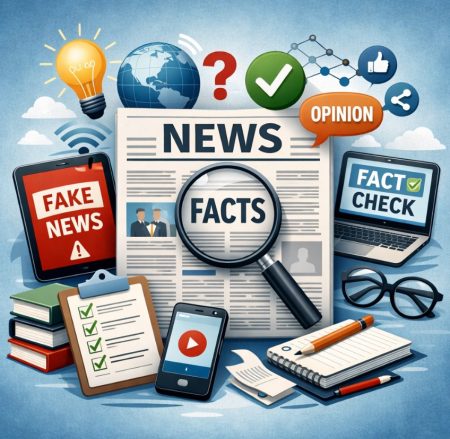
- Developing Critical Evaluation Abilities: Structured instruction also emphasizes the critical evaluation of information sources. Students are guided to assess the authority, accuracy, relevance, and timeliness of information, which is essential in an era of misinformation and unverified online content. Through examples and practice exercises, students learn to distinguish scholarly articles from non-academic materials and to identify bias or unsupported claims. This evaluative ability empowers students to make informed choices about which sources to use in their academic work.
- Promoting Ethical and Responsible Use of Information: Another significant contribution of structured library instruction is its focus on ethical information use. Students are taught the importance of academic integrity, proper citation practices, and responsible use of intellectual property. Instruction on referencing styles and plagiarism awareness helps students understand how to acknowledge sources correctly and avoid unintentional misconduct. These lessons not only improve the quality of students’ academic work but also foster responsible scholarly behavior.
- Supporting Independent and Lifelong Learning: By progressively building information literacy skills, structured library instruction encourages students to become independent learners. As students gain confidence in searching, evaluating, and applying information, they become less dependent on step-by-step guidance and more capable of conducting research on their own. These skills extend beyond academic life, enabling graduates to continuously learn, adapt, and make informed decisions in professional and personal contexts.
Structured library instruction significantly improves students’ information literacy skills by providing systematic guidance, practical training, and the development of critical thinking. Through carefully designed instructional programs, libraries help students navigate academic resources, evaluate information critically, and use information ethically and effectively. Ultimately, structured library instruction not only enhances academic performance but also prepares students for lifelong learning in an increasingly complex information environment.
Role of Academic Librarians in Strengthening Students’ Research Competencies
Academic librarians play a crucial role in strengthening students’ research competencies by guiding them through the complex process of finding, evaluating, and using scholarly information effectively. As information specialists, librarians help students understand how academic knowledge is produced, organized, and accessed across disciplines. Through library orientations, research workshops, and course-integrated instruction, librarians introduce students to library catalogs, academic databases, and research tools, enabling them to move beyond basic web searching and engage with high-quality scholarly resources.
In addition to teaching access skills, academic librarians actively develop students’ critical thinking and evaluative abilities. They train students to assess the credibility, relevance, and authority of information sources, helping them distinguish peer-reviewed research from non-scholarly or unreliable content. Librarians also support students in formulating research questions, refining search strategies, and synthesizing information from multiple sources. Through one-on-one research consultations and personalized guidance, librarians address individual research challenges and foster students’ confidence in conducting independent research.
Academic librarians promote ethical and responsible research practices by educating students about citation standards, academic integrity, and plagiarism avoidance. They introduce reference management tools and demonstrate proper citation techniques, ensuring that students acknowledge sources accurately and responsibly. By combining instructional support, individualized assistance, and ongoing research guidance, academic librarians significantly enhance students’ research competencies, contributing to their academic success and preparing them for lifelong learning and professional research activities.
How Can Library Instruction Bridge the Gap Between Information Access and Effective Information Use?
Library instruction plays a crucial role in bridging the gap between information access and effective information use by transforming students from basic information retrievers into critical and purposeful users of information. Although academic libraries provide extensive access to books, journals, and online databases, many students struggle to use these resources effectively without proper guidance. Through structured library instruction, students learn how to interpret assignment requirements and identify appropriate information needs. For example, instead of downloading random articles from the internet, students are taught how to select peer-reviewed journal articles from subject-specific databases that directly support their research topics.
In addition, library instruction focuses on helping students apply information meaningfully through evaluation and synthesis. Librarians guide students in assessing the credibility, relevance, and timeliness of sources, such as distinguishing scholarly research articles from opinion-based web content. For instance, during hands-on training sessions, students may compare multiple sources on the same topic and decide which ones are suitable for academic use. Instruction also emphasizes ethical use of information by teaching proper citation practices and strategies to avoid plagiarism. As a result, students learn not only how to access information but also how to integrate it into assignments, research papers, and presentations in a responsible and effective manner.
How Hands-On Library Training Enhances Students’ Critical Thinking Abilities
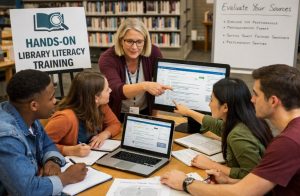 In higher education, critical thinking is a fundamental skill that enables students to analyze information, evaluate arguments, and make informed decisions. While theoretical instruction introduces students to concepts, hands-on library training plays a particularly powerful role in strengthening critical thinking by actively engaging students in the research process. Through practical, experience-based learning, library training encourages students to question information, compare sources, and apply judgment rather than passively consuming content.
- Encouraging Active Engagement with Information: Hands-on library training places students in real research situations where they must interact directly with information resources. Instead of simply being told how to search, students practice locating books, articles, and data using catalogs and academic databases. For example, during a practical session, students may be asked to search for sources on a specific topic and refine their results based on relevance or credibility. This active engagement requires students to think critically about their search choices, keywords, and filters, fostering analytical thinking from the very beginning of the research process.
- Developing Source Evaluation Skills: One of the strongest contributions of hands-on library training to critical thinking is its focus on evaluating information sources. Students learn to assess authorship, publication type, research methodology, and bias through guided exercises. For instance, librarians may ask students to compare a peer-reviewed journal article with a popular web article on the same topic and identify differences in reliability and academic value. Such activities train students to question the quality of information rather than accepting it at face value, a core element of critical thinking.
- Promoting Problem-Solving and Decision-Making: Hands-on training often involves problem-solving tasks that require students to make informed decisions. When students encounter challenges such as too many search results, conflicting information, or limited access to full texts, they must decide how to adjust their strategies. Librarians guide students to think logically, test alternative approaches, and evaluate outcomes. This process strengthens students’ ability to analyze problems, weigh options, and select the most effective solutions—skills that are central to critical thinking both inside and outside the classroom.
- Enhancing Information Synthesis and Interpretation: Critical thinking is not only about finding information but also about interpreting and synthesizing it. Hands-on library training encourages students to combine information from multiple sources and identify patterns, similarities, or contradictions. For example, students may be asked to summarize findings from several articles and determine how they collectively support or challenge a research question. This practice helps students move beyond surface-level understanding and develop deeper analytical insights.
- Building Confidence and Independent Thinking: By repeatedly practicing research tasks in a guided environment, students gain confidence in their ability to think independently. Hands-on library training reduces reliance on memorization or step-by-step instructions and encourages students to ask questions, test ideas, and justify their choices. As confidence grows, students become more willing to engage critically with information, challenge assumptions, and develop their own informed perspectives.
Hands-on library training significantly enhances students’ critical thinking abilities by promoting active learning, source evaluation, problem-solving, and information synthesis. Through practical engagement with academic resources, students learn to question information, analyze evidence, and make reasoned decisions. These skills not only improve academic performance but also prepare students to navigate complex information environments and become thoughtful, independent learners throughout their lives.
How Library Instruction Helps Students Identify Their Information Needs
Library instruction plays a critical role in helping students clearly identify their information needs by guiding them through the early stages of the research process. Many students begin academic tasks with broad or unclear topics and are often unsure about what type of information is required. Through structured library instruction, librarians help students interpret assignment requirements, understand research objectives, and break down topics into manageable and focused research questions. For example, instead of searching for general information on a broad subject, students learn how to narrow their focus by identifying key concepts, defining the scope of their study, and determining whether they need background information, scholarly articles, statistical data, or primary sources.
Library instruction also encourages reflective and critical thinking about information gaps. Librarians use guided exercises, discussions, and practical examples to help students assess what they already know and what additional information is needed to support their academic work. For instance, during hands-on sessions, students may be asked to draft a research question and then identify specific keywords and information types needed to answer it. This process helps students become more purposeful and strategic in their information-seeking behavior. By developing the ability to recognize and articulate their information needs, library instruction enables students to conduct more focused research, select appropriate sources, and ultimately produce higher-quality academic work.
What Instructional Methods Are Most Effective for Teaching Information Literacy?

Information literacy is a foundational skill in higher education, enabling students to locate, evaluate, and use information effectively and ethically. Because students come from diverse academic backgrounds and possess varying levels of research experience, no single teaching method is sufficient on its own. The most effective information literacy instruction combines multiple instructional approaches that actively engage learners, address real academic needs, and reinforce skills through practice and reflection.
- Active Learning–Based Instruction: Active learning is widely recognized as one of the most effective methods for teaching information literacy. Instead of passively listening to lectures, students participate in hands-on activities such as database searching, source evaluation exercises, and group problem-solving tasks. For example, students may be asked to compare scholarly and non-scholarly sources or refine search strategies based on research questions. This approach encourages critical thinking, improves retention, and helps students apply information literacy skills directly to their academic work.
- Course-Integrated Library Instruction: Instruction that is embedded within academic courses is particularly effective because it aligns information literacy skills with specific assignments and learning outcomes. When library sessions are integrated into coursework, students immediately see the relevance of information literacy to their studies. For instance, a library session scheduled before a research paper deadline allows students to apply search and evaluation techniques directly to their assignments, reinforcing learning through immediate application.
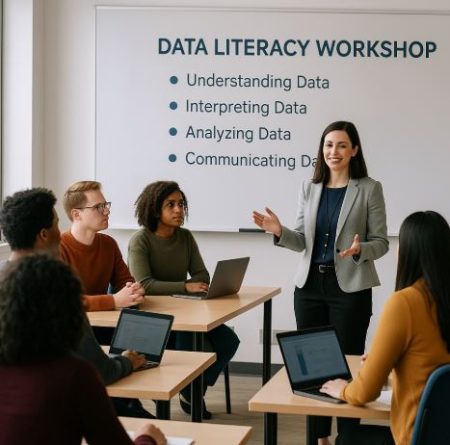
- Workshops and Hands-On Training Sessions: Workshops provide focused and practical instruction on specific information literacy skills, such as database searching, citation management, or plagiarism awareness. These sessions often include demonstrations followed by guided practice, allowing students to learn by doing. Workshops are especially effective for building confidence and helping students overcome common research challenges in a supportive learning environment.
- One-to-One Research Consultations: Individual research consultations are highly effective for addressing personalized information needs. During these sessions, librarians can tailor instruction to a student’s research topic, academic level, and discipline. Personalized guidance helps students refine research questions, improve search strategies, and select appropriate sources, making this method particularly valuable for advanced research projects and thesis work.
- Online Tutorials and Learning Guides: Online tutorials, videos, and research guides support flexible and self-paced learning. These resources allow students to revisit concepts as needed and are especially useful for reinforcing skills introduced during in-person instruction. Well-designed online materials can cover topics such as database navigation, source evaluation, and citation practices, extending information literacy instruction beyond the classroom.
- Collaborative and Discussion-Based Learning: Group discussions and collaborative activities encourage students to share perspectives, question assumptions, and evaluate information collectively. For example, students may work in groups to analyze different sources on the same topic and discuss their strengths and weaknesses. This method promotes deeper understanding and helps students develop analytical and communication skills.
The most effective instructional methods for teaching information literacy are those that are interactive, contextual, and learner-centered. Active learning, course-integrated instruction, hands-on workshops, individualized consultations, and supportive online resources together create a comprehensive instructional framework. By combining these methods, libraries can effectively equip students with the critical information literacy skills needed for academic success and lifelong learning.
How Library Instruction Influences Students’ Confidence in Conducting Academic Research
Library instruction significantly influences students’ confidence in conducting academic research by providing them with the knowledge, skills, and practical experience needed to navigate the research process effectively. Many students initially feel overwhelmed by academic assignments that require scholarly sources, unfamiliar databases, and strict citation rules. Through structured library instruction, students learn how to use library catalogs, academic databases, and research tools step by step, which reduces anxiety and uncertainty. For example, when students are guided on how to locate peer-reviewed journal articles or refine search results using appropriate keywords and filters, they gain a clearer sense of control over the research process.
Library instruction also builds confidence by strengthening students’ critical evaluation and decision-making abilities. Librarians teach students how to assess the credibility, relevance, and quality of information sources, helping them trust their own judgment when selecting materials for assignments. Hands-on practice, such as evaluating multiple sources on the same topic or comparing scholarly articles with general web content, reinforces students’ understanding and self-assurance. As students become more familiar with academic research conventions—such as citation practices and ethical information use—they feel more prepared to complete assignments independently.