
Online Information Retrieval (OIR) refers to the process of locating and accessing information stored on digital platforms, such as the Internet or databases, using various search tools, algorithms, and technologies. Unlike traditional information retrieval, which may rely on physical archives or printed materials, OIR primarily operates in a digital environment where vast amounts of data are stored in a variety of formats, including text, images, and multimedia. It is powered by search engines, databases, and repositories that use sophisticated indexing techniques, query processing, and ranking algorithms to deliver relevant results to users. One of the central aspects of online information retrieval is the ability to effectively navigate through vast and often unstructured information, such as web pages, academic papers, and multimedia content. It involves understanding the user’s intent through search queries and providing the most relevant and accurate information in response. Over time, advancements in machine learning, natural language processing, and artificial intelligence have significantly enhanced the precision and efficiency of OIR systems, allowing them to evolve from simple keyword searches to more complex and context-aware retrieval processes. As the internet continues to expand, the field of online information retrieval is critical for ensuring that users can efficiently access the information they need amidst the growing digital landscape.
What is Online Information Retrieval?
Online Information Retrieval (OIR) is the process of searching for, accessing, and retrieving information stored in digital formats across various platforms like the Internet, cloud services, or digital databases. Unlike traditional methods of information retrieval, which often involve manually searching through physical materials such as books, archives, or printed journals, OIR utilizes digital tools such as search engines, online databases, and repositories. These systems index large amounts of data and make it searchable through queries, typically entered by users into search engines or database search interfaces. OIR systems are designed to process complex queries and return results in real time, offering immediate access to a broad range of multimedia content, including text, images, videos, and datasets.
The primary difference between OIR and traditional methods lies in the medium and scale of information access. Traditional retrieval methods are typically limited by physical constraints, such as the availability of materials in a specific location or the time required to manually search through extensive collections. In contrast, OIR provides access to an exponentially larger amount of information that is continually updated, enabling users to find results almost instantly from a global pool of data. Moreover, OIR systems rely on algorithms and artificial intelligence to rank and filter results based on relevance, enhancing the efficiency and accuracy of searches. Traditional methods, on the other hand, generally lacked such automated features, often requiring human judgment to identify relevant sources.
How Online Information Retrieval Works in Terms of Search Engines and Databases
Online Information Retrieval (OIR) is a fundamental process that powers the way we search for and access digital content across the internet. This process is typically carried out using search engines and online databases, which employ sophisticated algorithms to organize, index, and retrieve information quickly and accurately. The functioning of these systems can be broken down into several key stages: indexing, querying, ranking, and presenting results. These stages are integral to both search engines and databases, though each system operates with its specific characteristics.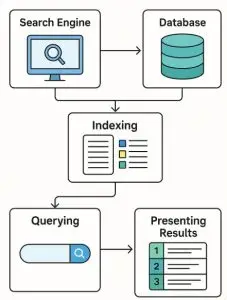
- Indexing:The first step in online information retrieval is indexing, which is essential for both search engines and databases. Indexing involves the systematic cataloging of information in a way that allows for fast and efficient retrieval. In search engines, indexing refers to the process of crawling the web to discover new content and storing this content in a database-like structure known as an index. This index is made up of a list of words, phrases, and metadata that are associated with web pages, images, videos, and other online content. For example, when Google crawls the internet, it collects information from various websites and organizes it into an index based on keywords and phrases that are present on each page.
Similarly, databases, whether academic, government, or commercial, index information stored within them by creating structured metadata that allows for easy searching. Database indexes are more likely to be organized based on predefined categories, such as article titles, authors, abstracts, or publication dates. In contrast to search engines, which index large volumes of unstructured content from the web, databases often handle more structured, curated datasets. - Querying:Once information is indexed, users can begin querying the system to retrieve relevant content. A query is typically a search term or a combination of search terms that a user enters into a search engine or database interface. For search engines, these queries are processed against the indexed web content to identify matching results. Search engines utilize natural language processing (NLP) techniques to understand the meaning behind the search terms and to interpret variations in the phrasing of queries. For instance, if a user searches for “best ways to improve study habits,” the search engine can interpret the intent and return results related to study tips, techniques, and resources.
In online databases, queries are often more structured and specific. Users may search for academic articles, books, or reports based on specific fields such as title, author, keywords, or publication date. Databases often allow for more advanced filtering options, such as Boolean search logic (AND, OR, NOT) or proximity searching, which enables users to refine their queries and obtain more targeted results. - Ranking:After a query is submitted, both search engines and databases use ranking algorithms to determine the order in which search results will be presented. Ranking is an essential component of the retrieval process, as it ensures that the most relevant and authoritative results appear first. In search engines, ranking is influenced by numerous factors, including the quality and relevance of the content, the number of external links (backlinks) pointing to a page, the page’s load speed, and user engagement signals. Search engines like Google employ complex machine learning models to continuously improve the accuracy of their ranking algorithms, which often include factors like context, search history, and user location.
For databases, ranking is often based on predefined criteria, such as how closely a document matches the user’s search query or the relevancy of certain keywords within a document. While the ranking algorithms in databases may not be as complex as those in search engines, they are still designed to return the most relevant academic or scholarly materials based on the user’s search terms. - Presenting Results:Finally, once the search results are ranked, they are presented to the user. In search engines, results are typically shown in a list, with the most relevant results at the top, often accompanied by snippets or previews that provide brief information about the content. For example, when searching for a specific topic, Google may display a list of relevant web pages, along with titles, URLs, and a short excerpt from each page that matches the search query.
In online databases, results are often presented in a more structured format, with options to sort or filter results based on different criteria such as publication date, author, or relevance. In academic databases like PubMed or JSTOR, users can view citations, abstracts, and links to full-text articles. Many databases also provide tools for saving and exporting search results, which can be helpful for research purposes.
The online information retrieval process in both search engines and databases is an intricate system that involves indexing, querying, ranking, and presenting results. While search engines are designed to handle vast amounts of unstructured web content and return quick, context-aware results, online databases tend to focus on more structured, specialized information, often tailored to specific academic, professional, or research needs. Both systems, however, leverage advanced algorithms and indexing techniques to ensure that users can efficiently retrieve relevant and reliable information. As technology continues to evolve, so too will the sophistication of online information retrieval systems, improving the user experience and the accuracy of search results across the digital landscape.
Main Components of an Online Information Retrieval System
An online information retrieval (OIR) system is a complex architecture designed to efficiently access and present relevant data from vast digital repositories. These systems are essential for searching and retrieving information from various sources such as the Internet, academic databases, and digital libraries. The key components of an OIR system work together to ensure that users can easily search, retrieve, and navigate information, even in the vast and diverse digital environment. The main components of an online information retrieval system include:
- Data Collection and Crawling:The first component in an OIR system is data collection, which often begins with the process of crawling. Crawling refers to the automatic discovery and gathering of information from multiple sources on the web or from specialized databases. For search engines, this process involves web crawlers (also known as spiders or bots) that systematically navigate through the internet, following hyperlinks from one webpage to another and collecting information. In academic databases, the process may involve importing data from journals, research papers, and institutional repositories. The collected data forms the foundation for indexing and querying, which are essential for retrieving relevant results.
- Indexing:Indexing is a critical component that allows OIR systems to store and organize large amounts of information. Once data is collected through crawling, it is processed and stored in an index. An index is a database that links terms or keywords to specific documents or resources. The indexing process involves breaking down content into smaller components such as individual words, phrases, or metadata (e.g., titles, authors, abstracts). In search engines, indexing ensures that when a user types a query, the system can quickly identify relevant documents. In academic databases, indexing allows for efficient searches based on criteria like author name, publication date, and keywords.
For example, when Google crawls a webpage, it extracts key terms from the text and assigns them to the index. This allows the search engine to match search queries with documents that contain the most relevant keywords. In specialized databases, indexing may also involve categorizing information based on predefined subject headings or classifications, making it easier to find specific types of content, such as academic articles in particular fields. - Query Processing:Once the data has been indexed, the next crucial step in the OIR system is query processing. Query processing refers to how the system interprets and processes user input, typically in the form of search terms or phrases. When a user submits a search query, the system must analyze it to understand the user’s intent. This process involves several sub-components:
-
- Tokenization: Breaking the query into smaller units, such as individual words or phrases.
- Stemming and Lemmatization: Reducing words to their base or root form. For example, “running” might be reduced to “run” to ensure that all variations of a word are accounted for.
- Query Expansion: Enhancing the search query by adding synonyms or related terms to broaden the scope of the search.
Effective query processing ensures that the system understands not just the keywords, but also the context in which they are used, providing more relevant results. For instance, when a user enters the phrase “best way to study,” the system should recognize that the user is looking for tips or methods for studying, not just the word “study” in isolation.
-
- Ranking Algorithms:Ranking is one of the most vital aspects of an OIR system. After the system processes the query, it uses ranking algorithms to determine the most relevant documents to return. These algorithms consider various factors, including:
-
- Relevance of Content: How closely the content of a document matches the query terms.
- Authority and Popularity: In search engines like Google, the number and quality of external links (backlinks) pointing to a document are used to determine its authority.
- User Engagement: In search engines, user interactions, such as clicks, shares, and time spent on a page, can signal the quality of a document.
Search engines like Google utilize complex algorithms such as PageRank, which evaluates the relationships between pages through backlinks, and machine learning models to continually improve the ranking of results. In academic databases, ranking may be based on citation counts, relevance to the search terms, or the credibility of the source.
-
- Retrieval and Presentation of Results:Once the documents are ranked, the retrieval component displays the results to the user. This is typically done in a list format, where the most relevant results appear at the top, along with brief snippets or descriptions that give the user an idea of the content. In search engines, these results are often accompanied by additional features, such as related searches, maps, or advertisements, to enhance the user experience.
In academic databases, the presentation may include more detailed information, such as article titles, author names, publication dates, and abstracts. Many databases also provide options for filtering results based on categories like publication type, subject area, or date range. This allows users to quickly narrow down their search to find the most relevant sources. - User Interface (UI) and User Experience (UX):The User Interface (UI) and User Experience (UX) design are critical for making the OIR system accessible and user-friendly. The UI is the part of the system that users interact with, such as the search bar, filters, and buttons for submitting queries. A clean, intuitive UI is essential for ensuring that users can easily enter their search terms and navigate through the results.
The UX refers to the overall experience a user has while interacting with the system. An optimal UX is one that minimizes effort for the user and maximizes satisfaction. Fast load times, relevant search suggestions, easy navigation, and responsive design are key aspects of a good UX in an OIR system. - Relevance Feedback and Refinement:Some OIR systems incorporate relevance feedback mechanisms, which allow users to provide input on the quality of the search results. This can be done explicitly (e.g., by marking a result as relevant or irrelevant) or implicitly (e.g., through user behavior like clicking on results). This feedback is then used to refine future searches and improve the accuracy of results.
For instance, if a user consistently clicks on articles about machine learning when searching for technology topics, the system may adjust its ranking algorithms to prioritize machine learning-related content in subsequent searches. This feedback loop is essential for making the system smarter and more responsive to user needs over time.
An online information retrieval system is a sophisticated combination of technologies and processes that work together to enable efficient searching and retrieval of digital information. From crawling and indexing to query processing and result ranking, each component plays a crucial role in ensuring that users can quickly and accurately access the information they need. As digital content continues to grow at an exponential rate, the development of advanced OIR systems will remain essential for navigating the vast digital landscape and providing users with the most relevant and reliable results.
The Role of Indexing in Online Information Retrieval
Indexing plays a pivotal role in online information retrieval (OIR) systems by organizing and categorizing vast amounts of data to make it accessible and searchable. Without indexing, retrieving relevant information from the enormous digital content available would be an arduous and time-consuming task. The primary function of indexing is to enable systems to quickly locate and retrieve documents or web pages that match a user’s query. It begins with the process of crawling, where automated bots collect data from websites, academic articles, or other digital resources. Once collected, the content is broken down into smaller units, known as tokens, such as individual words or terms. Techniques like stemming and lemmatization are applied to reduce words to their root forms, ensuring that variations of the same word are treated as identical, thereby improving search accuracy.
Indexing also involves the removal of common stop words like “the” and “and,” which do not add meaningful value to search queries. Metadata, such as titles, authors, publication dates, and keywords, is extracted and stored to further enhance the indexing process. The indexed information is then organized into a structure called an inverted index, which maps each term to the documents in which it appears. This allows the system to rapidly access relevant documents when a user submits a query. Different types of indexing methods are employed depending on the nature of the data. Full-text indexing stores every word in the document, ideal for searching through extensive datasets like web pages, while metadata indexing focuses on categorizing documents by attributes like author or publication date. Hierarchical and faceted indexing methods, commonly used in academic and research databases, categorize documents based on predefined classifications or multiple attributes, providing more refined search options.
Ultimately, indexing enhances the speed and accuracy of information retrieval systems. By organizing vast amounts of data and linking it to specific keywords, indexing ensures that users can find relevant content in a fraction of a second. As the digital landscape continues to grow, the importance of efficient indexing becomes even more critical in helping users navigate the expanding pool of information. Without it, online information retrieval systems would be unable to provide timely and accurate results, making it an indispensable component of modern digital search systems.
Common Techniques Used for Ranking Search Results in Online Information Retrieval
Ranking search results is a crucial component of online information retrieval (OIR) systems, which aim to deliver the most relevant and authoritative content to users based on their search queries. As the digital landscape continues to grow, OIR systems are becoming more sophisticated, using advanced techniques to improve the accuracy, speed, and relevance of the results. Let’s explore some of the most common techniques employed in ranking search results, which are essential to the effective functioning of search engines and other information retrieval systems.
- Keyword Matching:Keyword matching is one of the most basic and widely used techniques in ranking search results. It works by comparing the terms in the user’s query to the indexed content in the OIR system. Documents that contain the same keywords or phrases as the search terms are prioritized and ranked higher. However, while keyword matching is simple and efficient, it has its limitations. It often fails to understand the context of a query or the intent behind it. For example, a search query like “how to bake a cake” could return results that contain the individual keywords “how,” “bake,” and “cake,” but may not necessarily provide useful instructions or context. To improve accuracy, OIR systems often use advanced methods like stemming or lemmatization, which reduce words to their root forms, allowing the system to match variations of a word (e.g., “baking” vs. “bake”).
- Relevance Scoring:Relevance scoring is a technique that assigns a numerical value or score to each document based on how well it matches the user’s query. This technique considers several factors such as the frequency of query terms in the document, the location of the terms (e.g., title, headings), and the overall structure of the document. The idea is that documents with a higher concentration of search terms, particularly in important sections like the title or subheadings, are more likely to be relevant to the query. Relevance scoring helps rank documents by determining which ones are most aligned with the user’s search intent, providing a more accurate and tailored list of results. This method also allows for the ranking of documents that may not contain the exact search terms but are still contextually relevant.
- PageRank and Link Analysis:PageRank, a ranking algorithm developed by Google, revolutionized the way web pages are ranked by evaluating the quality and number of links pointing to a particular page. The underlying idea is that a web page is considered more authoritative if it is linked to by other reputable pages. This technique, known as link analysis, essentially treats links as “votes” for a webpage’s credibility and importance. Pages that receive many links from authoritative or high-quality websites are ranked higher because they are seen as more valuable sources of information.
While PageRank is still an integral part of many search engines, it has evolved to consider other factors like the context of the link (e.g., anchor text relevance), the quality of the linking pages, and even user engagement signals. Link analysis is particularly important for ranking websites, as it helps determine the relevance of a page within the broader web ecosystem. - User Engagement Signals:User engagement signals, such as click-through rate (CTR), bounce rate, and time spent on a page, are increasingly being used to influence the ranking of search results. These signals provide insights into how users interact with content and how useful or relevant it is to them. For example:
-
- Click-Through Rate (CTR): If a particular result receives a high number of clicks relative to its position in search results, it indicates that users find it relevant, which can lead to an increase in its ranking.
- Time Spent on Page: The amount of time users spend on a page after clicking on a result can signal the quality of the content. Longer engagement times typically suggest that the content is valuable, thus improving its ranking.
- Bounce Rate: A low bounce rate (when users stay on the page rather than quickly returning to the search results) suggests that the page is providing meaningful content, which can boost its ranking.
These signals help search engines refine their results based on actual user behavior, making the ranking process more dynamic and responsive to user preferences.
-
- Natural Language Processing (NLP):Natural Language Processing (NLP) techniques are increasingly being used by OIR systems to improve the understanding of search queries and content. Unlike simple keyword matching, NLP allows systems to interpret the meaning and context of a query more accurately, making the ranking process more sophisticated. NLP techniques include:
-
- Named Entity Recognition (NER): Identifying proper nouns such as people, places, or organizations to enhance query understanding.
- Part-of-Speech Tagging: Analyzing the structure of a sentence to understand the grammatical roles of words.
- Semantic Search: Using semantic analysis to interpret the meaning of words and phrases in the context of the query, rather than just matching exact terms.
With NLP, search engines can better understand queries expressed in natural, conversational language. This is particularly helpful for voice search and complex queries where a more nuanced understanding of the user’s intent is required.
-
- Personalization and Contextualization:Personalization is another key technique in ranking search results. By leveraging data about a user’s search history, location, preferences, and behavior, OIR systems can tailor results to individual users. Personalized search results are ranked based on factors such as:
-
- Search History: The system can use past search queries to predict what content a user may find relevant in the future.
- Location: Search engines can provide location-based results, such as local businesses, restaurants, or events.
- Device: Mobile devices often prioritize mobile-optimized websites, ensuring a better user experience for users on smartphones or tablets.
Personalization helps ensure that the search results are more relevant to the individual, enhancing the user experience and making the retrieval process more efficient.
-
- Machine Learning and Artificial Intelligence:Machine learning (ML) and artificial intelligence (AI) have significantly advanced ranking techniques in OIR systems. These technologies enable systems to continuously learn from large datasets, adapting and refining their ranking algorithms based on user interactions and patterns. Machine learning models can process vast amounts of data and identify subtle trends, allowing the system to predict which content is most likely to be useful to a particular user. Some common applications of AI and ML in ranking include:
-
- Behavioral Analysis: AI models can analyze how users engage with content and refine rankings based on this feedback.
- Content Categorization: AI can automatically categorize and classify content to better match it with user queries.
- Query Understanding: ML models can help interpret more complex or ambiguous queries, ensuring that users receive the most relevant results even when their search terms are vague or unclear.
These techniques enable OIR systems to become smarter over time, learning from vast amounts of data and improving the relevance and accuracy of search results.
-
Ranking search results is a complex and multifaceted process that involves a range of techniques designed to improve the accuracy, relevance, and efficiency of online information retrieval systems. From basic keyword matching to advanced machine learning algorithms, these ranking techniques ensure that users receive the most relevant and authoritative content based on their search queries. As the digital world continues to evolve, these techniques will continue to advance, enabling OIR systems to deliver even more precise, personalized, and effective search results. Whether it’s through understanding user engagement signals, leveraging natural language processing, or using machine learning models, the goal remains the same: to provide users with the most relevant and valuable information as quickly as possible.
How Algorithms and Machine Learning Contribute to the Effectiveness of Online Information Retrieval
Algorithms and machine learning (ML) play a vital role in enhancing the effectiveness of online information retrieval (OIR) systems, ensuring that users can quickly and accurately find relevant content. Traditional search systems, which rely on keyword matching, can fail to fully understand the nuances of user queries, especially in complex or ambiguous situations. Advanced algorithms, particularly those based on Natural Language Processing (NLP), help OIR systems interpret the meaning and context behind a query. By processing and understanding natural language, these algorithms can recognize synonyms, context, and relationships between words, enabling more precise search results. For example, a query like “best ways to improve productivity” could be understood in a broader context, leading to results about time management techniques or productivity tools, even if the exact terms are not present.
Algorithms help improve the ranking of search results by evaluating various factors such as keyword relevance, content structure, and document quality. Ranking algorithms, like PageRank, assess the authority of web pages based on link analysis, while machine learning introduces learning-to-rank models, which refine the ranking process by continuously learning from past user interactions and behaviors. These ML models analyze a variety of signals, including user engagement, click-through rates, and time spent on a page, to adjust the ranking dynamically, ensuring that more relevant results are prioritized. This ability to personalize and contextualize search results is further enhanced by ML, which tailors results based on individual user preferences, past searches, location, and even device type, providing a more customized and relevant experience.
Machine learning also helps address the challenges of ambiguous or complex queries by improving contextual understanding. For example, if a user searches for “Java,” machine learning can help disambiguate the query, understanding whether the user is referring to the programming language or the beverage, based on the context of the user’s past behavior, location, or search history. The system continually learns from interactions, adapting to new patterns and trends, which ensures that it stays relevant and effective as user behavior and content evolve. Additionally, machine learning aids in filtering out irrelevant content and improving content classification by automatically tagging documents based on their subject matter and filtering out spammy or low-quality results.
Ultimately, algorithms and machine learning are integral to the success of OIR systems. They improve query understanding, relevance ranking, and personalization while also enabling the system to adapt and learn over time. As the digital content landscape continues to expand, these technologies will become even more critical in helping users navigate vast amounts of information and find the most relevant and valuable content. By leveraging the power of machine learning, OIR systems can ensure a more accurate, efficient, and user-centered search experience.
How User Behavior Influences Online Information Retrieval and Search Engine Results
User behavior plays a significant role in shaping the effectiveness and accuracy of online information retrieval (OIR) systems, particularly in search engines. As search engines evolve, they increasingly rely on data collected from users’ interactions with search results to refine algorithms and improve the quality of future searches. By analyzing patterns such as click-through rates, time spent on pages, and other engagement signals, search engines can better understand what users find relevant and adjust their ranking algorithms accordingly. Here are how user behavior influences OIR systems and search engine results, enhancing the search experience and driving improvements in search accuracy and relevance.
- Click-Through Rate (CTR):One of the most important signals that search engines use to gauge user behavior is the click-through rate (CTR), which refers to the percentage of users who click on a search result after viewing it. A higher CTR indicates that users find a particular result relevant to their query. Search engines like Google use this data to improve future rankings, adjusting their algorithms to prioritize pages with higher CTRs for similar queries. If a particular result consistently receives a high CTR, the search engine recognizes that users are more likely to find it helpful, leading to its improved position in subsequent searches.
Conversely, a low CTR for a specific result suggests that users are not engaging with the page as expected, which may lead to a decrease in its ranking over time. This behavioral feedback loop ensures that search engines adapt to user preferences and provide more relevant results as users interact with them. In essence, user behavior directly informs search engines about which content resonates with audiences, enabling continuous refinement of search results. - Time Spent on Page and Engagement Signals:The amount of time users spend on a webpage after clicking on a search result is another crucial indicator that search engines analyze. Time spent on a page is often seen as a signal of content quality—if users spend more time reading or interacting with a page, it suggests that the content is valuable, engaging, and relevant to their query. As a result, search engines use this information to rank pages that have higher user engagement more favorably in future search results.
Additionally, other engagement signals such as scrolling behavior, social shares, and interactions with page elements (e.g., clicking on internal links, watching videos, or filling out forms) are also considered. Search engines may interpret these behaviors as indicators of how useful the content is to users, further influencing rankings. If a page exhibits high engagement and longer visit durations, search engines are likely to consider it as a more authoritative and relevant result. - Bounce Rate and User Intent:The bounce rate, or the percentage of users who leave a page after viewing only one page, is another important signal for search engines. A high bounce rate often suggests that users did not find what they were looking for on the page, leading to a negative impact on the page’s ranking. Conversely, a low bounce rate—indicating that users stay on the page and engage with additional content—signals that the page is relevant and meets user expectations, improving its position in search results.
User behavior helps search engines interpret the intent behind a query. For example, if a user quickly returns to the search engine results after clicking on a link (a signal of a high bounce rate), it suggests that the page did not meet the user’s needs. This behavioral data enables search engines to refine their understanding of user intent, improving how they match queries with the most appropriate results. By examining patterns in bounce rates and time spent on pages, search engines continuously adjust their rankings to align better with what users actually want. - Personalization of Search Results:As search engines gather more data about users’ past search behavior, they can personalize search results to suit individual preferences and needs. Personalization tailors result based on various factors, such as:
-
- Search history: A search engine can prioritize content based on a user’s previous queries, allowing it to return results that reflect the user’s interests and preferences. For instance, if a user frequently searches for information about fitness, future searches may be more likely to display fitness-related content, even if the query is broad.
- Geolocation: User location significantly influences search results. When users search for terms like “restaurants,” “hotels,” or “events,” search engines often prioritize results that are geographically close to the user, improving the relevance of the results.
- Device type: Search results are often tailored to the device the user is accessing. For instance, mobile search results may prioritize pages with mobile-optimized content or display features such as click-to-call phone numbers.
These personalized results are designed to meet the specific needs and preferences of the user, enhancing the search experience by delivering more accurate, relevant content.
-
- Search Query Refinement and Suggestions:User behavior also plays a role in refining future search results through search query refinement. When users modify or clarify their search queries, this behavior provides valuable insights into what they are looking for. If users consistently adjust their queries with terms like “best,” “top,” or “reviews,” the search engine can infer that they are seeking high-quality, comparative content. In response, search engines can adjust the ranking of results for future searches, prioritizing content that aligns with the refined query.
Moreover, search engines often provide auto-suggestions and related search terms based on popular user behavior. These suggestions are generated by analyzing common patterns in the way users refine their searches. This feature not only helps users discover more relevant content but also shapes future search behaviors by nudging users toward commonly explored topics. - Learning from User Feedback:Many search engines incorporate explicit user feedback, such as thumbs-up/thumbs-down ratings, “like” buttons, or comment sections, to improve the accuracy of their results. This feedback serves as a direct signal to the search engine about which content is perceived as useful or not. For example, in academic search engines or specialized content platforms, user reviews or ratings of articles, products, or services can help refine the search engine’s algorithms and improve the overall quality of the results.
Additionally, search engines may analyze implicit feedback, such as user interactions with ads or content links, to assess the relevance of results. By combining both explicit and implicit feedback, search engines can better understand user preferences and adjust rankings accordingly. - Adaptation and Evolution of Algorithms:User behavior is a key driver in the continuous evolution of search engine algorithms. As search engines collect more data about how users interact with search results, they continuously refine and adapt their algorithms to better meet user expectations. Over time, this leads to more accurate results, as search engines learn to prioritize content that users consistently engage with, stay on, and rate highly. The system becomes increasingly refined and tailored to the preferences of individual users, allowing for a more personalized and efficient search experience.
User behavior is a critical factor in shaping online information retrieval systems, particularly in search engines. By analyzing signals such as click-through rates, time spent on pages, bounce rates, and engagement patterns, search engines can continuously refine their algorithms and improve the relevance of search results. As these systems learn from user interactions and adapt over time, they deliver more accurate, personalized, and relevant content. This dynamic feedback loop ensures that search engines become increasingly adept at understanding user intent and providing the most useful results, ultimately enhancing the overall search experience.
The Importance of Relevance in Online Information Retrieval and How It Is Determined
Relevance is the cornerstone of online information retrieval (OIR) systems, as it determines how effectively a system can provide useful, accurate, and appropriate results in response to a user’s query. The primary function of OIR systems is to help users find exactly what they are searching for, and relevance is what ensures that the most pertinent content is presented. When relevance is achieved, users experience improved satisfaction, as they are able to locate the information they need quickly and effectively. Conversely, irrelevant search results can frustrate users and reduce trust in the system. In academic or professional contexts, irrelevant results can hinder research or even lead to incorrect conclusions, further emphasizing the importance of relevance. As the digital landscape grows, relevance becomes increasingly critical, as users expect fast, precise, and tailored results.
Relevance in OIR systems is determined through various methods and algorithms that assess how well a document matches the user’s query and intent. One basic method is keyword matching, where the system checks for the presence of query terms in the indexed content. However, this approach alone is not sufficient for more complex queries. To enhance relevance, systems use semantic analysis to understand synonyms and contextual relationships between terms, ensuring that related content is retrieved even if exact keywords are not present. Query understanding is another important aspect; advanced systems use Natural Language Processing (NLP) to interpret user intent, particularly in ambiguous or conversational queries. For example, a query for “Apple” could refer to the fruit or the company, and NLP helps the system infer which one the user likely means based on the context or user history.
Document structure and content quality are key factors. Documents with clear structure, quality content, and the right amount of detail are deemed more relevant. A webpage that is well-organized, comprehensive, and contains multimedia elements like images or videos is more likely to rank higher in relevant results. Ranking algorithms, such as PageRank, also play a significant role by evaluating the authority of a page based on its inbound links. Pages that are frequently linked to by authoritative sources tend to be ranked higher as they are seen as more credible. Machine learning models take this a step further by using learning-to-rank algorithms that analyze user behavior signals, such as click-through rates and engagement, to continuously improve the accuracy of rankings based on real-time user interactions.
Furthermore, personalization and contextual relevance are crucial for determining relevance. By considering factors like a user’s search history, location, device type, and preferences, OIR systems can deliver more tailored results. For instance, a user searching for “best restaurants” will receive location-based results, prioritizing nearby options. Timeliness also plays a significant role, particularly for time-sensitive queries like news or event-related searches, where the most recent content is considered more relevant. However, determining relevance is not without challenges. Ambiguous queries, short search terms, or vague user intent can make it difficult for systems to interpret exactly what the user is seeking, leading to less precise results.
Relevance is essential to the success of online information retrieval systems. By utilizing a combination of keyword matching, query understanding, content analysis, ranking algorithms, user engagement signals, and personalization techniques, OIR systems strive to deliver the most relevant and useful content to users. As these systems continue to evolve and incorporate machine learning and AI, their ability to determine relevance will only improve, ensuring that users receive accurate, timely, and personalized results with greater efficiency. Relevance is not just about matching search terms but understanding user intent and the broader context in which the search is made, making it the cornerstone of effective online search experiences.
Examples of Online Information Retrieval Systems Used in Academic Research and Libraries
In academic research and libraries, online information retrieval (OIR) systems play an essential role in helping researchers, students, and library users access a vast array of digital resources, from scholarly articles to books, theses, and multimedia content. These systems are designed to manage and search through extensive collections of information, providing users with quick, efficient access to relevant and authoritative content. Below are some prominent examples of OIR systems used in academic research and libraries, each with its unique features and contributions to the academic landscape.
1. Google Scholar
Google Scholar is one of the most widely used OIR systems in academic research. It functions as a freely accessible search engine that indexes scholarly literature from a variety of disciplines, including peer-reviewed articles, theses, books, conference papers, patents, and court opinions. Researchers can use Google Scholar to find academic resources across a broad range of topics and gain access to citation information. The system ranks results based on relevance and citation frequency, allowing users to find influential works on a particular subject. Google Scholar also provides tools for tracking citations, creating alerts for specific topics, and integrating with reference management software, making it an invaluable resource for academic research.
The system’s integration with other Google services, such as Google Books and Google Patents, further enhances its value by offering a comprehensive view of the scholarly landscape. Its ease of use and wide coverage make it a popular tool for both researchers and students alike, though it lacks some of the advanced filtering features found in more specialized academic databases.
2. PubMed
PubMed is a powerful OIR system that provides access to a vast collection of biomedical and life sciences literature. Managed by the National Library of Medicine (NLM), PubMed indexes articles from journals in the fields of medicine, biology, healthcare, and related disciplines. It is particularly useful for researchers in the healthcare industry, providing access to peer-reviewed articles, clinical studies, reviews, and more. PubMed’s search capabilities are robust, allowing users to search using keywords, authors, journal names, and other criteria, with a focus on the quality and relevance of the content.
PubMed also offers advanced search features such as MeSH (Medical Subject Headings) to standardize and improve search accuracy, helping researchers locate highly relevant documents. Furthermore, PubMed links to full-text articles when available and provides information about articles that may be behind paywalls, offering access to abstracts, citations, and other relevant metadata. The system is widely used by academic researchers, clinicians, and students in the healthcare and life sciences fields.
3. JSTOR
JSTOR is a widely respected digital library used by academic researchers and students across many disciplines, including the humanities, social sciences, and natural sciences. JSTOR provides access to thousands of academic journals, books, and primary source materials. Unlike some OIR systems, which primarily index scholarly articles, JSTOR also offers a rich collection of ebooks, primary documents, and historical archives, making it a valuable resource for interdisciplinary research.
JSTOR’s search functionality is highly advanced, allowing users to search by author, title, keyword, and publication date. It also offers filtering options to narrow down results based on criteria such as subject, publication type, and availability of full-text content. JSTOR is particularly well known for its role in preserving academic literature, providing access to older articles that may no longer be available in print. The system offers both free access to limited content and institutional subscriptions that give researchers access to a larger pool of resources.
4. Scopus
Scopus is one of the largest and most comprehensive abstract and citation databases for academic research, covering a wide range of disciplines, including science, technology, medicine, social sciences, and more. It is particularly valuable for researchers looking to track citations and analyze research trends. Scopus indexes millions of articles from thousands of scholarly journals and conferences, offering robust search tools that allow users to refine results based on various parameters such as publication type, author, and keywords.
Scopus also provides citation analysis tools, which help researchers assess the impact of individual articles, journals, and authors. These tools are commonly used for bibliometric analysis and to evaluate research quality. The database allows users to create citation alerts, which help them track how often a specific paper is cited, making it an essential tool for academic scholars and researchers working in data-driven fields.
5. IEEE Xplore
IEEE Xplore is an online information retrieval system dedicated to providing access to the digital library of the Institute of Electrical and Electronics Engineers (IEEE). It focuses on engineering, computer science, and technology-related literature. IEEE Xplore indexes peer-reviewed journals, conferences, standards, and other technical documents. With its expansive collection of high-quality, cutting-edge research in engineering and technology, IEEE Xplore is an invaluable resource for researchers in fields like computer science, electrical engineering, and telecommunications.
IEEE Xplore’s search features include advanced filtering by publication type, author, and keyword. The platform also allows users to access a wide range of standards, which are crucial for practitioners and researchers involved in engineering projects. Additionally, IEEE Xplore provides citation tools, enabling users to track how often specific documents have been cited in other publications, thus helping researchers stay updated on the latest developments in their field.
6. Library Catalogs (OPACs)
Library catalogs, often referred to as Online Public Access Catalogs (OPACs), are integral to OIR systems in academic libraries. OPACs allow users to search a library’s collection of physical and electronic resources, including books, journals, e-books, and multimedia materials. Academic libraries use OPAC systems to provide students, faculty, and researchers with access to their holdings, offering search functionality based on title, author, subject, and keyword.
OPACs are typically integrated with other systems, such as Interlibrary Loan (ILL) services, making it easy for users to borrow materials from other libraries when needed. Modern OPACs often incorporate features like keyword search, full-text access to e-books and journals, and links to online databases. OPACs are a vital component of academic libraries’ information retrieval systems, serving as the gateway for users to discover both physical and digital resources.
7. ERIC (Education Resources Information Center)
The ERIC (Education Resources Information Center) database is a specialized OIR system focused on education-related research and resources. Managed by the Institute of Education Sciences (IES), ERIC provides access to a wealth of documents, including research articles, reports, and curriculum materials, that support educators, policymakers, and researchers in the field of education. The system allows users to search through a broad array of resources, from academic articles to grey literature such as government reports and conference proceedings.
ERIC offers a variety of search filters and indexing tools to help users find specific materials. It also includes links to full-text documents when available, as well as detailed metadata that provides contextual information about the resources. For researchers in the education sector, ERIC is an invaluable tool for accessing high-quality, peer-reviewed literature and policy documents.
The use of online information retrieval systems in academic research and libraries has transformed the way scholars, students, and researchers access information. These systems, such as Google Scholar, PubMed, JSTOR, Scopus, IEEE Xplore, and ERIC, provide users with access to vast repositories of scholarly content across various disciplines. Whether through comprehensive journal databases, citation tools, or specialized catalogs, OIR systems enable users to efficiently locate and retrieve relevant information that supports their research. As academic libraries and research institutions continue to expand their digital collections, the importance of these systems in facilitating access to high-quality, peer-reviewed, and authoritative content will only continue to grow.

5 Comments
Dear Sir
Namaskar
Your all articles are very valuable n knowledgeable.
Thank you sir for the usefull information it is very valuable
hello, can i get all the sources of this article? I can’t find the reference section. thank you
This is basically a class note. That’s why no sources are mentioned here.
Thank you for the knowledgeable notes.
I am a student of BLIS and want some advise from you.
Thank you