What Is an Authority Record in Library Science?
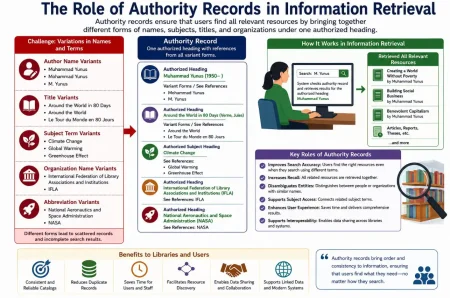
An authority record is a standardized metadata record used in library cataloging. Its purpose is to establish and maintain the authorized forms of names, subjects, titles, and other access points within a library catalog. By doing so, authority records ensure consistency, accuracy, and reliability when describing and retrieving information resources.
Instead of allowing multiple versions of an author’s name, a corporate body’s name, subject heading, or title to exist throughout the catalog, an authority record identifies a single approved form. It links all alternative spellings, pseudonyms, abbreviations, and related terms to that authorized heading. This process, known as authority control, helps prevent confusion and enables users to find all relevant resources through a consistent access point.
For example, the Nobel Prize-winning Bengali poet Rabindranath Tagore may appear in different publications as Rabindranath Thakur, R. Tagore, Robindronath Tagore, or simply Tagore. An authority record establishes one authorized form, such as “Tagore, Rabindranath, 1861–1941,” while recording all other forms as variant names. Consequently, whether a library user searches for “Rabindranath Thakur” or “R. Tagore,” the catalog will redirect their search to the authorized heading and display all works by the same author.
Authority records are not limited to personal names; they are also created for corporate bodies, conference names, geographic locations, uniform titles, series titles, and subject headings. For instance, the organization known as the World Health Organization may sometimes be referred to simply as WHO in publications. An authority record establishes “World Health Organization” as the authorized heading while recording “WHO” as a variant form. Similarly, a conference like the International Conference on Digital Libraries (ICDL) may appear with different names over the years. An authority record standardizes the conference name, allowing all proceedings to be found together.
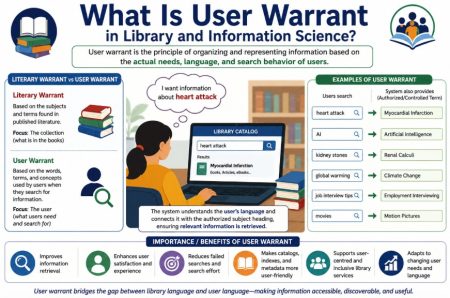
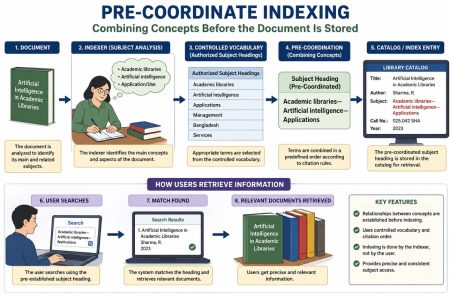
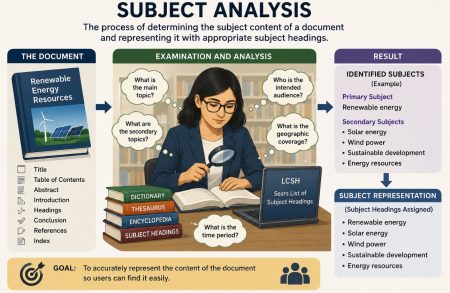
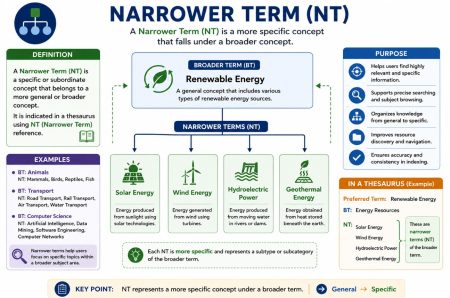
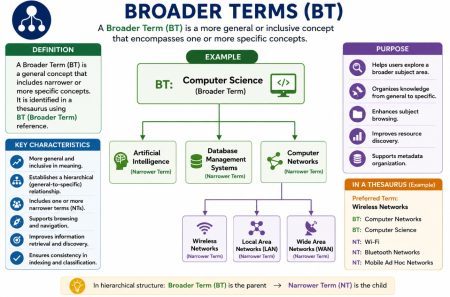
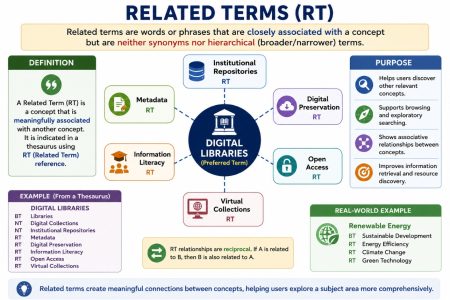
Authority records also significantly enhance subject access. For example, some users might search for “Cell Phones,” while others may use “Mobile Phones” or “Smartphones.” If the library adopts “Mobile Phones” as the authorized subject heading, authority records will create references to the other terms, ensuring that users reach the correct subject regardless of their wording. Likewise, a user searching for “Heart Attack” may automatically be directed to the authorized medical subject heading “Myocardial Infarction” in libraries that utilize controlled vocabularies.
A typical authority record contains several important elements, including the authorized heading, variant forms of the heading, cross-references (such as “See” and “See Also” references), qualifiers to distinguish similar names, source citations used to establish the heading, and a unique control number. For instance, two authors with the name John Smith can be distinguished by adding qualifiers such as their birth year or profession.
Smith, John, 1968– (Historian)
Smith, John, 1982– (Computer Scientist)
These qualifiers help prevent confusion between individuals who share the same name.
Modern libraries create and maintain authority records in accordance with international cataloging standards, such as Resource Description and Access (RDA) and the MARC 21 Authority Format. They also utilize internationally recognized authority files, including the Library of Congress Name Authority File (LCNAF), the Library of Congress Subject Headings (LCSH), and the Virtual International Authority File (VIAF). For example, when cataloging a book by J.K. Rowling, a librarian can consult the LCNAF or VIAF to verify the correct format of the author’s name and ensure consistency across catalogues worldwide.
Example of a Simple Authority Record
Example of a Simple Authority Record
| Element | Example |
|---|---|
| Authorized Heading | Tagore, Rabindranath, 1861–1941 |
| Variant Names | Rabindranath Thakur; R. Tagore; Robindronath Tagore |
| See Reference | Rabindranath Thakur → Tagore, Rabindranath, 1861–1941 |
| Occupation | Poet, Novelist, Composer |
| Source | Encyclopaedia Britannica; Library of Congress |
| Control Number | n79021164 (Example) |
In today’s digital library environment, authority records play a crucial role in improving information retrieval, supporting linked data applications, and enhancing user navigation within Online Public Access Catalogues (OPACs) and discovery systems. These records ensure that all resources related to a specific person, organization, subject, or title are grouped together, even if different names or spellings are used. For instance, a student searching an OPAC for WHO, World Health Organization, or World Health Organisation (British spelling) will still retrieve the same set of records because the authority record links these variations to a single authorized heading.
Why Are Authority Records Important in Library Cataloguing?
Authority records play a crucial role in library cataloging by ensuring consistency, accuracy, and uniformity in the representation of names, subjects, titles, and other access points in a library catalogue. Without authority records, the same person, organization, or subject could be represented under multiple names or spellings, which can complicate users’ ability to locate all relevant resources. By establishing a single authorized form for a heading and linking it to its alternative forms, authority records enhance information retrieval and improve the overall quality of library catalogues.
One of the primary functions of authority records is to maintain consistency across catalogue entries. Authors, organizations, and subjects may be represented differently in various publications due to spelling variations, abbreviations, language differences, or changes over time. Authority records standardize these variations under one authorized heading. For example, books written by Stephen King may also include works published under his pseudonym, Richard Bachman. An authority record links both names, enabling users searching for either name to discover all relevant works by the same author.
Authority records also help eliminate ambiguity between individuals or organizations with identical names. Many authors share common names, which can cause confusion during information retrieval. For instance, there may be several authors named Michael Brown writing in different disciplines. An authority record distinguishes them by providing identifying information such as birth year, profession, or institutional affiliation. Thus, Brown, Michael, 1975– (Economist) and Brown, Michael, 1988– (Environmental Scientist) are treated as separate entities, preventing confusion around their publications.
Another significant advantage of authority records is that they enhance information retrieval and search accuracy. Library users often search using various spellings, abbreviations, or common names, rather than the official form. Authority records include these alternative forms and direct users to the authorized heading. For example, a user searching for NASA will be directed to the authorized heading National Aeronautics and Space Administration, granting access to all related resources without requiring knowledge of the organization’s full name.
Authority records support effective subject searching by controlling synonyms and related terms. Different users might use different words to describe the same concept. For instance, one user may search for “Artificial Intelligence,” another for “AI,” and yet another for “Machine Intelligence.” If the library adopts “Artificial Intelligence” as the authorized subject heading, authority records will link the other terms through references, ensuring that users retrieve the full collection regardless of the term they enter. Additionally, authority records consolidate all works related to the same entity, even when names change over time. This is particularly useful for organizations that undergo renaming. For example, the social media company formerly known as Facebook, Inc. changed its corporate name to Meta Platforms, Inc. An authority record connects both names, ensuring that publications produced under either name remain linked in the library catalogue.
Authority records are also vital for multilingual and international cataloging. Names of places, authors, and organizations may be represented differently in various languages or scripts. For example, the city known internationally as Beijing was formerly referred to as Peking in many English-language publications. An authority record bridges these forms so that users searching either name can find all related materials. Moreover, authority records enhance catalogue maintenance and efficiency. Since all bibliographic records are linked to a single authority record, librarians can update information in one place rather than editing hundreds or thousands of individual catalogue records. For instance, if a university changes its official name from Daffodil International University to Daffodil University, updating the authority record automatically maintains consistency across all associated bibliographic records.
Authority records also facilitate resource sharing and interoperability among libraries. Libraries worldwide exchange bibliographic records through shared cataloguing systems and union catalogues. By adhering to international standards such as Resource Description and Access (RDA) and the MARC 21 Authority Format, libraries can utilize common authority records, reducing duplicate work and ensuring consistency across institutions. For example, when a university library imports a catalogue record from another institution, the linked authority records ensure that author names and subject headings remain standardized.