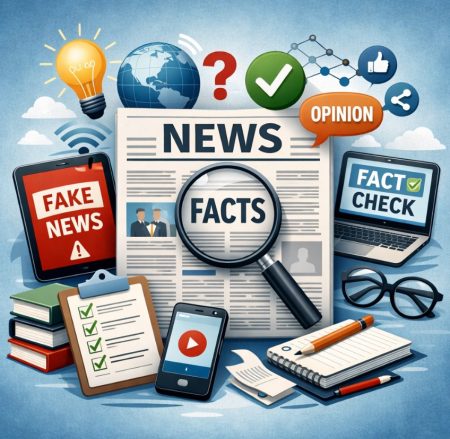
People with low news literacy are more likely to believe false or misleading news stories because they lack the skills needed to critically evaluate information and understand how news is produced. Without knowledge of journalistic practices such as fact-checking, source verification, and balanced reporting, individuals may assume that all published or widely shared content is accurate and reliable. This makes them vulnerable to accepting rumors, opinion-based articles, or sponsored content as factual news, especially when such content appears professional or authoritative at first glance.
Another important reason is the tendency to rely on headlines, visuals, or social media summaries rather than reading full articles. Sensational headlines and emotionally charged images are designed to capture attention and can easily mislead readers who do not examine the full context. People with low news literacy may also struggle to identify bias, propaganda, or manipulated content, causing them to interpret misleading information as objective reporting. As a result, they are more likely to trust news that confirms their existing beliefs, reinforcing misinformation through confirmation bias.
Additionally, low news literacy limits the ability to verify information across multiple credible sources. Many individuals fail to verify the original source, publication date, or supporting evidence before believing or sharing a story. In fast-paced digital environments, particularly on social media and messaging platforms, false information spreads quickly and repeatedly, often gaining credibility through repeated exposure. This repeated exposure, combined with a lack of critical evaluation skills, increases the likelihood that people with low news literacy will believe and act upon false or misleading news stories.
How a Lack of News Literacy Contributes to the Spread of Misinformation
In the digital age, news reaches people faster than ever before through websites, social media platforms, messaging apps, and online videos. While this rapid flow of information has many benefits, it also increases the risk of misinformation spreading widely. News literacy-the ability to access, analyze, evaluate, and engage critically with news content-is essential for navigating this environment. When news literacy is weak or absent, misinformation can spread easily, causing confusion, fear, and poor decision-making. The following points provide a detailed explanation of how a lack of news literacy contributes to the spread of misinformation.
- Inability to Distinguish Between News and Other Content: One major consequence of low news literacy is the inability to differentiate between factual news, opinion pieces, advertisements, sponsored content, and satire. Many people assume that all professionally designed online content is “news,” even when it is actually promotional or opinion-based in nature. For example, a sponsored article promoting a product or political agenda may appear to be a regular news report. Without news literacy skills, readers may accept such content as objective truth and share it with others, unknowingly spreading biased or misleading information.
- Overreliance on Headlines and Visuals: Individuals with limited news literacy often rely solely on headlines, images, or brief captions rather than reading the full articles. Headlines are sometimes written to attract attention and may oversimplify or exaggerate facts. For instance, a headline suggesting a dramatic outcome may mislead readers when the actual article presents a more balanced or conditional explanation. When users share such content without reading or understanding the full context, misinformation spreads quickly, especially on social media platforms.
- Poor Evaluation of News Sources: A lack of news literacy reduces the ability to assess the credibility of news sources. Readers may not know how to identify trustworthy news organizations, check author credentials, or verify whether a website follows journalistic standards. As a result, rumors, unverified blogs, and anonymous social media accounts should be treated with caution as reliable sources. For example, during emergencies or crises, false information shared by unknown sources often spreads more quickly than official updates because people fail to verify the source before sharing it.
- Failure to Verify Facts and Evidence: News-literate individuals understand the importance of evidence, data, and multiple sources. In contrast, individuals with low news literacy may accept claims without verifying the facts or seeking confirmation from other credible sources. For instance, misleading statistics or fabricated quotes can appear convincing if presented with charts or authoritative language. When readers fail to question the accuracy of such information, they contribute to the wider dissemination of false or distorted facts.
- Influence of Emotional and Sensational Content: Misinformation often relies on emotional appeal, such as fear, anger, or excitement, to encourage sharing. Individuals who lack news literacy are more likely to react emotionally rather than critically. For example, alarming news about crime, health risks, or political events may be shared impulsively without verification. This emotional response facilitates the rapid spread of misinformation, as people prioritize urgency and personal feelings over accuracy.
- Confirmation Bias and Echo Chambers: A lack of news literacy strengthens confirmation bias—the tendency to accept information that supports existing beliefs while rejecting opposing viewpoints. People often follow like-minded individuals or groups online, creating echo chambers where the same misinformation is repeated and reinforced. For example, false or misleading political news may circulate within closed groups without being challenged. Over time, repeated exposure makes misinformation seem credible and normal, further increasing its spread.
- Misinterpretation of Data and Statistics: Without basic skills in interpreting data, graphs, and statistics, readers may misunderstand or misuse information presented in news reports. Percentages, averages, or scientific findings can be taken out of context to support false claims. For instance, a single study with limited data may be presented as definitive proof of a broad conclusion. Low news literacy prevents readers from recognizing such limitations, allowing misleading interpretations to circulate widely.
- Uncritical Sharing on Social Media and Messaging Apps: Social media and messaging platforms facilitate the instant sharing of information with a large audience. Individuals with low news literacy may forward messages, videos, or links without checking their accuracy. For example, false warnings or rumors often spread through group messages because people assume the sender is trustworthy. This uncritical sharing behavior significantly accelerates the spread of misinformation.
- Erosion of Trust in Credible Journalism: When misinformation spreads widely, it can create confusion and skepticism toward all news, including reliable journalism. People who cannot distinguish between false and credible reporting may lose trust in established news organizations. This distrust makes them more likely to rely on alternative or unreliable sources, creating a cycle in which misinformation continues to flourish.
- Long-Term Social and Academic Consequences: The spread of misinformation due to low news literacy has serious long-term effects on society, education, and research. In academic settings, students may use unreliable news sources in assignments or research, leading to inaccurate conclusions. In society, misinformation can influence public opinion, fuel social tension, and hinder informed decision-making. Strengthening news literacy helps individuals become responsible news consumers who verify information, think critically, and contribute to a more informed and resilient information environment.
A lack of news literacy significantly contributes to the spread of misinformation by weakening individuals’ ability to evaluate sources, verify facts, understand context, and manage emotional responses to news. In an era of information overload, developing strong news literacy skills is crucial for safeguarding individuals and society from the detrimental effects of misinformation. Education, libraries, and media organizations play a crucial role in promoting these skills and fostering a culture of critical and responsible news consumption.
Why People with Low News Literacy Are More Likely to Believe False or Misleading News Stories
People with low news literacy are more likely to believe false or misleading news stories because they lack the skills needed to critically evaluate information and understand how news is produced. Without knowledge of journalistic practices such as fact-checking, use of credible sources, and editorial review, individuals may assume that anything presented in a news-like format is accurate. For example, a blog post or social media page designed to resemble a professional news website may publish unverified claims, yet readers with low news literacy may perceive it as trustworthy journalism.
Another key reason is the overreliance on headlines, images, and brief summaries, particularly on social media. Sensational or misleading headlines are often crafted to attract attention and provoke emotion, even when the full article tells a different story. For instance, a headline claiming a dramatic scientific “breakthrough” may ignore limitations mentioned in the article itself. Readers who do not read beyond the headline may believe and share the exaggerated claim, unintentionally spreading misinformation.
Low news literacy also makes it difficult to recognize bias, manipulation, and emotionally charged content. People may confuse opinion pieces, sponsored posts, or political propaganda with factual news reporting. For example, a strongly opinionated article promoting a particular viewpoint may be accepted as objective news simply because it aligns with the reader’s personal beliefs. This confirmation bias increases the likelihood of believing misleading information without questioning its accuracy. Additionally, individuals with low news literacy often do not verify information by checking multiple reliable sources. During emergencies or breaking news situations, false rumors and outdated information frequently circulate online. For example, during natural disasters or public health crises, misleading advice or incorrect statistics may spread rapidly through messaging apps. When people do not check official sources or reputable news outlets, repeated exposure to such false information makes it seem credible. Strengthening news literacy enables readers to pause, question, and verify news, thereby reducing their vulnerability to false or misleading stories.
Why Viral Posts Spread Faster Among Users Who Do Not Verify Sources
Viral posts tend to spread faster among users who do not verify sources because speed, emotion, and convenience often take priority over accuracy in digital environments. Users who lack the habit of source verification are more likely to react immediately to eye-catching headlines, dramatic images, or emotionally charged messages. For example, a sensational claim shared on social media may trigger fear, excitement, or anger, prompting users to share it instantly without verifying its origin or reliability. This rapid and impulsive sharing enables such posts to reach a wide audience in a very short time.
Another important factor is the role of trust within social networks. People who do not verify sources often rely on social cues rather than credibility, assuming that content shared by friends, family members, or popular accounts must be true. For instance, a misleading post forwarded in a messaging group may be shared repeatedly because users trust the sender, not the source of the information. When verification is ignored, repetition itself creates a false sense of credibility, making viral content appear more trustworthy simply because it is widely shared.
Social media platforms are designed to reward engagement, not accuracy. Posts that receive quick likes, shares, or comments are promoted by algorithms, increasing their visibility. Users who do not verify sources contribute to this process by engaging with content based on emotion rather than evidence. As misleading posts gain momentum, they become harder to challenge or correct. Encouraging source verification and critical thinking can slow down the spread of viral misinformation and promote more responsible information sharing.