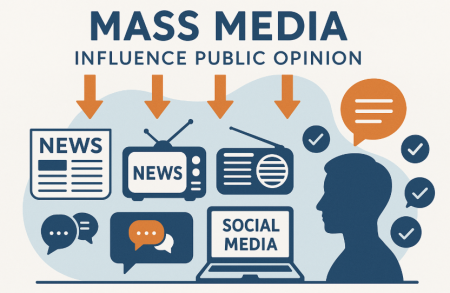
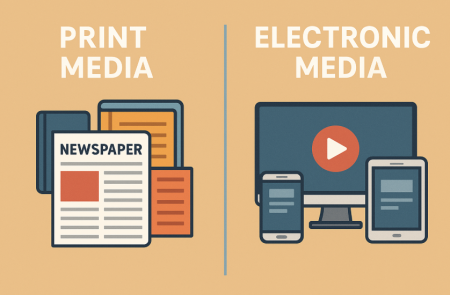
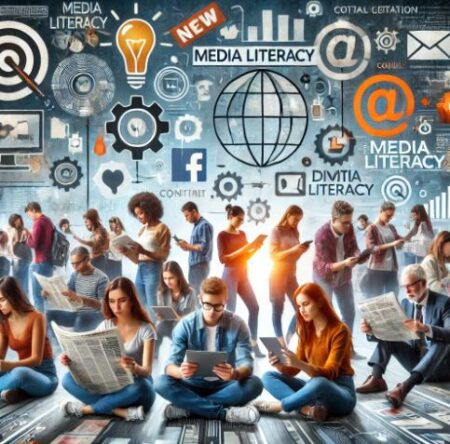
Mass media refers to the means of communication designed to reach a large and diverse audience simultaneously. It encompasses traditional forms, such as newspapers, magazines, radio, and television, as well as modern digital platforms, including online news portals, websites, and social media. For example, newspapers inform the public about national and international events, television news channels broadcast live coverage of elections or natural disasters, and radio programs deliver news and educational content to people even in remote areas. In the digital age, online platforms enable real-time updates, allowing audiences to access breaking news through websites or mobile devices. Mass media also play an educational and cultural role by broadcasting documentaries, talk shows, and awareness campaigns on issues such as public health, environmental protection, and social responsibility. Additionally, advertising through mass media influences consumer behavior by promoting products and services to a wide audience. Through these diverse functions and examples, mass media serve as a powerful tool for disseminating information, fostering public awareness, providing entertainment, and promoting social development.
What Is Mass Media?
Mass media refers to the various channels and technologies used to simultaneously communicate information, ideas, and messages to a large, diverse audience. It serves as a powerful tool for informing the public, shaping opinions, and connecting people across different regions and cultures. Traditional mass media encompasses newspapers, magazines, radio, and television, which have long been utilized to disseminate news, entertainment, and educational content to millions. Today, digital platforms such as online news portals, social media networks, blogs, and streaming services have expanded the reach and speed of communication, allowing information to spread instantly across the globe. Mass media influences how people perceive events, understand social issues, and make decisions in their daily lives. Whether broadcasting live news coverage, sharing political updates, promoting health awareness campaigns, or offering entertainment programs, mass media plays a vital role in shaping society, supporting democracy, and fostering informed citizenship.
Types of Mass Media
Mass media encompasses a wide range of communication channels that are used to disseminate information, ideas, and messages to a large audience. Based on their format, reach, and mode of communication, mass media can be classified into several major types, each playing a distinct role in society.
- Print media is the earliest form of mass media and includes newspapers, magazines, journals, newsletters, and books. It is valued for providing detailed, organized, and credible information. Print media allows readers to engage with content at their own pace and is widely used for news reporting, academic discussion, and in-depth analysis. Despite the growth of digital platforms, print media remains important for archival records and formal communication.
- Broadcast media consists of radio and television, which transmit information through audio and audiovisual formats. Radio is a cost-effective medium that reaches a broad audience, including rural and remote populations, and is often used for news, music, educational programs, and public service announcements. Television, on the other hand, combines sound and visuals, making it a powerful medium for news coverage, documentaries, entertainment, and awareness campaigns.
- Digital media represents the most dynamic and influential form of mass media in the modern era. It includes online news portals, websites, social media platforms, blogs, podcasts, mobile applications, and streaming services. Digital media enables instant communication, global accessibility, and interactive engagement, allowing users not only to receive information but also to create and share content. Its real-time nature has transformed how information is produced, distributed, and consumed.
Outdoor and advertising media include billboards, posters, banners, transit advertisements, and electronic display boards, all of which are placed in public spaces. This form of media is primarily used for advertising, promotions, and public awareness messages. Due to its high visibility, outdoor media is effective in repeatedly reinforcing messages to a large audience.
Why Is Mass Media Important in Modern Society?
Mass media play a vital role in modern society by serving as a key link between information sources and the public. It enables the rapid dissemination of news, ideas, and knowledge to a large and diverse audience, making communication more efficient and accessible in today’s interconnected world. Through newspapers, radio, television, and digital platforms, people remain informed about current events, government policies, scientific developments, and global issues. Access to timely and accurate information enables individuals to make informed decisions in their personal, professional, and civic lives, particularly during emergencies such as natural disasters or public health crises.
In addition to information sharing, the mass media play an important role in supporting democracy and public participation. By covering political events, elections, and public policies, it promotes transparency and accountability in governance. Mass media provide a platform for debate and discussion, enabling citizens to express opinions and engage in democratic processes. Investigative journalism further strengthens society by exposing corruption, injustice, and misuse of power, thereby encouraging responsible leadership and informed citizenship.
Mass media is also essential for education, awareness, and social development. Educational programs, documentaries, and public awareness campaigns help people understand critical issues such as health, environmental protection, social justice, and digital literacy. These initiatives contribute to positive social change by encouraging responsible behavior and informed attitudes. At the same time, mass media supports cultural development by promoting art, literature, music, and shared social experiences, while exposure to diverse cultures through media fosters tolerance and social cohesion. Furthermore, the mass media contribute significantly to economic growth and development. It supports businesses through advertising and marketing, helps consumers make informed purchasing decisions, and generates employment in sectors such as journalism, broadcasting, advertising, and digital content creation. With the rise of digital media, innovation and entrepreneurship have expanded further, strengthening the information economy.
Functions of Mass Media
Mass media perform a wide range of functions that significantly influence individuals and society as a whole. Each function extends beyond simple communication, contributing to social awareness, development, and cohesion. The major functions of mass media are discussed in detail below.
- Information Dissemination: One of the most fundamental functions of mass media is the dissemination of information. Through newspapers, television, radio, and digital platforms, mass media deliver news and updates about local, national, and international events. This function helps people stay informed about political developments, economic trends, public policies, scientific discoveries, and emergencies such as natural disasters or health outbreaks. By providing timely and credible information, mass media enable individuals to make informed decisions and respond appropriately to changing circumstances.
- Education and Knowledge Building: Mass media play a crucial educational role by extending learning opportunities beyond formal educational institutions. Educational programs, documentaries, news features, interviews, and articles collectively contribute to the public’s understanding of complex issues, including health, the environment, technology, and social welfare. Awareness campaigns on topics such as vaccination, digital literacy, climate change, and road safety educate people and encourage them to adopt responsible behavior. In this way, mass media support lifelong learning and help bridge knowledge gaps in society.
- Entertainment: Entertainment is another major function of mass media that contributes to emotional well-being and social interaction. Television shows, films, music, sports programs, and online content provide relaxation and enjoyment to audiences of all ages. Entertainment media help reduce stress, offer escape from daily routines, and foster creativity and imagination. Shared entertainment experiences also strengthen social bonds by creating common topics of discussion and cultural connections.
- Formation of Public Opinion: Mass media play a significant role in shaping public opinion by presenting information, perspectives, and interpretations of events and issues. Editorials, opinion columns, talk shows, and debates shape how people perceive social, political, and economic issues. By highlighting specific issues and framing them in particular ways, the mass media guides public discussion and encourages critical thinking. This function is particularly important in helping citizens form informed opinions based on reliable information and analysis.
- Social and Cultural Transmission: Mass media serve as a carrier of cultural values, traditions, and social norms. It promotes literature, art, music, language, and cultural events, helping to preserve cultural heritage and identity. At the same time, mass media introduces audiences to diverse cultures and lifestyles, fostering tolerance, understanding, and social integration. This cultural exchange contributes to social cohesion in increasingly diverse and globalized societies.
- Support for Democracy and Governance: In democratic societies, the mass media acts as a watchdog by monitoring government actions and holding leaders accountable. Through investigative journalism and political reporting, it exposes corruption, injustice, and misuse of power. Mass media also inform citizens about elections, public policies, and civic rights, encouraging participation in democratic processes. By promoting transparency and accountability, mass media strengthen democratic governance.
- Economic and Commercial Function: Mass media play a vital role in economic development by supporting advertising, marketing, and business communication. Through advertisements and promotional content, it connects producers with consumers, helping to inform purchasing decisions. The media industry itself generates employment in journalism, broadcasting, advertising, and digital content creation. Furthermore, the growth of digital media has fueled innovation and expanded economic opportunities in the information sector.
- Social Awareness and Development: Mass media play a significant role in social development by raising awareness about societal problems and promoting positive change. Campaigns addressing issues such as public health, environmental protection, social inequality, and disaster preparedness encourage informed and responsible behavior. By highlighting social challenges and success stories, mass media motivates collective action and supports sustainable development.
The functions of mass media are diverse and interconnected, extending far beyond the transmission of information. By informing, educating, entertaining, shaping opinions, preserving culture, supporting democracy, and promoting economic and social development, mass media remain an indispensable force in modern society.
How Has Social Media Changed the Concept of Mass Media?
Social media has significantly changed the concept of mass media by transforming how information is produced, distributed, and consumed. Traditional mass media, such as newspapers, radio, and television, mainly functioned through one-way communication, where professional organizations created content for a passive audience. With the rise of social media, this model has evolved into a more interactive and participatory system, where users actively engage with content through comments, likes, sharing, and content creation. Audiences are no longer just consumers of information; they have become contributors, which has blurred the distinction between media producers and users.
Another major change brought by social media is the democratization of communication. Unlike traditional mass media, which require significant financial and technical resources, social media platforms enable individuals and small groups to reach large audiences at minimal cost. This has enabled citizen journalism, online activism, and grassroots movements to gain visibility and influence public discourse. News and information now spread in real time through social networks, often faster than through traditional media outlets, making social media a primary source of breaking news for many people.
Social media has also introduced personalized and algorithm-driven content consumption. Instead of receiving the same information as everyone else, users are shown content based on their interests, preferences, and online behavior. While this personalization increases engagement, it also creates challenges such as echo chambers, misinformation, and reduced exposure to diverse viewpoints. Additionally, traditional media organizations have adapted by using social media for news gathering, audience engagement, and content distribution, integrating both old and new media forms.