What Is Blockchain Technology?
Blockchain technology is a digital system for recording and storing information in a secure, transparent, and decentralized manner. Instead of keeping data in a single centralized database controlled by one authority, blockchain distributes the same record across a network of computers, known as nodes. Information is stored in blocks, and each block contains a set of transactions, a timestamp, and a cryptographic link to the previous block. Once a block is verified and added to the chain, the data becomes extremely difficult to alter, ensuring trust and data integrity without the need for intermediaries.
One of the defining features of blockchain technology is its use of cryptography and consensus mechanisms to validate and secure transactions. Before any new data is added to the blockchain, network participants must agree on its validity through a predefined consensus process. This agreement makes the system resistant to fraud, tampering, and unauthorized changes. Because all participants can view the same version of the ledger, blockchain promotes transparency while maintaining security and accountability.
Overall, blockchain technology represents a major shift in how digital information is managed and exchanged. By enabling secure peer-to-peer transactions, reducing dependence on centralized authorities, and ensuring permanent records, blockchain has applications far beyond digital currencies. It is increasingly being explored in areas such as finance, supply chain management, healthcare, education, and information services, where trust, accuracy, and transparency are essential.
Why Is Blockchain Referred to as a “Distributed Ledger”?
Blockchain is referred to as a “distributed ledger” because it records and maintains data across multiple computers, known as nodes, rather than storing it in a single central location. In a traditional ledger system, one authority controls the database and is responsible for updating and verifying records. In contrast, a blockchain ledger is shared and synchronized across all participating nodes in the network. Each participant holds an identical copy of the ledger, ensuring that no single entity has complete control over the data.
The distributed nature of the ledger enhances transparency and trust among participants. Whenever a new transaction is added, it is broadcast to the entire network and verified through a consensus mechanism. Once approved, the transaction is recorded simultaneously on all copies of the ledger. This shared verification process reduces the risk of fraud, errors, or unauthorized changes, as altering a record would require modifying the ledger on a majority of nodes at the same time, which is extremely difficult. Furthermore, a distributed ledger improves system reliability and resilience. Since data is not stored in a single server, the failure or compromise of one node does not affect the overall system. This decentralization makes blockchain more secure, fault-tolerant, and resistant to cyberattacks. As a result, blockchain’s ability to maintain a shared, secure, and continuously updated record across a network is why it is widely described as a distributed ledger.
Main Components of a Blockchain
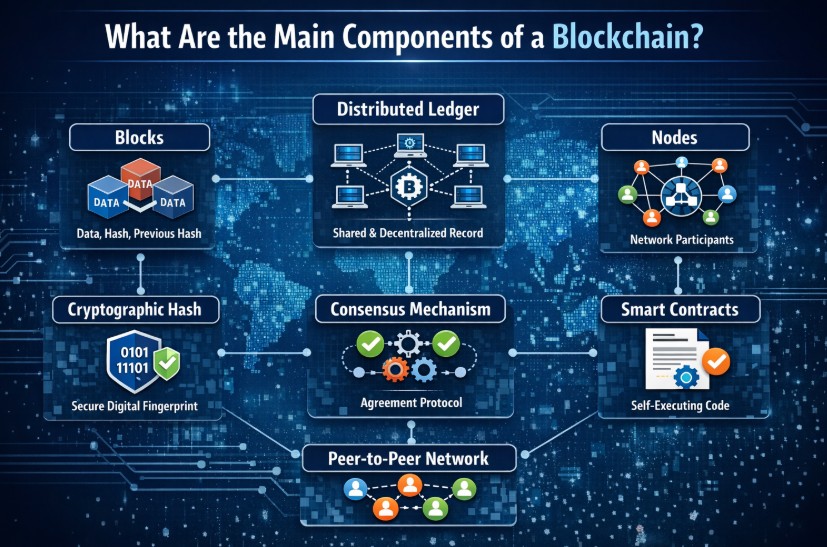
Blockchain technology is built on several key components that work together to ensure security, transparency, and decentralization. Each component plays a specific role in maintaining the integrity and functionality of the blockchain system. The main components of a blockchain are discussed below.
- Blocks: Blocks are the fundamental units of a blockchain. Each block contains a group of verified transactions, a timestamp indicating when the data was recorded, and a unique cryptographic hash. Blocks also store the hash of the previous block, which links them together in chronological order and forms a continuous chain.
- Distributed Ledger: The distributed ledger is a shared database that records all transactions across the blockchain network. Instead of being controlled by a single authority, the ledger is maintained by multiple nodes, each holding an identical copy. This distribution ensures transparency, reduces the risk of data manipulation, and increases trust among participants.
- Nodes: Nodes are computers or devices that participate in the blockchain network. They store copies of the blockchain, validate transactions, and help maintain the network’s security. Some nodes may also take part in verifying and adding new blocks, depending on the blockchain’s design.
- Cryptographic Hash: A cryptographic hash is a unique digital fingerprint generated for each block. It ensures data integrity by making it extremely difficult to alter information once it has been recorded. Any change in the data would result in a completely different hash, immediately revealing tampering.
- Consensus Mechanism: The consensus mechanism is the process through which all nodes agree on the validity of transactions before adding them to the blockchain. It ensures that only legitimate transactions are recorded and that all copies of the ledger remain consistent across the network.
- Smart Contracts: Smart contracts are self-executing programs stored on the blockchain that automatically enforce agreements when predefined conditions are met. They reduce the need for intermediaries and enable faster, more efficient transactions in many blockchain applications.
- Peer-to-Peer Network: Blockchain operates on a peer-to-peer network where nodes communicate directly with each other. This structure eliminates reliance on a central server and supports decentralization, making the system more secure and resilient.
Together, these components form the foundation of blockchain technology. By combining blocks, cryptography, distributed ledgers, and consensus mechanisms, blockchain creates a secure and transparent system for recording and sharing data across a decentralized network.
Why Is Blockchain Considered a Secure Technology?
Blockchain is considered a secure technology because it combines decentralization, cryptography, and consensus mechanisms to protect data from unauthorized access and tampering. Unlike traditional centralized systems, where data is stored in a single server, blockchain distributes data across multiple nodes in a network. Each node maintains an identical copy of the ledger, which means there is no single point of failure. If one node is compromised, the rest of the network continues to function securely, making large-scale attacks extremely difficult.
Another key reason for blockchain’s security is its use of cryptographic techniques. Each block contains a cryptographic hash of its own data and the hash of the previous block, creating a strong and irreversible link between blocks. Any attempt to alter the data in a block would change its hash and immediately break the chain, alerting the network to the tampering. Additionally, public and private key cryptography ensures that only authorized users can initiate transactions, while all transactions remain verifiable.
Blockchain also relies on consensus mechanisms to validate transactions before they are added to the ledger. These mechanisms require agreement among network participants, preventing fraudulent or invalid transactions from being recorded. Once a transaction is confirmed and added to the blockchain, it becomes permanent and nearly impossible to change. Together, decentralization, cryptography, and consensus make blockchain a highly secure and trustworthy technology for managing digital information and transactions.
What Are the Different Types of Blockchains?
Blockchain technology can be implemented in different ways depending on who is allowed to participate, validate transactions, and access data. Based on access control and governance structure, blockchains are generally classified into four main types: public, private, consortium, and hybrid blockchains. Each type has distinct features, advantages, and real-world use cases. A detailed discussion with examples is presented below.
- Public Blockchain: A public blockchain is an open and permissionless network where anyone can join, participate, and view transactions. There is no central authority controlling the system, and all participants can act as nodes to validate transactions. Public blockchains rely on consensus mechanisms to maintain trust and security. Because data is transparent and distributed across a large number of nodes, public blockchains are highly secure and resistant to censorship. However, they may suffer from slower transaction speeds and high energy consumption.
Example: Bitcoin is a well-known public blockchain where anyone can send or receive transactions and view the entire transaction history. Ethereum is another example that supports decentralized applications and smart contracts on a public network. - Private Blockchain: A private blockchain is a permissioned network managed by a single organization. Only authorized participants are allowed to access the network, validate transactions, or view records. This type of blockchain offers higher efficiency, faster transaction processing, and greater privacy compared to public blockchains. Private blockchains are commonly used by enterprises where data confidentiality and internal control are essential. However, because authority is centralized, transparency is limited.
Example: A large corporation may use a private blockchain to manage internal records, such as employee data or supply chain information. For instance, a bank might use a private blockchain to securely process internal transactions between departments. - Consortium Blockchain: A consortium blockchain is a semi-decentralized network governed by a group of organizations rather than a single entity. Transaction validation is carried out by selected members of the consortium, while other participants may have restricted access. This model provides a balance between decentralization and control, making it suitable for collaborative environments where trust is shared among multiple institutions.
Example: A group of academic libraries could use a consortium blockchain to manage shared digital resources or interlibrary loan systems. Similarly, multiple banks may form a consortium blockchain to streamline cross-border payments while maintaining shared governance. - Hybrid Blockchain: A hybrid blockchain combines features of both public and private blockchains. In this model, certain data is made public for transparency, while sensitive information remains private and accessible only to authorized users. Hybrid blockchains offer flexibility and are particularly useful in environments that require both public trust and data privacy.
Example: A government organization might use a hybrid blockchain where public records are openly accessible, but confidential citizen data is protected. In a library context, metadata about digital collections could be public, while user access and usage data remain private.
Each type of blockchain serves different purposes and organizational needs. Public blockchains emphasize openness and decentralization, private blockchains focus on efficiency and control, consortium blockchains support collaboration among multiple entities, and hybrid blockchains provide a flexible combination of transparency and privacy. Understanding these types with practical examples helps organizations choose the most appropriate blockchain model for their specific applications.