
PMEST is a theoretical framework introduced by S. R. Ranganathan for subject analysis in library classification, especially in faceted classification and Colon Classification.
PMEST stands for Personality, Matter, Energy, Space, and Time. These are called fundamental categories because Ranganathan proposed that any subject in any field of knowledge can be analyzed and expressed using these five facets.
In PMEST, Personality represents the core or focal entity of a subject-what the subject is essentially about. Matter refers to the material, substance, or properties of that entity. Energy denotes actions, processes, operations, or activities related to the subject. Space identifies the geographical or spatial location, and Time indicates the period or temporal aspect.
PMEST provides a systematic and logical method for breaking down complex subjects into simpler, conceptually distinct components. Once analyzed, these facets are synthesized in a fixed order (P-M-E-S-T) to construct precise and flexible class numbers. This analytic–synthetic approach avoids the rigidity of enumerative classification systems and allows unlimited subject expansion.
Why PMEST Matters in Classification
The organization of knowledge is one of the core functions of library and information systems, and effective classification depends on accurate and flexible subject analysis. PMEST, proposed by S. R. Ranganathan, plays a crucial role in this process by providing a logical and universal framework for breaking down and organizing subjects. As the conceptual foundation of faceted classification and Colon Classification, PMEST continues to influence both traditional library systems and modern information environments.
- Providing a Systematic Method for Subject Analysis:One of the primary reasons PMEST matters in classification is that it offers a structured approach to subject analysis. By dividing any subject into five fundamental categories-Personality, Matter, Energy, Space, and Time-PMEST allows classifiers to identify the essential components of even the most complex subjects. This systematic breakdown prevents ambiguity and ensures consistency in classification decisions, which is particularly important in large and diverse collections.
- Supporting the Analytic-Synthetic Approach:PMEST underpins the analytic-synthetic method of classification, where subjects are first analyzed into independent facets and then synthesized in a prescribed order. Unlike enumerative classification systems that list subjects in advance, PMEST allows classifiers to construct class numbers dynamically. This approach enhances flexibility and ensures that new or interdisciplinary subjects can be accommodated without disrupting the existing classification structure.
- Enhancing Flexibility and Hospitality:A major strength of PMEST is its ability to support the principle of hospitality in classification. Since subjects are built by combining facets rather than selecting from fixed schedules, the system can easily incorporate emerging fields of knowledge, new research areas, and evolving terminologies. This flexibility makes PMEST particularly valuable in academic and research libraries where knowledge is constantly expanding.
- Enabling Precise and Multidimensional Representation:PMEST allows subjects to be represented multidimensionally by capturing not only what a subject is about, but also its material aspects, processes, geographical scope, and time period. This level of precision improves both shelving arrangement and information retrieval, as users can locate materials that match specific combinations of concepts rather than broad, generalized topics.
- Relevance in Digital and Modern Information Systems:Although PMEST originated in a traditional library context, its conceptual value extends to digital libraries, metadata systems, and faceted search interfaces. Modern information retrieval systems often rely on facet-based navigation, which mirrors the principles of PMEST. By structuring information into meaningful facets, PMEST supports more intuitive searching, filtering, and discovery in online environments.
PMEST matters in classification because it provides a logical, flexible, and universal framework for organizing knowledge. By supporting systematic subject analysis, enabling analytic-synthetic classification, and accommodating the continuous growth of knowledge, PMEST remains a cornerstone of library classification theory. Its enduring relevance demonstrates that Ranganathan’s ideas continue to shape effective knowledge organization in both traditional libraries and contemporary digital information systems.
Facet Order and Notation in Colon Classification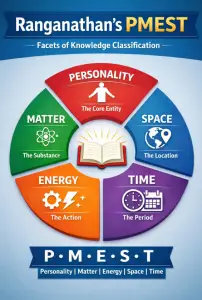
Colon Classification (CC), developed by S. R. Ranganathan, is a classic example of a faceted, analytic-synthetic classification system. One of its most distinctive features is the use of a fixed facet order and specific notational symbols to represent complex subjects precisely and systematically. This structure ensures consistency, clarity, and unlimited scope for subject expansion.
>> Facet Order in Colon Classification:
In Colon Classification, subjects are analyzed using the PMEST formula, which represents five fundamental facets: Personality, Matter, Energy, Space, and Time. These facets are arranged in a fixed sequence:
Personality → Matter → Energy → Space → Time (P-M-E-S-T)
This order follows the principle of decreasing concreteness, where the most concrete and specific aspect of a subject (Personality) comes first, and the most abstract or general aspects (Space and Time) come later. Maintaining this order is essential, as it ensures uniformity in classification and avoids ambiguity in subject representation.
>> Notation in Colon Classification:
Colon Classification uses a mixed notation system consisting of Arabic numerals, Roman letters, and special punctuation marks. Each facet is introduced or separated by a specific symbol, which gives the system its name-Colon Classification.
The standard facet indicators are:
-
- Personality (P) →
,(comma) - Matter (M) →
;(semicolon) - Energy (E) →
:(colon) - Space (S) →
.(dot or period) - Time (T) →
'(apostrophe)
- Personality (P) →
These symbols act as facet separators, clearly indicating the transition from one facet to another during synthesis. They help in expressing compound and complex subjects in a compact yet highly expressive form.
The combination of fixed facet order and distinctive notation allows Colon Classification to represent subjects with great precision and flexibility. Classifiers can construct class numbers step by step, adding facets as needed without disturbing existing class numbers. This supports the principle of hospitality, making the system adaptable to new subjects and emerging disciplines.
Moreover, the explicit notation improves interpretability. A trained user can read a class number and immediately understand the conceptual structure of the subject-what it is about, what materials or processes are involved, and where and when it applies.
Facet order and notation are central to the effectiveness of Colon Classification. The PMEST sequence ensures a logical and consistent arrangement of subject components, while the facet-specific symbols provide clarity and expressiveness in notation. Together, they make Colon Classification a powerful system for organizing complex knowledge and remain a significant contribution to the theory and practice of library classification.
How Does PMEST Help in the Analysis of Complex Subjects?
PMEST helps in the analysis of complex subjects by providing a systematic and logical framework that breaks down a subject into its fundamental conceptual components. In many cases, complex subjects consist of multiple ideas, such as a central theme, associated materials, activities, geographical scope, and time period, combined into a single expression. PMEST simplifies this complexity by identifying each element separately under five facets: Personality, Matter, Energy, Space, and Time. By isolating the core focus of the subject as Personality and clearly distinguishing supporting characteristics, processes, and contextual dimensions, the internal structure of the subject becomes more transparent and easier to interpret.
Through this facet-based analysis, PMEST significantly reduces ambiguity and subjectivity in classification. Each concept within a complex subject is assigned to a specific facet, ensuring conceptual clarity and consistency across classification decisions. This disciplined approach allows classifiers to understand not only what the subject is about, but also how it is studied or applied, where it is relevant, and when it is situated. As a result, complex and multidimensional subjects can be represented more accurately than in rigid enumerative systems.
PMEST also supports the analytic-synthetic method of classification, which is particularly effective for handling interdisciplinary and emerging fields of knowledge. Once a subject is analyzed into its component facets, these facets are synthesized in a fixed and logical order-Personality, Matter, Energy, Space, and Time-allowing unlimited combinations without disturbing the existing classification structure. This flexibility makes PMEST especially suitable for research-oriented and evolving subjects. By enabling precise subject representation and improving consistency and retrievability, PMEST remains a powerful and enduring tool for the analysis of complex subjects in both traditional and digital library environments.
