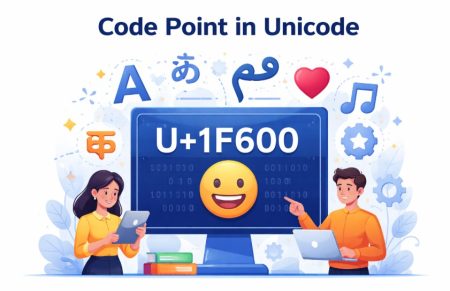
Unicode is a universal character encoding standard designed to enable computers and digital systems to represent, store, process, and exchange text from all the world’s writing systems in a consistent and reliable manner. Before the development of Unicode, different languages and regions relied on separate and often incompatible encoding schemes, which often resulted in unreadable or corrupted text when files were shared between systems. For example, a document created using a local encoding for Bangla or Arabic might appear as meaningless symbols when opened on another computer that did not support that encoding. Unicode addressed this problem by assigning a unique numeric value, known as a code point, to every character—such as the Latin letter “A,” the Bangla letter “ক,” the Arabic letter “م,” or even symbols like “€” and emojis like “😊”—ensuring that each character is interpreted correctly across platforms.
At its core, Unicode provides a common foundation for multilingual computing by guaranteeing that the same text is displayed consistently on different devices, software applications, and operating systems. For instance, a multilingual web page containing English, Bangla, and Chinese characters can be viewed correctly on Windows, macOS, Linux, or mobile devices when encoded in Unicode, particularly UTF-8. Similarly, search engines and digital libraries rely on Unicode to index and retrieve content written in multiple languages without losing accuracy. In academic publishing and email communication, Unicode allows researchers to write names, titles, and citations in their original scripts without distortion. Through such practical applications, Unicode not only addresses technical encoding challenges but also facilitates global communication, preserves information, and ensures inclusive access to digital knowledge.
What is UNICODE?
Unicode is a universal character encoding standard that enables computers and digital systems to represent, store, process, and exchange text from virtually all the world’s writing systems in a consistent and reliable way. It was developed to address the issue of incompatible character encodings that existed prior to its introduction, where different languages and regions employed separate encoding schemes, often resulting in data corruption and unreadable text when information was shared across platforms. Unicode addresses this issue by assigning a unique numeric value, known as a code point, to every character, including letters, numbers, punctuation marks, symbols, and emojis, regardless of language, operating system, or software application.
By providing a single, unified standard, Unicode enables multilingual computing and ensures that the same text appears correctly on various devices and environments. For example, a document containing English, Bangla, Arabic, and Chinese characters can be created, shared, and displayed accurately on various operating systems when encoded using Unicode formats such as UTF-8. Unicode is therefore fundamental to modern technologies, including the web, email, databases, digital libraries, and academic publishing. Beyond its technical role, Unicode also supports digital inclusion and cultural preservation by allowing languages from around the world to have an accurate and lasting presence in the digital space.
Why Was Unicode Developed?
Unicode was developed to overcome the serious limitations of earlier character encoding systems that could not adequately support the growing need for multilingual digital communication. Before Unicode, computers used a wide variety of local or language-specific encodings, such as ASCII and extended ASCII variants, which were designed primarily for English and a small set of Western European languages. These encodings reused the same numeric values to represent different characters in different regions, creating incompatibility between systems. As a result, text created on one computer often appeared as garbled or meaningless symbols when opened on another system that used a different encoding, a problem commonly referred to as “character corruption” or “mojibake.”
The rapid expansion of the internet and global information exchange made these limitations increasingly unacceptable. As people began communicating, publishing, and storing information digitally in diverse languages—such as Bangla, Arabic, Chinese, Hindi, and many others—there was a clear need for a single, universal standard that could consistently represent all characters. Unicode was developed to meet this need by assigning a unique code point to every character, regardless of language or platform. This ensured that the same text could be created, shared, and displayed correctly across different operating systems, applications, and devices.
Why Is Unicode Important for Multilingual Computing?
Unicode is essential for multilingual computing because it provides a single, standardized way to represent and process text written in different languages and scripts within the same digital environment. In a multilingual context, users often need to read, write, store, and exchange information in multiple languages—sometimes even within a single document or application. Without Unicode, computers would rely on separate and incompatible character encodings for each language, making it difficult to display mixed-language text correctly. Unicode solves this problem by assigning a unique code point to every character from all major writing systems, allowing languages such as English, Bangla, Arabic, Chinese, and Hindi to coexist seamlessly in digital systems.
The importance of Unicode becomes especially clear in global technologies such as the web, databases, email systems, and digital libraries. For example, a multilingual website encoded in Unicode can display content accurately to users worldwide, regardless of their device or operating system. Search engines and information retrieval systems also depend on Unicode to index and retrieve content written in different scripts without confusion or data loss. In academic and professional environments, Unicode enables researchers to use original language titles, names, and citations, preserving meaning and authenticity. By supporting consistent text representation across platforms, Unicode plays a critical role in enabling effective multilingual computing, promoting digital inclusion, and ensuring equal access to information in the global digital landscape.
What Problems Did Character Encoding Face Before Unicode?
Before the development of Unicode, character encoding systems suffered from serious limitations that made multilingual computing difficult and unreliable. Early encodings such as ASCII were designed primarily for the English language and could represent only a small set of characters. As computing spread to different regions of the world, many countries developed their own local or language-specific encodings to support additional characters. However, these encodings were often incompatible with one another, and the same numeric values were frequently used to represent different characters in different systems. This led to widespread confusion when text was transferred between computers using different encodings.
One of the most common problems was the corruption or misinterpretation of text, often referred to as “mojibake,” where readable characters turned into meaningless symbols. For example, a document written in Bangla or Arabic using a local encoding might appear as random characters when opened on a system configured for a different language. Mixing multiple languages in a single document was also extremely difficult, as most encodings could support only one script at a time. In addition, software developers had to create and maintain multiple versions of the same application to handle different encodings, increasing complexity and cost.
These limitations became more severe with the growth of the internet and global communication. Emails, web pages, and databases often failed to display text correctly across platforms, resulting in data loss and misunderstandings. The lack of a universal standard also posed challenges for long-term data preservation, as older encodings were often not well-documented or widely supported. Unicode was developed to address these problems by providing a single, consistent encoding system capable of representing all characters from the world’s writing systems, thereby eliminating incompatibility and enabling reliable multilingual digital communication.
How Many Characters Are Currently Supported by Unicode?
Unicode currently supports over 150,000 characters, covering a vast range of the world’s writing systems, symbols, and pictographic representations. These characters include letters from modern and ancient languages, numerals, punctuation marks, mathematical symbols, technical signs, currency symbols, and a continually expanding collection of emojis. Each character is assigned a unique numeric identifier, known as a code point, which allows it to be consistently represented and interpreted across different computers, operating systems, and software applications.
The Unicode standard is organized into multiple planes, with the Basic Multilingual Plane (BMP) containing the most commonly used characters, such as those for English, Bangla, Arabic, Chinese, Japanese, and Korean. Additional planes are used to accommodate less common scripts, historic writing systems, musical notation, mathematical alphabets, and specialized symbols. Importantly, Unicode is not static; it is regularly updated by the Unicode Consortium to include new characters and scripts as linguistic, cultural, and technological needs evolve. This ongoing expansion ensures that Unicode remains capable of supporting global communication, preserving linguistic diversity, and representing both traditional text and modern digital expressions in a unified and standardized way.
What Is a Code Point in Unicode?
A code point in Unicode is a unique numeric value assigned to each individual character to ensure consistent identification and representation across all digital systems. It serves as the fundamental building block of the Unicode standard, allowing computers to distinguish one character from another regardless of language, script, or platform. Code points are typically written in hexadecimal notation and prefixed with “U+”, such as U+0041 for the Latin capital letter “A” or U+0995 for the Bangla letter “ক”. By assigning a single, unambiguous value to every character, Unicode eliminates the confusion and incompatibility that existed in earlier character encoding systems.
The importance of code points becomes especially evident in multilingual and cross-platform computing. When text is stored or transmitted, software relies on code points rather than visual appearance to identify characters. This means that the same character can be correctly displayed on different devices as long as they support Unicode and have appropriate fonts. Code points are organized into defined ranges known as blocks and planes, which group related scripts and symbols together. However, a code point represents an abstract character, not its visual shape or style; how that character appears on screen depends on the font and rendering system. Through this clear separation between character identity and visual presentation, Unicode code points provide a stable and universal foundation for modern digital text processing.
Why Is Unicode Considered a Universal Character Encoding Standard?
Unicode is considered a universal character encoding standard because it provides a single, unified system for representing text from virtually all of the world’s languages and writing systems. Unlike earlier encoding schemes that were limited to specific regions or languages, Unicode assigns a unique code point to every character, regardless of script, platform, or software environment. This means that the same text—whether written in English, Bangla, Arabic, Chinese, or any other language—can be created, stored, and exchanged without ambiguity or data corruption. By eliminating the need for multiple, incompatible encodings, Unicode establishes a common foundation for global digital communication.
Another reason Unicode is regarded as universal is its broad adoption across modern technologies and platforms. Operating systems, programming languages, web standards, databases, and digital libraries all rely on Unicode to handle multilingual text consistently. Encoding forms such as UTF-8 allow Unicode to remain efficient and backward-compatible with older systems while still supporting a vast range of characters. Furthermore, Unicode is continuously maintained and expanded to include new scripts, symbols, and emojis, ensuring that it evolves alongside linguistic and technological developments. Through its comprehensive coverage, consistent representation, and worldwide adoption, Unicode has become the universal standard that enables seamless, inclusive, and reliable text processing in the digital age.
What Are the Main Unicode Encoding Forms (UTF-8, UTF-16, and UTF-32)?
Unicode encoding forms define how Unicode code points are actually stored and transmitted in computer systems. The three main Unicode encoding forms—UTF-8, UTF-16, and UTF-32—all represent the same set of Unicode characters but differ in how many bytes they use and how efficiently they handle text. These encoding forms allow Unicode to be flexible and usable across different platforms, devices, and applications.
UTF-8 is a variable-length encoding that uses one to four bytes to represent a character. It is the most widely used Unicode encoding today, especially on the web, because it is backward-compatible with ASCII and efficient for texts dominated by English and other Latin-based languages. For example, common English characters use only one byte, while characters from scripts such as Bangla, Arabic, or emojis require more bytes. This efficiency and compatibility have made UTF-8 the default encoding for HTML, email, and many databases.
UTF-16 is also a variable-length encoding, but it uses two or four bytes to represent characters. Most commonly used characters, particularly those in the Basic Multilingual Plane (BMP), are stored in two bytes, while less common characters require a pair of two-byte units known as surrogate pairs. UTF-16 is widely used in certain operating systems and programming environments, such as Java and Windows, where it offers a balance between memory usage and processing efficiency for multilingual text.
UTF-32 is a fixed-length encoding that uses four bytes for every character, regardless of how frequently the character is used. This makes UTF-32 simple to process because each character occupies the same amount of space, allowing direct indexing. However, it is less memory-efficient than UTF-8 and UTF-16, especially for texts containing mostly common characters. As a result, UTF-32 is typically used in specialized applications where simplicity and speed are more important than storage efficiency.
Together, UTF-8, UTF-16, and UTF-32 ensure that Unicode can be implemented efficiently in a wide range of technical environments, making it possible to support global multilingual text in modern computing systems.
Why Is UTF-8 the Most Widely Used Unicode Encoding?
UTF-8 is the most widely used Unicode encoding because it combines efficiency, compatibility, and flexibility in a way that suits modern digital communication. One of its greatest advantages is backward compatibility with ASCII, meaning that all standard English characters are represented using the same one-byte values as in older systems. This allows existing software, legacy data, and network protocols to work seamlessly with UTF-8 without modification. As a result, UTF-8 could be adopted globally without disrupting earlier technologies.
Another key reason for UTF-8’s widespread use is its efficient storage of text. UTF-8 is a variable-length encoding that uses one to four bytes per character, so common characters—such as English letters and numbers—take up very little space, while less frequently used characters from other scripts or emojis use more bytes only when necessary. This makes UTF-8 especially suitable for web pages, emails, and databases, where storage efficiency and fast data transmission are important. For multilingual content, UTF-8 provides a practical balance between space efficiency and broad character support.
Finally, UTF-8 is supported by virtually all modern operating systems, programming languages, web browsers, and standards, including HTML, XML, and JSON. It handles text reliably across different platforms and avoids many of the encoding errors associated with older systems. Due to its simplicity, robustness, and universal acceptance, UTF-8 has become the default and preferred encoding for the internet and most modern software applications, thereby reinforcing its position as the most widely used Unicode encoding format.
How Does Unicode Support Non-Latin Scripts Such as Arabic, Chinese, or Bengali?
Unicode supports non-Latin scripts by providing a comprehensive and systematic framework that allows every character from diverse writing systems to be uniquely identified, stored, and processed in digital form. For scripts such as Arabic, Chinese, and Bengali, Unicode assigns distinct code points to each character or symbol, ensuring that they are represented accurately and consistently across different platforms and software environments. This eliminates the need for separate, language-specific encodings and allows multiple scripts to coexist within the same document, database, or web page without conflict.
Beyond basic character representation, Unicode also addresses the structural and linguistic complexities of non-Latin scripts. For example, Arabic is written from right to left and includes contextual letter shaping, where a character’s visual form changes depending on its position within a word. Unicode supports this through its bidirectional text algorithm and by encoding characters in their logical order rather than their visual appearance. In the case of Chinese, Unicode accommodates thousands of ideographic characters by organizing them into dedicated blocks and planes, enabling consistent representation of both simplified and traditional forms. For Bengali and other Indic scripts, Unicode supports combining characters, vowel signs, and consonant conjuncts, allowing proper rendering of complex script structures.
Additionally, Unicode works in conjunction with font technologies and text-rendering engines to ensure that non-Latin scripts are displayed correctly on screen and in print. While Unicode defines the characters and their relationships, fonts and rendering systems handle the visual presentation according to linguistic rules. Through this layered approach, Unicode enables reliable multilingual computing, preserves linguistic diversity, and ensures that non-Latin scripts such as Arabic, Chinese, and Bengali can be used seamlessly in modern digital communication, academic publishing, and information systems.
Reference Article:
- Jain, C. (2017). Evolving a Model for National Digital Repository of Indian Government Publications using Institutional Repository Infrastructure. Retrieved from: http://hdl.handle.net/10603/190797