What is POSDCORB?
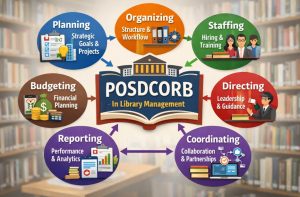 POSDCORB is a classical management concept introduced by Luther Gulick and Lyndall Urwick in 1937. The term represents seven key administrative functions: Planning, Organizing, Staffing, Directing, Coordinating, Reporting, and Budgeting. Developed within administrative theory, it explains the essential duties of managers in both public and private organizations. POSDCORB provides a systematic framework that helps administrators understand their responsibilities and perform managerial tasks efficiently. Although originally formulated for public administration, these principles remain highly relevant in modern organizational management, including library and information centers.
Planning involves setting goals and determining the strategies needed to achieve them. Organizing refers to arranging resources and tasks to implement plans effectively. Staffing focuses on recruiting, training, and maintaining competent personnel. Directing means guiding and supervising employees to ensure tasks are completed properly. Coordinating ensures harmony among different departments and activities within the organization. Reporting involves maintaining records and communicating performance and progress to stakeholders. Finally, budgeting deals with financial planning, accounting, and controlling expenditures.
In modern contexts, such as academic libraries, POSDCORB continues to serve as a foundational framework for administrative efficiency. Library managers use planning for strategic development, organizing for service structuring, staffing for professional development, directing for effective leadership, coordinating for service integration, reporting for accountability, and budgeting for financial sustainability. Thus, POSDCORB remains a timeless and practical model for understanding and implementing effective management practices.
Relevance of POSDCORB in Modern Library Management
POSDCORB, developed by Luther Gulick and Lyndall Urwick, is a classical administrative model that outlines seven key managerial functions: Planning, Organizing, Staffing, Directing, Coordinating, Reporting, and Budgeting. Although it was originally created for public administration, this framework continues to be highly relevant in modern library management. Today’s libraries serve as dynamic knowledge hubs that integrate print collections, digital resources, automation systems, research support services, and user-centered innovations. In such a complex environment, POSDCORB provides a structured, systematic approach to effective governance and service delivery.
Planning is essential for modern libraries to establish strategic goals related to digitization, the subscription to electronic databases, the development of institutional repositories, and the implementation of AI-driven tools. Libraries must anticipate user needs, technological trends, and financial requirements to remain sustainable and competitive. Organizing ensures that both physical and digital collections are systematically arranged and that departments, workflows, and responsibilities are clearly defined. Efficient organization enhances service delivery and minimizes operational inefficiencies.
Staffing has become increasingly important, as library professionals now require advanced digital skills, information literacy expertise, and knowledge of data management systems. Continuous training and professional development are crucial for maintaining service quality. Directing involves leadership, supervision, and motivation, particularly during technological changes such as automation or digital transformation. Effective direction ensures a smooth adaptation to new systems and services.
Coordinating is vital for fostering collaboration among different library sections, faculty members, IT departments, and external vendors, especially in managing consortium-based e-resources and research support services. Reporting enhances transparency and accountability through performance analysis, usage statistics, and annual reports, which support evidence-based decision-making. Finally, budgeting is critical in balancing expenditures between print collections, digital subscriptions, infrastructure development, and emerging technologies.
How POSDCORB Supports Strategic Planning in Academic Libraries
Strategic planning is essential for academic libraries to remain relevant, sustainable, and aligned with the goals of their parent institutions. In today’s academic environment, libraries transcend traditional roles of managing printed collections; they now operate as digital knowledge centers, research support hubs, and collaborative learning spaces. In this complex landscape, the classical administrative framework known as POSDCORB—developed by Luther Gulick and Lyndall Urwick—provides a structured and systematic approach to strategic planning. Its seven managerial functions—Planning, Organizing, Staffing, Directing, Coordinating, Reporting, and Budgeting—collectively guide academic libraries in formulating, implementing, and evaluating long-term strategies.
Planning forms the foundation of strategic management by defining the library’s vision, mission, and long-term objectives in alignment with university priorities. For example, an academic library may design a five-year strategic plan to expand digital collections, strengthen institutional repository services, enhance information literacy programs, or adopt advanced technologies. Organizing ensures that these strategic goals are translated into practical actions by structuring departments, defining responsibilities, and establishing efficient workflows. If improving research support is a strategic priority, the library may organize specialized units to manage scholarly communication, citation analysis, and research data services. Staffing plays a vital role in strategic success by ensuring that qualified and skilled professionals are available to implement initiatives. Modern academic libraries often require librarians with expertise in digital systems, data management, and emerging technologies, making recruitment and continuous professional development essential components of strategic planning.
Directing provides the necessary leadership and guidance to effectively execute strategic initiatives. Library leaders must communicate the strategic vision clearly, motivate their staff, and manage change, especially during technological transitions or when introducing new services. Coordinating efforts further enhances strategic planning by aligning library activities with faculty, IT departments, research offices, and administrative authorities. This ensures that collaborative efforts support institutional goals.
Reporting plays a crucial role in evidence-based decision-making by analyzing performance indicators such as resource usage statistics, user feedback, and service outcomes. This analysis enables administrators to assess progress and refine strategies as needed. Finally, budgeting ensures that strategic objectives are financially sustainable by appropriately allocating funds across print resources, digital subscriptions, infrastructure, and technological upgrades. By integrating these seven functions, the POSDCORB framework remains a practical and enduring tool that strengthens strategic planning and promotes sustainable development in academic libraries.
Application of POSDCORB Principles in Modern Library Management
Modern libraries operate in a complex environment shaped by digital technologies, user-centered services, research support demands, and financial constraints. To effectively manage these challenges, libraries need a clear and systematic administrative framework. The acronym POSDCORB represents seven essential managerial functions: Planning, Organizing, Staffing, Directing, Coordinating, Reporting, and Budgeting. These functions are highly relevant to contemporary library management. Applying these principles in practice helps modern libraries maintain efficiency, accountability, and long-term sustainability.
- Planning: Planning forms the foundation of effective library management. It involves setting clear goals and determining strategies to achieve them.
Application in Modern Libraries:- Developing strategic plans for digitization projects.
- Expanding electronic databases and online services.
- Designing user education and information literacy programs.
- Anticipating technological changes and future user needs.
Example: An academic library prepares a multi-year strategy to enhance remote access services and improve digital resource availability.
- Organizing: Organizing ensures that tasks, resources, and responsibilities are structured efficiently.
Application in Modern Libraries:- Structuring departments such as circulation, technical services, digital services, and research support.
- Implementing classification systems and metadata standards.
- Using integrated library management systems to streamline operations.
Example: Creating a dedicated digital services unit to manage institutional repositories and e-resources.
- Staffing: Staffing focuses on recruiting, training, and retaining qualified personnel.
Application in Modern Libraries:- Hiring professionals with expertise in digital technologies and database management.
- Conducting regular training programs to update staff skills.
- Encouraging continuous professional development.
Example: Training librarians to support plagiarism detection tools, research data management, and citation analysis services.
- Directing: Directing involves leadership, supervision, and motivation to ensure that plans are properly implemented.
Application in Modern Libraries:- Guiding staff during system upgrades or service innovations.
- Supervising daily operations to maintain service standards.
- Motivating employees to adapt to technological change.
Example: Library leadership managing the implementation of a new automated circulation system.
- Coordinating: Coordinating ensures collaboration among departments and stakeholders.
Application in Modern Libraries:- Working with faculty to integrate library resources into course curricula.
- Collaborating with IT units for stable remote access to digital resources.
- Managing partnerships in consortium-based e-resource subscriptions.
Example: Coordinating workshops with academic departments to enhance research support services.
- Reporting: Reporting promotes transparency and supports data-driven decision-making.
Application in Modern Libraries:- Preparing annual performance reports.
- Analyzing usage statistics of print and electronic resources.
- Collecting user feedback to improve services.
Example: Using database usage statistics to evaluate subscription renewals.
- Budgeting: Budgeting ensures financial control and sustainability.
Application in Modern Libraries:- Allocating funds between print and electronic resources.
- Planning expenditures for infrastructure and technological upgrades.
- Conducting cost-benefit analysis before new investments.
Example: Adjusting acquisitions budgets during financial constraints while maintaining essential services.
The application of POSDCORB principles offers a comprehensive and practical framework for managing modern libraries. By systematically implementing the functions of planning, organizing, staffing, directing, coordinating, reporting, and budgeting, libraries can effectively navigate digital transformation, meet user expectations, and maintain operational efficiency. Despite technological advancements, these core managerial principles continue to guide successful library administration in today’s academic environments.