Human Capital and Intellectual Capital are two critical assets that drive organizational success in today’s knowledge-driven economy. Human capital refers to the skills, knowledge, experiences, and capabilities that employees bring to an organization. It emphasizes the value individuals contribute through their education, creativity, problem-solving abilities, and interpersonal skills. On the other hand, intellectual capital encompasses the intangible assets and knowledge that reside within the organization itself, including patents, proprietary technologies, databases, processes, and customer relationships. While human capital is tied to the workforce, intellectual capital represents institutional knowledge that provides a lasting competitive advantage. Both forms of capital are essential, yet they serve different roles in fostering innovation, improving productivity, and ensuring long-term sustainability. Understanding how they complement each other is key to maximizing organizational value and performance.
What is Human Capital?
Human capital refers to individuals’ collective skills, knowledge, abilities, and experiences, which contribute to their economic value and productivity within an organization or society. It encompasses formal education and training and less tangible qualities like creativity, problem-solving abilities, communication skills, and emotional intelligence. Human capital is considered an essential asset because it directly influences a workforce’s efficiency, innovation, and overall performance.
Investing in human capital—through education, professional development, health, and well-being—enhances an individual’s capacity to contribute effectively to the organization’s goals. Unlike physical capital (machines, buildings) or financial capital, human capital is tied to people and leaves the organization when employees exit. However, organizations that cultivate a highly skilled and engaged workforce are better equipped to innovate, adapt to changing environments, and maintain a competitive edge.
What is Intellectual Capital?
Intellectual capital refers to an organization’s intangible assets and knowledge resources that contribute to its competitive advantage and long-term value. These assets include proprietary information, patents, copyrights, trademarks, business processes, customer relationships, organizational knowledge, and brand reputation. Intellectual capital is not tied to individual employees but is embedded in the company’s systems, processes, and intellectual property, making it an essential element of its success.
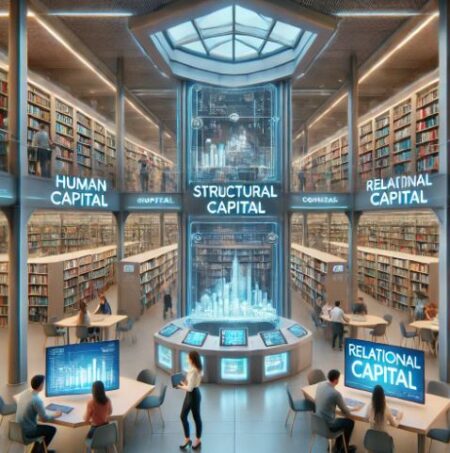
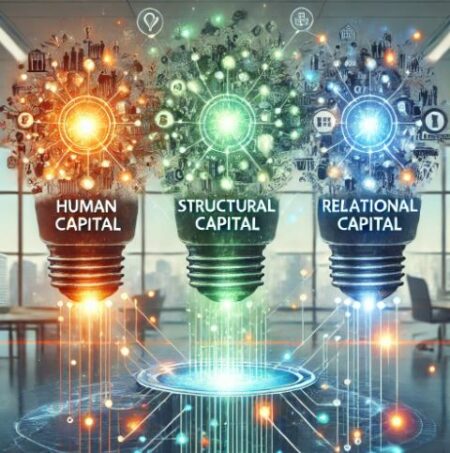
Intellectual capital can be broadly divided into three key components:
- Human Capital (as a subset): The skills, knowledge, and expertise of employees that contribute to innovation and problem-solving within the organization.
- Structural Capital: The internal systems, databases, processes, and intellectual property that allow the organization to function efficiently. This includes documented knowledge, patents, and valuable organizational processes even when employees leave.
- Relational Capital: The external relationships the organization has with customers, suppliers, partners, and other stakeholders. It includes brand value, customer loyalty, and reputation, all of which are crucial for sustaining business growth.
Intellectual capital is often difficult to quantify but is critical for driving innovation, improving efficiency, and maintaining a competitive edge in today’s knowledge-based economy. Organizations that effectively manage their intellectual capital are better positioned to leverage their knowledge assets for long-term growth and sustainability.
Differences between Human Capital and Intellectual Capital
The distinction between Human Capital and Intellectual Capital is crucial in understanding how organizations manage and leverage their resources. Human capital refers to individuals’ collective skills, knowledge, experiences, and capabilities within an organization. It is the value that employees bring through their expertise, creativity, and problem-solving abilities. On the other hand, intellectual capital is the organization’s intangible assets, including proprietary knowledge, patents, trademarks, business processes, and customer relationships. While human capital resides in people and is tied to their individual competencies, intellectual capital remains with the organization and represents knowledge that has been institutionalized. Both types of capital are essential for innovation and growth, but they differ in terms of ownership, tangibility, and their role in driving short-term productivity and long-term competitive advantage. Understanding these differences helps organizations strategically manage both forms of capital to maximize value.
Scaling up often requires significant investment in additional physical assets, such as purchasing more machinery or expanding production facilities.
| Aspect | Human Capital | Intellectual Capital |
|---|---|---|
| Definition | This refers to the combined value of employees’ competencies, knowledge, abilities, experiences, and personality traits that contribute to an organization’s performance. It encompasses both hard skills (like technical abilities) and soft skills (like communication, leadership, and adaptability). Human capital is an organization’s workforce capability, meaning it is reliant on the personal attributes that employees bring to their roles. | On the other hand, intellectual capital refers to the intangible knowledge assets embedded within the organization. This can include institutional knowledge, processes, intellectual property, patents, trademarks, and databases. These assets provide long-term value to the organization and often contribute to its competitive advantage. While human capital leaves when employees exit, intellectual capital remains within the firm, as it is embedded in the systems, patents, and knowledge resources. |
| Focus | Human capital focuses on people, developing their abilities and maximizing their potential within the organization. Investment in human capital includes training, mentorship, and creating an environment that nurtures talent. This focus emphasizes continuous learning and development to keep the workforce competitive and aligned with the organization’s strategic goals. | Intellectual capital is centered around knowledge management—accumulating, organizing, and utilizing the knowledge and intellectual property generated within the organization. It also focuses on how this knowledge can be stored, shared, and protected. While human capital is about nurturing people, intellectual capital is about institutionalizing knowledge and skills into organizational systems and processes that provide long-term value. |
| Tangibility | Human capital is more tangible in that it directly relates to the workforce’s performance and productivity. For example, the output of employees can be measured in terms of productivity metrics, efficiency, and skills development. It’s also visible in employee turnover, the quality of hires, and performance reviews. Although it is somewhat intangible because it is a part of the people in the organization, its effects are evident in the day-to-day functioning and success of the business. | Intellectual capital is intangible and often harder to measure. It includes assets such as patents, trademarks, copyrights, databases, institutional knowledge, and customer relationships. These long-term strategic assets do not directly show their value in the short term but are critical to competitive advantage. For instance, a company may hold patents that provide a monopoly on specific innovations, or they may have developed a highly valuable customer database that offers insight into consumer behavior, which becomes an invaluable strategic tool. |
| Growth and Development | Human capital grows through continuous learning and development initiatives. Employees increase their human capital by acquiring new skills through formal education, training programs, and on-the-job experiences. For instance, a company might invest in upskilling its workforce through online courses, certifications, and mentorship programs. Over time, as employees improve their capabilities, the organization benefits from their enhanced productivity, innovation, and problem-solving abilities. | Intellectual capital grows through innovation and the systematic management of knowledge assets. Research and Development (R&D) activities, collaboration, and intellectual property rights are ways through which intellectual capital grows. For example, a tech company invests in R&D to create or improve new products. The resulting patents, trademarks, and processes then become part of the company’s intellectual capital. The more an organization can capture and retain its knowledge assets, the richer its intellectual capital becomes. |
| Ownership | The employees own human capital. They take their skills, experience, and knowledge when they leave the organization. This is why organizations often invest heavily in employee retention and engagement strategies to keep their talented workforce. A business that neglects its human capital risks losing its most valuable assets when employees resign or retire. | The organization owns intellectual capital. Once intellectual property like patents, trademarks, or proprietary systems is developed, it belongs to the company. This knowledge, even if developed by employees, stays within the organization as a corporate asset. For instance, if an employee leaves, the processes, databases, and client relationships they helped build remain with the organization. This is why companies are highly protective of their intellectual capital, often requiring non-disclosure agreements (NDAs) or non-compete clauses to safeguard it. |
| Measurement and Valuation | Measuring human capital often involves assessing individual and collective employee competencies, performance metrics, turnover rates, and productivity levels. Methods like 360-degree feedback, performance appraisals, and skills assessments are used. However, quantifying human capital in financial terms can be challenging due to its intangible nature and dependence on individual employee contributions. | Intellectual capital measurement focuses on valuing intangible assets like patents, trademarks, proprietary processes, and brand equity. Financial valuation models, such as discounted cash flow analysis for patents or market capitalization methods, are used to estimate the monetary value of these assets. Intellectual capital is often reflected in the company’s balance sheet under intangible assets, making it somewhat easier to quantify than human capital. |
| Impact on Financial Statements | Generally, human capital is not directly reflected in financial statements. Employee-related costs like salaries, benefits, and training expenses appear as operating expenses, but the value of employees’ knowledge and skills is not capitalized as an asset. This omission can lead to the undervaluation of organizations that heavily rely on skilled labor. | Intellectual capital can be partially represented on financial statements through intangible assets. For example, acquired patents, trademarks, and goodwill from mergers and acquisitions are recorded on the balance sheet. This inclusion provides investors with insights into the company’s intangible asset base and potential for future earnings. |
| Risk Management | Risks associated with human capital include employee turnover, loss of key talent, skill shortages, and low employee engagement. Organizations mitigate these risks through retention strategies, competitive compensation, career development opportunities, and fostering a positive organizational culture. | Intellectual capital risks involve intellectual property theft, obsolescence of proprietary technologies, and loss of competitive advantage due to leaks of confidential information. Companies manage these risks through legal protections like patents and trademarks, cybersecurity measures, and strict confidentiality agreements. |
| Role in Innovation | Employees’ creativity, problem-solving abilities, and expertise are critical drivers of innovation. A workforce with diverse skills and perspectives can generate new ideas, improve processes, and develop novel solutions to challenges. | Intellectual capital provides the foundation for innovation by offering existing knowledge assets that can be built upon. Patents, proprietary technologies, and accumulated organizational knowledge enable companies to innovate more efficiently and effectively, leveraging past learnings to create new value. |
| Transferability | Human capital is non-transferable in that it resides within individuals. While employees can share knowledge and train others, their personal skills and experiences cannot be transferred in entirety to another person. When an employee leaves, the organization loses that individual’s unique human capital. | Intellectual capital is transferable within the organization and can be shared across departments and teams. For example, documented processes, training materials, and knowledge databases can be accessed and utilized by multiple employees, enhancing organizational efficiency and coherence. |
| Examples in Practice | A highly skilled software engineer contributing innovative code, a seasoned sales professional building strong client relationships, or a creative designer crafting compelling marketing materials are all examples of human capital at work. | A company’s patented technology that gives it a market edge, a well-known brand that commands customer loyalty, or a proprietary algorithm that improves operational efficiency exemplifies intellectual capital. |
| Cultural Impact | Organizational culture significantly affects human capital by influencing employee engagement, satisfaction, and productivity. A positive culture that promotes diversity, inclusion, and collaboration enhances human capital. | Culture also impacts how knowledge is shared and utilized within the organization. A culture that encourages knowledge sharing, continuous learning, and innovation helps in building and leveraging intellectual capital. |
| Examples of Loss | A company may suffer from the departure of key employees, leading to a loss of expertise, disruption of team dynamics, and potential declines in productivity. | Loss or theft of intellectual property, such as a leaked trade secret or expired patents without renewal, can erode a company’s competitive advantage and market position. |
The primary distinction between human capital and intellectual capital is the source and nature of the value they bring. Human capital resides in the people working for the organization, while intellectual capital exists within the systems, knowledge, and relationships embedded in the organization. Both are critical to long-term success: human capital drives innovation and productivity, while intellectual capital ensures that knowledge and proprietary assets continue to generate value over time. Organizations that excel in managing both forms of capital tend to enjoy sustainable competitive advantages.