
What is Sociology?
Sociology is the scientific study of human society, social relationships, and the patterns of interaction among individuals and groups. The term “sociology” was first introduced by Auguste Comte, who is widely regarded as the father of the discipline. Sociology aims to understand how societies are formed, how social institutions function, and how social forces influence human behavior. It examines the ways in which individuals interact with each other and how these interactions shape social structures such as family, education, religion, economy, and government. Through systematic study of social life, sociology seeks to explain how societies operate and how social changes occur over time.
Sociology focuses on both individual behavior and the broader social context in which people live. Sociologists analyze how social norms, values, traditions, and cultural practices influence the actions and attitudes of individuals. For example, sociological studies may explore how family background affects educational achievement, how economic conditions shape social inequality, or how cultural beliefs influence social behavior. By examining these relationships, sociology helps reveal the underlying structures that organize social life.
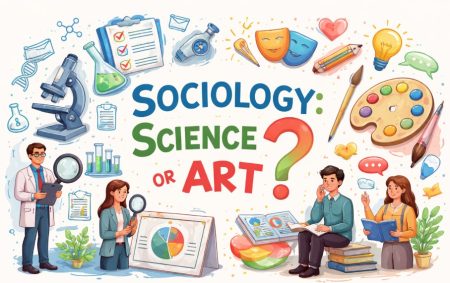
Another important aspect of sociology is its use of scientific methods to study social phenomena. Sociologists collect data through observation, surveys, interviews, and statistical analysis to understand patterns of social behavior. These research methods allow sociologists to analyze social issues objectively and develop theories that explain social processes. For instance, sociologists may study patterns of urbanization, migration, crime, or social stratification to understand how different factors influence society.
Sociology also helps people understand social change and the challenges that societies face in the modern world. Rapid technological advancements, globalization, population growth, and cultural transformations have significantly changed the way people interact and live together. Sociologists study these developments to understand their effects on social institutions and human relationships. By analyzing these changes, sociology provides valuable insights that help individuals, communities, and policymakers better understand social problems and develop informed solutions.
The Nature of Sociology
Sociology is the scientific study of human society, social relationships, institutions, and the patterns of interaction among individuals and groups. The term “sociology” was first introduced by Auguste Comte, who is widely regarded as the father of the discipline. The aim of sociology is to understand how societies are formed, how social institutions operate, and how social forces influence human behavior. The nature of sociology encompasses the fundamental characteristics that define the discipline and explain how sociologists systematically and scientifically study social life.
- Sociology is a Social Science: Sociology is categorized as a social science because it focuses on understanding human society and the relationships among individuals within social groups. Unlike natural sciences, such as physics or chemistry, which examine physical or biological phenomena, sociology investigates social behavior, interactions, and the structures that influence human life.
Sociologists analyze how individuals affect one another and how institutions like family, education, religion, and government shape people’s attitudes and behaviors. For instance, they may explore how a person’s family background impacts their educational success or how cultural traditions influence social norms and values within a community. Through these studies, sociology provides insights into how individuals and groups operate within society. - Sociology is a Scientific Discipline: Sociology is considered a scientific discipline because it employs systematic and scientific methods to study social phenomena. Sociologists use empirical research methods such as observation, surveys, interviews, experiments, and statistical analysis to collect and interpret data. These methods enable researchers to examine social patterns and relationships objectively, rather than relying on personal opinions or assumptions. For instance, when studying unemployment, a sociologist might gather statistical data, conduct interviews with job seekers, and analyze economic conditions to understand the causes and effects of unemployment. By applying these scientific methods, sociology generates reliable knowledge about society and human behavior.
- Sociology is an Abstract Science: Sociology is considered an abstract science because it focuses on ideas, concepts, and relationships rather than specific physical objects or individual events. It examines patterns of social interactions and general social processes, including cooperation, competition, conflict, and socialization. Sociologists prioritize understanding the underlying principles that govern social life instead of focusing solely on isolated incidents. For instance, rather than studying just one specific family, sociology investigates the concept of family as a social institution, exploring its functions, roles, and relationship patterns across various cultures and societies. By doing so, sociology develops general concepts that help explain broader social realities.
- Sociology is a Pure Science: Sociology is often regarded as a pure science because its primary goal is to gain knowledge and understanding of social phenomena. Sociologists aim to discover general principles and theories that explain how society functions. While the knowledge produced by sociology can be used to address social problems, its main purpose is to enhance intellectual understanding rather than provide immediate practical solutions. For example, a sociologist might conduct research to understand the causes of crime or social inequality. Although this research could later assist governments or organizations in developing policies to reduce crime or inequality, the sociologist’s primary objective is to explain the social factors that contribute to these issues.
- Sociology is a General Science: Sociology is considered a general science because it examines society as a whole and explores the overarching patterns of relationships among various social institutions. Unlike specialized social sciences that focus on specific aspects of human life, sociology takes a broad and comprehensive approach to understanding society. For example, economics primarily studies economic activities, political science focuses on political systems and governance, and anthropology looks at cultural aspects of human life. In contrast, sociology investigates how these different elements are interconnected and influence one another. For instance, sociologists may analyze how economic inequality impacts educational opportunities, family life, and social mobility within society.
- Sociology is Both Theoretical and Empirical: Sociology combines theoretical concepts with empirical research. Sociologists develop theories to explain social behavior, social structures, and patterns of interaction within society. These theories provide frameworks that help researchers understand complex social phenomena. At the same time, sociology relies on empirical evidence collected through research methods such as surveys, field studies, and statistical analysis to test and refine these theories.
For example, the concept of social stratification explains how societies are divided into different social classes based on factors such as income, occupation, and education. Sociologists gather data on these factors to study how social class influences individuals’ opportunities and life experiences. In this way, theory and research work together to enhance our understanding of society. - Sociology is a Dynamic Science: Sociology is a dynamic and ever-evolving discipline, reflecting the constant changes within society. Social institutions, cultural values, and interaction patterns transform over time due to factors such as technological advancements, economic shifts, urbanization, and globalization. Sociologists study these transformations to comprehend their impact on individuals and communities. For instance, the rise of digital technology and social media has significantly altered communication patterns, social relationships, and access to information. Sociologists investigate how these technological changes influence social behavior, cultural norms, and social structures. As society continues to evolve, sociology must also adapt its theories and research methods to better understand new social realities.
- Sociology is Value-Neutral: Sociology aims to maintain objectivity and value neutrality when studying social phenomena. This means that sociologists strive to analyze social issues without letting personal beliefs, moral judgments, or cultural biases influence their findings. The goal of sociology is to understand and explain social reality, rather than to determine what is right or wrong. For instance, when examining topics such as poverty, crime, or divorce, sociologists do not assess these phenomena morally. Instead, they investigate their causes, patterns, and consequences within society. By upholding value neutrality, sociology ensures that its research findings are based on evidence and objective analysis.
In conclusion, sociology is a scientific and systematic discipline that examines human society and social relationships. As a social science, it focuses on understanding the complex interactions between individuals and social institutions. By employing scientific methods, abstract concepts, theoretical frameworks, and empirical research, sociologists can analyze social structures and processes in a thorough manner. Given that society is constantly evolving, sociology is a dynamic field that continuously generates new ideas and insights. Through its objective and systematic approach, sociology provides valuable knowledge that enhances our understanding of how human societies function and develop.






3 Comments
When I zoom in ur tags are not place in one place it’s move to an another place .check ur program I have some while u using table row in HTML or in css
Sir please send this no.